ABN Amro verlaagt de rente van 0,1% naar 0%, aandeelhouders in hoerastemming

Vanmorgen
prominent op Radio1 en BNR de stap van staatsbank ABN Amro om de
rente van 0,1 te verlagen naar 0%. Wat er op BNR niet bij werd
verteld (heb verder Radio1 laten rusten vanwege een te groot lulkoek
gehalte) is dat deze regeling geldt voor mensen die een spaarrekening
hebben tot 100.000 euro. Voor grofgraaiers met een spaarrekening van
100.000 tot 2,5 miljoen euro, geldt hetzelfde, topgraaiers met een
spaarrekening vanaf 2,5 miljoen euro gaan 0,5% rente betalen over hun
tegoed…… Klinkt leuk die halve procent negatieve rente, echter
gegarandeerd dat de bank deze klanten zal adviseren elders rekeningen
te openen, zodat deze klanten middels spreiding van hun vermogen
toch vrijblijven van negatieve rente…… 

Bovendien is het spreiden van het vermogen over meerdere banken goed voor het garanderen van tegoeden bij een crisis als het faillissement van de IJslandse banken, waar PvdA hufter Bos, destijds minister van Financiën de garantie op teruggave van kapitaal bij zo’n faillissement verhoogde van 50.000 naar 100.000 euro…… (schandelijk en dat voor krenterige figuren die voor een half procent meer een rekening openden bij één of meer van deze IJslandse banken…..)

ABN Amro
stelt o.a. dat het geld kost om geld te stallen, alsof de bank
spaargeld niet gebruikt om te investeren, of zelfs te gokken op de
beurs…… Daarnaast verdient de bank wel degelijk aan rente, neem
de hypotheken die via een bank worden afgesloten, of wat dacht je van
andere leningen aan particulieren en (kleine) bedrijven……

Intussen
worden met deze rente percentages vooral de grootaandeelhouders
beloond, waar de Europese Centrale Bank (ECB) de eerste verantwoordelijke is voor deze smerige
beloning t.b.v. mensen die in feite deze winsten niet eens nodig
hebben, neem het koningshuis, grootaandeelhouder van (Koninklijke)
Shell……..

Banken
kunnen praktisch gratis geld lenen bij de ECB en verdienen vervolgens
op dit geleende geld aan diensten zoals gezegd bijvoorbeeld
hypotheken en andersoortige leningen…… Zo hebben banken het
spaargeld van klanten in feite niet meer nodig, immers ze kunnen
praktisch gratis geld lenen van de ECB

Ronduit
stuitend zijn de klachten van banken over de lage rente door
ingrijpen van de ECB, terwijl ze daar wel degelijk (goud-) garen bij
spinnen, zoals direct hiervoor aangegeven…..

De ECB
is onderdeel van de EU en als zodanig wordt geheel ten overvloede nog
eens aangegeven dat de EU niet het belang van de EU burgers dient,
maar vooral de belangen behartigt van de grote bedrijven en de
welgestelden……. Middels de ECB is de EU ook verantwoordelijk voor
het steeds verder verminderen van de spaarpot voor de oude dag, ofwel
de pensioenen worden verlaagd door ingrijpen van de ECB en daarmee is de
EU mede verantwoordelijk…… Benieuwd trouwens of de rekeningen van de pensioenfondsen bij banken ook te maken krijgen met een negatieve rente, immers dat zou de pensioenpotten nog verder uitkleden……

Al vaker gesteld op deze plek: Nederland zou als de andere
EU-lidstaten, uit de EU moeten stappen, deze geldverslindende
organisatie staat niet ten dienste van de EU burgers…. Wat betreft ons, heeft men in Noordwest- en Midden-Europa Nederland toch nodig, dit vanwege onze geografische ligging en uitstekende infrastructuur. Voorts zou een dergelijke stap van één of nog meer EU-lidstaten, leiden tot het opheffen van deze dievenorganisatie. Zie de ellende met de Brexit, deze heeft er alleen toe geleid dat men de EU nog meer macht wil geven zodat men zich wel tien keer bedenkt voor men uit dit bondgenootschap stapt……. 

Eén van de eerste zaken die EU burgers tegen de borst stuitte en die de Brexit ingang zette, is juist het steeds meer macht geven aan de EU, wat ten koste ging (en gaat) van de eigen soevereiniteit…. (niet voor niets stemde men in Nederland tegen de grondwet van de EU, die de macht van de EU zou vergroten en dat ook werkelijk heeft gedaan, men noemde het niet langer een grondwet en zo werd ook ons de boel door de strot geduwd, als waren we ganzen met een te grote lever…..)

Tot slot
nog dit: het is ronduit schandalig dat staatsbank ABN Amro komt met
een renteverlaging naar 0%. Is dit de beloning voor het redden van de
bank met ons belastinggeld nadat de bankencrisis in 2008 in volle omvang losbarstte…???
Een redding die nodig was daar de topgraaiers van de bank in foute
financiële producten hadden geïnvesteerd en geld hadden geleend aan
Zuid-Europese landen, waarvan een kind had kunnen weten dat deze
landen nooit in staat zouden zijn, deze gelden terug te betalen en
waarvoor nu de Griekse bevolking mag bloeden…… Het laatste ook weer na volkomen
misdadig ingrijpen van de ECB en de Europese Commissie (in
samenwerking met het inhumane, neoliberale IMF…)….

Het
volgende artikel komt van De Beurs.nl en daar is men blij
met de stap van ABN Amro, daar ook deze stap goed is voor de
aandeelhouders en daar werd de bank vanmorgen voor beloond met een plus van 1,1
procent op de beurs (AEX)…….

‘Rentestap
ABN AMRO is positief’

Gepubliceerd op 14 jan
2020 om 10:12 | | Onderwerpen: banken

AMSTERDAM (AFN) – Het besluit van
ABN AMRO om de spaarrente op nul te zetten en vermogende spaarders te
laten betalen is positief. Dat schrijft ING in een reactie op de
bekendmaking. Door die stap kan ABN AMRO namelijk de druk op zijn
nettorente-baten opvangen.

ABN AMRO hanteert per april drie
klassen om klanten in te delen. De eerste groep omvat spaarders met
tegoeden tot 100.000 euro. Voor die groep beloofde de bank eerder al
dat er nooit negatieve rente zal worden gerekend. De tweede groep
bevat alle spaarders met tegoeden van tussen de 100.000 euro en 2,5
miljoen euro. Die groep krijgt ook geen rente meer. De groep die meer
dan 2,5 miljoen euro op de rekening heeft staan, gaat 0,5 procent
rente betalen over het tegoed.

ING stelt dat bij ABN de groep met
meer dan 2,5 miljoen euro op de rekening goed is voor een
totaalbedrag van 30 miljard euro. De rente-inkomsten, uitgaande van
geen verandering in klantgedrag, zouden bij de groep moeten uitkomen
in 2020 op 150 miljoen euro, berekende ING.

Het advies voor ABN AMRO staat op
hold, met een koersdoel van 18,50 euro. Het aandeel noteerde
dinsdagochtend omstreeks 10.00 uur een plus van 1,1 procent op 16,52
euro.

In de VS begint de huizenmarkt weer in te zakken

Bijzonder
lage rente voor hypotheken heeft in de VS niet kunnen voorkomen dat
de huizenmarkt verder onderuitzakt. Vooral in de
dichtbevolkte binnensteden met daaromheen veel minder dicht bevolkte
buitenwijken, gebieden waar nog volop werkgelegenheid is te vinden,
komt de klad in de huizenverkoop……

Tegelijk
neemt het aantal achtergelaten huizen toe, dus waar de bewoners niet
langer de kosten op kunnen brengen voor hun veel te dure huis, ofwel
het gaat hier vooral over hypotheken die ‘onder water staan…’

In het
volgende artikel van Zero Hedge 50 voorbeelden van
gebieden waar de boel vast lijkt te lopen, terwijl vreemd genoeg de
huizenprijzen dalen in die gebieden, iets dergelijks gebeurde ook
voordat de crisis in 2008 in volle hevigheid losbarstte……
Destijds wist men in de VS slechte hypotheken te slijten aan vooral
Europese banken, wat voor veel van die banken de doodsklap was geweest, ware het
niet dat de burgers werden gedwongen op te draaien voor de verliezen
die het veel te hoog betaalde schoftentuig van banken hadden gemaakt, ofwel om de banken
te redden van faillissement……*

Here
Are The 50 US Housing Markets Already Turning Ugly

by
Tyler Durden

Mon,
12/23/2019 – 22:05

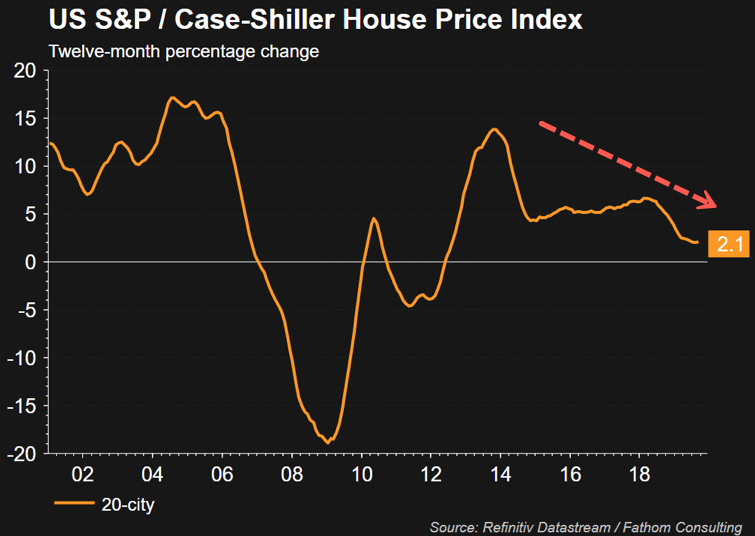
Plunging
mortgage rates in late 2018 through 2019 wasn’t enough to revive the
housing market (despite the hope of 20-year homebuilder sentiment).
Cracks are already starting to appear in many metro areas across the
country, as a more profound slowdown could
be imminent.
Last week, Home Depot ruined the
party and pretty much declared that a housing boom in 2020 is
non-existent. 

The home-improvement chain cut its
sales forecast for 2020, signaling that real estate and consumers
could exhibit weakness in the year ahead. 
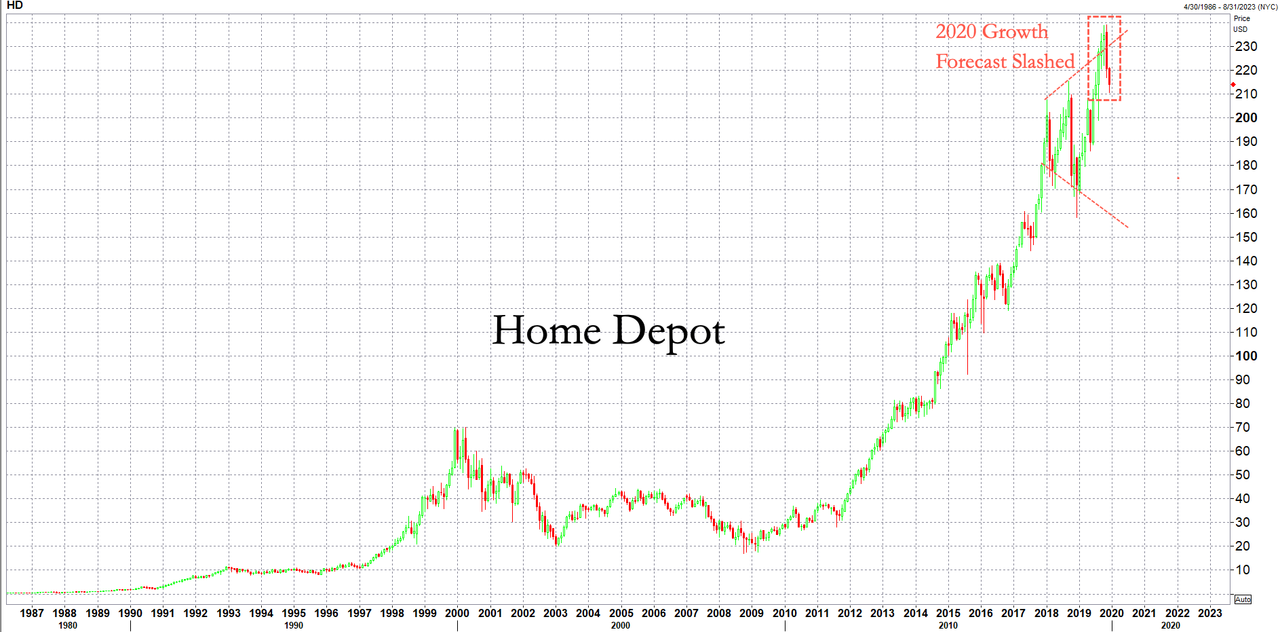
The disappointing 2020 forecast
comes amid a report that 50 housing markets across the country are
already showing signs of a downturn. 

GOBankingRates evaluated
500 metro areas for high rates of foreclosures and underwater
mortgages, variations in median home listing prices, the number of
days homes are on the market, and the percentage of for-sale listings
with price cuts, against the national average and determined the 50
most at-risk metro areas that are already turning south.

GOBankingRates determined that
Peoria, Illinois, is the most at-risk metro area of seeing its
housing market implode. Florida had the highest amount of real estate
markets that were slowing. Here’s the full list: 

50. Fort Myers, Florida

  • Median list price: $249,999
  • 2-year price change: -1.4%
  • Percentage of underwater
    mortgages: 6.9%

  • Foreclosures: 1 in every
    1,921 homes

House prices are dropping in
this city in southwest Florida. While home prices nationwide have
climbed an average of 9.4% over the past two years, prices have
dropped 1.4% in Fort Myers over the same period. Plus, houses for
sale spend 105 days on the market in Fort Myers, on average, compared
with a national average of 66 days.

49. Newport News, Virginia

  • Median list price: $190,000
  • 2-year price change: 8.4%
  • Percentage of underwater
    mortgages: 19.2%

  • Foreclosures: 1 in every
    2,172 homes

The percentage of underwater
mortgages in this city in southeastern Virginia near Virginia
Beach is more than double the national average of 8.2%. However, the
real estate market here hasn’t turned too ugly yet. In fact, the
percentage of listed home with price cuts in Newport News — 12.6% —
is lower than the national average of 17.5%.

48. Cumming, Georgia

  • Median list price: $383,511
  • 2-year price change: 1.2%
  • Percentage of underwater
    mortgages: 4%

  • Foreclosures: 1 in every
    2,311 homes

Home prices still are rising in
this suburb of Atlanta — but not nearly as much as the
national average. In fact, home prices in Cumming increased an
average of just 0.7% over the past year. And 21.8% of listed homes
here have seen price cuts compared with a national average of 17.5%.

47. Toledo, Ohio

  • Median list price: $84,900
  • 2-year price change: 8.8%
  • Percentage of underwater
    mortgages: 24.7%

  • Foreclosures: 1 in every
    1,428 homes

Home price growth has slowed
over the past year in this western Ohio city on the banks of Lake
Erie. However, the bigger problem here is the high percentage of
underwater mortgages — which is about three times the national
average. Plus, the number of foreclosed homes is higher than the
national average.

46. Naperville, Illinois

  • Median list price: $439,990
  • 2-year price change: -2.2%
  • Percentage of underwater
    mortgages: 6.5%

  • Foreclosures: 1 in every
    3,897 homes

This Chicago suburb has made it
onto plenty of “best places to live” lists. However, the housing
market has been slumping here. Home prices have dropped more than 2%
over the past two years. And at 26.4%, Naperville has the highest
percentage of listed homes with prices cuts of any city on this list.

45. Sarasota, Florida

  • Median list price: $359,000
  • 2-year price change: 5.6%
  • Percentage of underwater
    mortgages: 4.5%

  • Foreclosures: 1 in every
    1,520 homes

South of Tampa on Florida’s
Gulf Coast, Sarasota has a real estate market that could turn ugly.
Home price growth has slowed. Houses for sale are sitting on the
market for an average of 99 days, far longer than the national
average of 66 days. On top of that, the foreclosure rate is higher in
Sarasota than it is nationwide.

44. Fort Lauderdale, Florida

  • Median list price: $499,900
  • 2-year price change: -0.2%
  • Percentage of underwater
    mortgages: 7%

  • Foreclosures: 1 in every
    1,507 homes

The current housing market is
slumping in this tourist destination about 30 miles north of Miami.
Home prices in Fort Lauderdale have fallen in the past two years. And
the average number of days houses stay on the market here — 133 —
is double the national average.

43. Menifee, California

  • Median list price: $380,000
  • 2-year price change: 8.3%
  • Percentage of underwater
    mortgages: 5.5%

  • Foreclosures: 1 in every
    808 homes

This city in Southern
California is part of the Los Angeles metro area. The median home
price in Menifee is well above the national median. However, the
housing market here could be headed for trouble. Menifee has the
third-highest foreclosure rate among cities on this list.

42. Tuscaloosa, Alabama

  • Median list price: $207,988
  • 2-year price change: 0%
  • Percentage of underwater
    mortgages: 11.7%

  • Foreclosures: 1 in every
    2,393 homes

Home to the University of
Alabama, Tuscaloosa has a higher percentage of homeowners with
negative equity than the nation as a whole. Nearly 12% of mortgages
are underwater here compared with about 8% nationwide. The
foreclosure rate also is slightly higher in Tuscaloosa than the
average across the U.S.

41. Wilmington, Delaware

  • Median list price: $194,550
  • 2-year price change: 0.5%
  • Percentage of underwater
    mortgages: 15%

  • Foreclosures: 1 in every
    1,218 homes

The percentage of foreclosed
properties in Delaware’s largest city is twice as high as the
national average. And the percentage of underwater mortgages in
Delaware is almost double the percentage nationwide.

40. Naples, Florida

  • Median list price: $407,990
  • 2-year price change: -8.8%
  • Percentage of underwater
    mortgages: 6%

  • Foreclosures: 1 in every
    2,515 homes

The housing market has been
slowing in this city on Florida’s Gulf Coast. While home prices
nationwide have climbed 9.4%, on average, over the past two years,
they’ve fallen 8.8% in Naples over the same period. And the average
number of days that homes are on the market here — 140 — is more
than double the national average.

39. West Palm Beach, Florida

  • Median list price: $298,000
  • 2-year price change: 1.4%
  • Percentage of underwater
    mortgages: 7.3%

  • Foreclosures: 1 in every
    1,297 homes

Although home prices have risen
slightly in West Palm Beach over the last two years, they’ve fallen
in the past year. In addition, houses for sale stay on the market in
this city north of Miami an average of 119 days compared with an
average of 66 days nationwide. The foreclosure rate here is also
higher than the national rate.

38. Waterbury, Connecticut

  • Median list price: $125,000
  • 2-year price change: 11.9%
  • Percentage of underwater
    mortgages: 29.4%

  • Foreclosures: 1 in every
    1,159 homes

Home prices have risen more in
this city 77 miles northeast of New York City over the past two
years than across the U.S. However, the housing market in Waterbury
could be in trouble. The percentage of underwater mortgages here is
higher than in any other city on this list.

37. Plainfield, Illinois

  • Median list price: $284,450
  • 2-year price change: 3.6%
  • Percentage of underwater
    mortgages: 7.7%

  • Foreclosures: 1 in every
    1,138 homes

Home prices have been rising in
this village 35 miles southwest of Chicago but not at the same pace
as the national average. More telltale signs, though, that the
housing market in Plainfield could be turning ugly are the relatively
high foreclosure rate and percentage of homes for sale with price
cuts. In fact, Plainfield has the second-highest percentage of listed
homes with price cuts at 25.3%.

36. Bakersfield, California

  • Median list price: $276,400
  • 2-year price change: 1.1%
  • Percentage of underwater
    mortgages: 11.8%

  • Foreclosures: 1 in every
    1,095 homes

Home price growth is slowing in
this agriculture hub in California’s Central Valley region.
However, foreclosures and underwater mortgages are even bigger
problems for Bakersfield’s real estate market. The rates for both
are higher than the national averages.

35. Jacksonville, Florida

  • Median list price: $219,000
  • 2-year price change: 11.8%
  • Percentage of underwater
    mortgages: 11.2%

  • Foreclosures: 1 in every
    814 homes

Home prices are rising at a
faster rate in Florida’s largest city, on average, than across the
U.S. But Jacksonville has one of the highest foreclosure rates of any
city on this list. The percentage of underwater mortgages in this
city on the Atlantic Coast also tops the national average.

34. Orlando, Florida

  • Median list price: $289,000
  • 2-year price change: 5.7%
  • Percentage of underwater
    mortgages: 6.6%

  • Foreclosures: 1 in every
    1,328 homes

The current housing market in
Orlando could use some Walt Disney World magic to keep it from
turning ugly. Home price growth in this tourist destination has been
slowing. And the percentage of listed homes with price cuts — 21.2%
— is higher than the national percentage. The foreclosure rate in
Orlando also is higher than the foreclosure rate nationwide.

33. McKinney, Texas

  • Median list price: $379,243
  • 2-year price change: -1.3%
  • Percentage of underwater
    mortgages: 4.3%

  • Foreclosures: 1 in every
    2,546 homes

Home prices have been falling
in this fast-growing city that is 30 miles north of Dallas. While
home prices have risen an average of 9.4% over the past two years
across America, prices have fallen 1.3% in McKinney. Plus, McKinney
has one of the highest percentages of listed homes with price cuts
among the cities on this list.

32. Summerville, South Carolina

  • Median list price: $268,293
  • 2-year price change: 4.9%
  • Percentage of underwater
    mortgages: 6.3%

  • Foreclosures: 1 in every
    1,279 homes

Houses for sale are lingering
on the market longer in Summerville than the national average — 72
days versus 66 days. The increase in home prices in this city 24
miles northwest of Charleston also is lagging behind the national
average. And the foreclosure rate in Summerville is twice as high as
the rate nationwide.

31. Annapolis, Maryland

  • Median list price: $499,181
  • 2-year price change: 0.7%
  • Percentage of underwater
    mortgages: 9.5%

  • Foreclosures: 1 in every
    3,964 homes

Although the foreclosure rate
in Annapolis is lower than the rate nationwide, the capital of
Maryland’s housing market is showing some signs of trouble. Home
price growth has slowed over the past year. In fact, the city has a
higher percentage of listed homes with price cuts than the percentage
nationwide. And houses are staying on the market 14 days longer than
the U.S. average.

30. Stamford, Connecticut

  • Median list price: $569,950
  • 2-year price change: 3.5%
  • Percentage of underwater
    mortgages: 11.1%

  • Foreclosures: 1 in every
    4,498 homes

The housing market is slowing
in this city about 30 miles from New York. Home prices haven’t
risen over the past year, and houses for sale are staying on the
market longer than the U.S. average. Plus, the percentage of
mortgages underwater in Stamford is higher than the percentage
nationwide.

29. Champaign, Illinois

  • Median list price: $164,900
  • 2-year price change: 3.2%
  • Percentage of underwater
    mortgages: 11%

  • Foreclosures: 1 in every
    2,173 homes

The housing market in this city
that is home to the University of Illinois is showing signs of
weakness. The growth in home prices has been slowing. Houses spend
more days on the market in Champaign than they do nationwide. And
both the foreclosure rate and percentage of homes underwater are
higher than the national rates.

28. Port Saint Lucie, Florida

  • Median list price: $247,280
  • 2-year price change: 7.6%
  • Percentage of underwater
    mortgages: 6.2%

  • Foreclosures: 1 in every
    1,171 homes

Although the percentage of
underwater mortgages is below the national average in this city
that’s halfway between Miami and Orlando, the foreclosure rate is
twice as high. Plus, home price growth has slowed in Port Saint
Lucie.

27. Bradenton, Florida

  • Median list price: $293,700
  • 2-year price change: 1.7%
  • Percentage of underwater
    mortgages: 6.6%

  • Foreclosures: 1 in every
    1,799 homes

The housing market is slowing
more in Bradenton than in neighboring Sarasota. Home prices have
fallen 0.3% over the past year. And 21% of listed homes have price
cuts compared with 19.8% in Sarasota and 17.5% nationwide.

26. Ocala, Florida

  • Median list price: $181,900
  • 2-year price change: 8.9%
  • Percentage of underwater
    mortgages: 10.3%

  • Foreclosures: 1 in every
    972 homes

The foreclosure rate in this
city in north-central Florida is among the top 10 highest on this
list. Plus, the percentage of underwater mortgages in Ocala is higher
than the U.S. average. To top it off, home price growth has slowed
over the past year.

25. Dayton, Ohio

  • Median list price: $67,000
  • 2-year price change: 16.5%
  • Percentage of underwater
    mortgages: 27.6%

  • Foreclosures: 1 in every
    1,820 homes

The big increase in home prices
in Dayton over the past two years might signal to some that the real
estate market in this southwestern Ohio city is doing just fine.
However, Dayton has the second-highest percentage of underwater
mortgages among the cities on this list. And the foreclosure rate is
higher here than the national rate.

24. Lehigh Acres, Florida

  • Median list price: $180,000
  • 2-year price change: 6.5%
  • Percentage of underwater
    mortgages: 6.9%

  • Foreclosures: 1 in every
    1,189 homes

Although the percentage of
underwater mortgages in Lehigh Acres is lower than the percentage
nationwide, the foreclosure rate is higher here than the U.S.
average. In addition, this city in the Fort Myers metro area on
Florida’s Gulf Coast has seen a slowdown in home price growth
over the past year. Twenty percent of homes listed for sale here have
had price cuts.

23. Rockford, Illinois

  • Median list price: $100,00
  • 2-year price change: 10.5%
  • Percentage of underwater
    mortgages: 21%

  • Foreclosures: 1 in every
    890 homes

Rockford’s real estate market
could turn ugly because a significant percentage of homeowners here
have negative equity. More than 20% of mortgages are underwater in
this northern Illinois city compared with about 8% nationally. Plus,
the foreclosure rate in Rockford is one of the highest among cities
on this list.

22. Mobile, Alabama

  • Median list price: $159,900
  • 2-year price change: 6.3%
  • Percentage of underwater
    mortgages: 16.1%

  • Foreclosures: 1 in every
    2,149 homes

Home prices are still rising in
this port city on the Gulf Coast, but not as fast as prices are
increasing across the U.S. However, the bigger problem for Mobile’s
real estate market is homeowners with negative equity. The percentage
of underwater mortgages here is twice the national average.

21. Cape Coral, Florida

  • Median list price: $262,200
  • 2-year price change: 4.2%
  • Percentage of underwater
    mortgages: 5.5%

  • Foreclosures: 1 in every
    1,191 homes

This city near Fort Myers has
seen rapid growth, but its current housing market is experiencing a
slowdown. Home prices increased just 0.1%, on average, over the past
year. Nearly 22% of homes listed for sale have price cuts. And houses
in Cape Coral stay on the market an average of 103 days compared with
a national average of 66 days.

20. Fort Pierce, Florida

  • Median list price: $199,900
  • 2-year price change: 0.5%
  • Percentage of underwater
    mortgages: 9.7%

  • Foreclosures: 1 in every
    1,585 homes

While home prices climbed more
than 9% nationwide over the past two years, they barely budged in
this small city on Florida’s Atlantic Coast. Nearly 10% of
mortgages are underwater in Fort Pierce compared with about 8%
nationwide. And the foreclosure rate is higher than the rate across
the U.S.

19. Suffolk, Virginia

  • Median list price: $282,785
  • 2-year price change: 0%
  • Percentage of underwater
    mortgages: 14.8%

  • Foreclosures: 1 in every
    1,846 homes

Home prices haven’t risen
any, on average, over the past two years in Suffolk. And homes for
sale stay on the market an average of 76 days compared with a
national average of 66 days. The other problems the real estate
market is facing in this city — which is part of the Virginia
Beach metro area — are the relatively high percentage of underwater
mortgages and high foreclosure rate.

18. Laurel, Maryland

  • Median list price: $350,000
  • 2-year price change: -2.8%
  • Percentage of underwater
    mortgages: 12.6%

  • Foreclosures: 1 in every
    1,457 homes

Home prices have been falling
in this city that’s located between Baltimore and Washington,
D.C. On top of that, nearly 13% of mortgages are underwater in
Laurel compared with about 8% nationwide. And the foreclosure rate is
higher than the U.S. average.

17. Joliet, Illinois

  • Median list price: $169,900
  • 2-year price change: 9.6%
  • Percentage of underwater
    mortgages: 15.5%

  • Foreclosures: 1 in every
    812 homes

Although home prices in Joliet
increased 9.6% over the past two years, prices haven’t risen any,
on average, over the past year. What’s more troubling, though, are
the high number of foreclosures and underwater mortgages in this city
30 miles southwest of Chicago. Joliet has the fourth-highest
foreclosure rate among cities on this list. And the percentage of
underwater mortgages here is almost double the percentage nationwide.

16. Valdosta, Georgia

  • Median list price: $154,900
  • 2-year price change: 0%
  • Percentage of underwater
    mortgages: 22.7%

  • Foreclosures: 1 in every
    3,304 homes

The foreclosure rate in this
city near the Georgia-Florida border is lower than the U.S.
average. However, Valdosta has one of the highest percentages of
underwater mortgages among cities on this list. Home prices here have
also fallen more than 6% over the past year.

15. Decatur, Illinois

  • Median list price: $99,900
  • 2-year price change: 8.5%
  • Percentage of underwater
    mortgages: 20.4%

  • Foreclosures: 1 in every
    5,785 homes

Decatur has the lowest
foreclosure rate among the cities on this list. But the housing
market in this central Illinois city could turn ugly due to its high
percentage of underwater mortgages. Decatur also has a higher
percentage of homes with price cuts than half of the cities on this
list, and homes for sale spend more days on the market here than in a
majority of cities.

14. Elgin, Illinois

  • Median list price: $240,000
  • 2-year price change: 7.8%
  • Percentage of underwater
    mortgages: 11.9%

  • Foreclosures: 1 in every
    1,223 homes

The foreclosure rate in this
Chicago suburb is twice the national rate. Plus, home price
growth in Elgin has slowed over the past year, and nearly 20% of
homes listed for sale have had price cuts.

13. Riverview, Florida

  • Median list price: $252,990
  • 2-year price change: 2.2%
  • Percentage of underwater
    mortgages: 7.2%

  • Foreclosures: 1 in every
    796 homes

Like other cities in the Tampa
area, Riverview has a housing market that could turn ugly. It has the
second-highest foreclosure rate on this list. Home price growth has
slowed over the past year. And nearly 25% of homes listed for sale
have had price cuts compared with 17.5% nationwide.

12. Atlanta

  • Median list price: $339,500
  • 2-year price change: 1.6%
  • Percentage of underwater
    mortgages: 8.8%

  • Foreclosures: 1 in every
    1,942 homes

Home prices have dropped 3%
over the past year in Georgia’s capital and largest city. Atlanta
is also seeing homes stay on the market longer than the U.S. average.
Plus, the foreclosure rate here is higher than the rate nationwide.

11. Lawton, Oklahoma

  • Median list price: $99,900
  • 2-year price change: 5%
  • Percentage of underwater
    mortgages: 25.7%

  • Foreclosures: 1 in every
    1,661 homes

Lawton has the fourth-highest
percentage of underwater mortgages among cities on this list. The
foreclosure rate also is higher in this southwestern Oklahoma city
than it is nationwide. And homes stay on the market an average of 117
days compared with a U.S. average of 66 days.

10. Hampton, Virginia

  • Median list price: $182,000
  • 2-year price change: 4.8%
  • Percentage of underwater
    mortgages: 19.9%

  • Foreclosures: 1 in every
    2,148 homes

Hampton is one of the
fastest-growing cities in the Hampton Roads region on the Chesapeake
Bay. However, it’s housing market has been slowing. Home prices
have fallen nearly 3%, on average, over the past year. And the
percentage of underwater mortgages here is double the percentage
nationwide.

9. Aurora, Illinois

  • Median list price: $220,000
  • 2-year price change: 4.7%
  • Percentage of underwater
    mortgages: 11.8%

  • Foreclosures: 1 in every
    1,491 homes

This Chicago suburb is actually
the second-largest city in Illinois. Its current housing market is
showing signs of trouble, though. Aurora has the fourth-highest
percentage of homes with price cuts at 23.7%. And the foreclosure
rate and percentage of underwater mortgages are higher than the U.S.
averages.

Voor de rest van de voorbeelden: zie het origineeel.

========================================

* Zie: ‘Belastingschijven onrecht: Rutte 3 knijpt de onderlaag verder af met verhoging belastingtarief, terwijl de welgestelden een belastingverlaging krijgen (en zie de reacties onder dat bericht)

Topman Credit Suisse wist niets van spionage zo blijkt uit eigen onderzoek van de bank…. ha! ha! ha! ha!

De
topman van Credit Suisse, Tidjane Thiam wist niets van de spionage
op een andere voormalige topman van deze bank, t.w. Iqbal Khan. Eén
en ander blijkt uit eigen onderzoek van de bank >> hoe
ongeloofwaardig wil je het hebben???

Het jaar is bijna om en wat 2019 ons ten overvloede nog eens heeft geleerd is dat de banken (inclusief de grote banken) bijna allemaal met hun kont in de misdaad zitten….. Ongelofelijk en wat mij betreft het teken dat de banken onder en boven de wet functioneren, iets dat we goed konden zien toen de bankencrisis van 2008 in al haar hevigheid losbarstte…. Het verlenen van krediet aan partijen die daar het geld niet voor hadden, inclusief landen als Griekenland en Italië, leidde tot de crisis, echter de banken die totaal onverantwoord, ja zelfs misdadig hebben gehandeld, werden ontzien…. 

De ECB (de centrale EU bank) ging zelfs zover dat ze begon met het opkopen van de niet in te vorderen schulden die banken op landen hadden en daarna landen als Griekenland ging uitkleden, alsof de bewoners schuldig waren aan het totaal onverantwoorde gedrag van ‘bankiers’ die onbeschoft veel verdienden….. Intussen is de armoede in Griekenland nog steeds enorm en kunnen velen zelfs belangrijke medicatie of medische handelingen niet betalen….. 

De bevolkingen in ons deel van de EU, waaronder uiteraard de Nederlandse belastingbetaler, hebben honderden miljarden moeten lappen om de banken niet failliet te laten gaan (‘too big to fail’, ofwel: ‘te groot om failliet te laten gaan’, een leugen van formaat!)

Het voorgaande terwijl zelfs een kind had kunnen weten dat je landen als Griekenland en Italië niet op de pof geld moet lenen….. De centrale banken van de afzonderlijke EU-lidstaten, die toezicht op de banken moeten houden, hebben voor het grootste deel niet opgelet, zoals De Nederlandse Bank, destijds onder beheer van de bekakte CDA zwetszever Wellink (die dergelijke leningen had moeten verbieden…..) Een schande waar men zich in de toekomst nog lang de kop op zal breken, hoe is dit allemaal mogelijk geweest, zonder dat bevolkingen in opstand kwamen…..???

Het
volgende artikel komt van DeBeurs.nl:

‘Topman
Credit Suisse wist niet van spionage’

Gepubliceerd op 23 dec
2019 om 08:54

ZÜRICH (AFN/BLOOMBERG) – Topman
Tidjane Thiam van Credit Suisse wist niet van het spionageschandaal
bij de Zwitserse bank. Dat meldt de Zwitserse krant SonntagsZeitung,
die de hand wist te leggen op de voorlopige uitkomsten van intern
onderzoek bij de instelling.

Credit Suisse kwam in opspraak toen
aan het licht kwam dat een voormalige topbestuurder van de Zwitserse
bank werd bespioneerd na diens overstap naar de Zwitserse concurrent
UBS. Privédetectives schaduwden in opdracht van de bank de
oud-topman van de vermogensbeheertak Iqbal Khan.

Khan vertrok afgelopen zomer bij
Credit Suisse na een vermeend conflict met Thiam. Het financiële
concern zou drie private onderzoekers hebben ingehuurd om te
onderzoeken of Khan bankiers wilde weglokken bij zijn oude werkgever.
De spionageopdracht kwam van de hand van operationeel directeur
Pierre-Olivier Bouée. Die nam vanwege de kwestie eerder al ontslag.
Hij zou alleen hebben gehandeld.

Britse banken steunen kolenverbranding met 25 miljard pond

Dacht
dak ik uit m’n stoel donderde toen ik gisteren een kop van een
Unearthed artikel las: (de 4 grootste) Britse banken steunen de
kolenindustrie met maar ‘liefst’ 25 miljard pond (ons miljard, dus
Engels biljoen).

Door het
financieren van o.a. nieuwbouw van kolencentrales dragen de banken bij aan
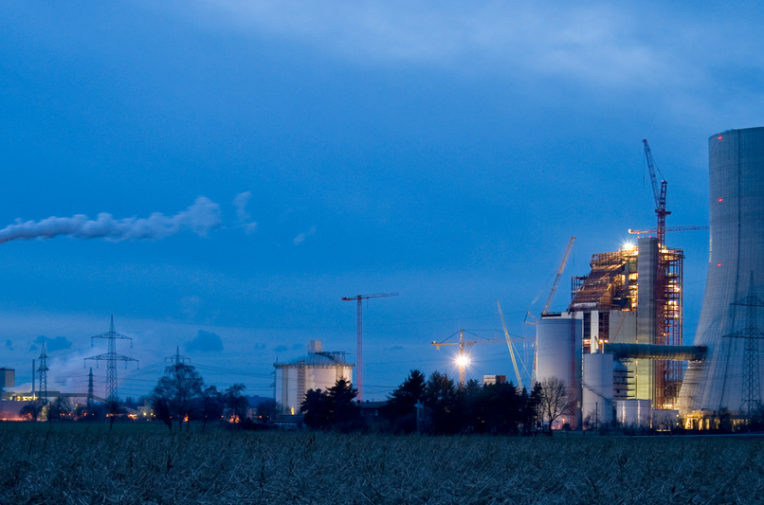
de vernietiging van de aarde zoals wij die kennen en waar de gevolgen van de klimaatverandering intussen al duizenden slachtoffers hebben gemaakt…. Vergeet niet (wat men bij die banken al lang is vergeten) dat wij na het volledig ‘losbarsten’ van de bankencrisis de banken op de been moesten houden met vele miljarden van ons belastinggeld……  

Moet je
nagaan: 4 jaar na het Klimaatakkoord van Parijs, waar ook de
bankwereld beterschap beloofde, dit jammer genoeg onder door henzelf
opgestelde criteria, ofwel geldig tot de deur achter de laatste
klimaatganger in Parijs werd gesloten….. (hetzelfde kan je stellen van de grote oliemaatschappijen, waar Shell het klimaatakkoord van Parijs op 8 punten niet nakomt…..*)

De banken moeten als de oliemaatschappijen dan ook betalen voor de gevolgen van de klimaatverandering die zij met leningen mogelijk hebben gemaakt, sterker nog: als de oliemaatschappijen zouden de grofgraaiers van de banken terecht moeten staan voor het Internationaal Strafhof (ICC) wegens massamoord en grootschalige vernietiging van natuur, plus de vernietiging van roerende en onroerende goederen……..

Moet je nagaan: The Royal Bank of Scotland is in feite een staatsbank, ofwel ook op andere manieren subsidieert de Britse regering het verbranden van steenkool, zoals onze regering dat ook nog steeds doet en dan durft zijne VVD leugenachtige hufterigheid Rutte te zeggen dat Nederland voorop loopt op duurzaam gebied….. ha! ha! ha! ha! ha! Ach ja, eens een leugenaar…….

Voor de begeleidende staatjes, zie het origineel (bijzonder lullig van Unearthed dat je deze niet kan overnemen…..)

Revealed:
UK banks’ £25 billion support for global coal

Afbeeldingsresultaat voor Revealed: UK banks’ £25 billion support for global coal

UK
banks have supported companies building new coal plants with
financing worth almost £25 billion since the Paris climate deal,
according to data gathered by environmental organisations Urgewald
and BankTrack and shared with Unearthed.


In
2015, world leaders agreed to ensure finance reduced greenhouse gas
emissions, but new data shows that HSBC, Standard Chartered, Barclays
and Royal Bank of Scotland continued to support firms investing in
coal.


The
data shows that those four banks supported companies with plans to
build new coal plants to the tune of $31.8 billion or £24.7 billion
between 2016 and 2019.


Between
them, these companies plan to build 174 gigawatts of new coal plants,
equivalent to the total operating capacity of the EU and Australia
put together. However, industry data is not yet sufficiently
transparent to calculate how much of the money is used directly for
coal plant construction. 


The
plans include the Adani megamine in Australia, a controversial new
coal plant in Germany and huge coal expansion in Indonesia.


Over
the period, HSBC was the biggest coal financer out of all UK banks,
with its support worth £8.4 billion. This consisted of £2.1 billion
of loans and £6.1 billion of underwriting.


Underwriting
is what banks do when companies issue bonds on the public markets. An
underwriting bank purchases bonds and then sells them on.


Despite
positioning themselves as concerned about climate change Barclays and
Standard Chartered actually increased the amount of support they
provided in the last two years, compared to 2014-2016.


The
figure for Barclays rose from £2.8 billion to £5.8 billion and the
figure for Standard Chartered rose from £2.5 billion to £6.6
billion.


HSBC,
meanwhile, has decreased its support for companies building new coal
plants from £8.7 billion to £6.1 billion.


The
state-owned Royal Bank of Scotland exited the global coal sector last
year, providing no financing at all for companies building new coal
plants from January to September.

Four
years since Paris


In
2015 at the United Nations climate conference in Paris, leaders
signed an agreement including a commitment to “making finance flows
consistent with a pathway towards low greenhouse gas emissions and
climate-resilient development”.


The
UK will next year host next year’s annual climate conference,
billed as the most important since Paris because world leaders are
meant to upgrade pledges made in 2015.


Greig
Aitken, coal campaigner at BankTrack, told Unearthed:
“One year out from the UK’s hosting of the UN Climate Summit, if
Barclays, HSBC and Standard Chartered don’t act rapidly to rein in
their financing of coal expansion companies, the UK government should
take steps or risk turning up in Glasgow with coal dust on their
faces thanks to our big fossil banks.

Compared
to their European counterparts, UK banks have stubbornly failed for
several years to adequately respond to the worsening climate
emergency by at least introducing policy restrictions to
significantly curb their sponsoring of coal expansion around the
world. Cosmetic policy tweaks no longer cut it.”


The
data, which was gathered from financial databases at Bloomberg and
Refinitiv and from company reporting, is part of a bigger report that
Urgewald and BankTrack plan to publish on the financing of new coal
plants globally. They shared the UK information with Unearthed in
advance of the final report.


It
is based on Urgewald’s list of 258 companies with known coal plant
expansion plans, 51 of which received financial support from UK
banks.


Between
2017 and 2019, the Finnish state-owned energy company Fortum received
more funding from UK banks than any other company with coal expansion
plans. It received £2.5 billion from Barclays, mainly in loans, and
£1.7 billion in loans from Royal Bank of Scotland, which is itself
state-owned.


Fortum
recently agreed to take control of the German energy company Uniper
in a 2.3 billion euro deal, meaning it will take over the company’s
numerous coal plants.


According
to Urgewald’s data, Fortum makes only 5% of its revenue from coal
and only 3% of the power it produces is from coal. However, Uniper is
involved in a controversial plan to build a new coal plant in
Germany.


The
plant, Datteln 4, is controversial because of the German government’s
plan to abandon coal as an energy source by 2038. According to a
report from Reuters, the 1.1 gigawatt plant will be allowed to enter
service despite the government’s commission recommending that no
new coal plants be brought into use.


A
spokesperson for Fortum said: “We don’t invest in Uniper because
of coal but despite coal. Our goal is to create a leader in Europe’s
energy transition. The energy transition will require significant
investments in the coming decades not only in renewables, but also in
gas, energy storage, and other flexibility solutions to provide
security of supply.”


A
Uniper spokesperson said that Fortum’s finances were a matter for
Fortum but added that the Datteln 4 project had not received any
“bilateral loans” from UK banks.


Another
state-owned company is second on the list. Perusahaan Listrik Negara
(PLN), an Indonesian government-owned utility company, received £1.8
billion in support from HSBC and £746m from Standard Chartered.


Coal
plants owned by PLN, amounting to 20 gigawatts, already emit 74
million tonnes of CO2 a year, or around 14% of the country’s total
emissions. It plans to develop another 10 gigawatts of coal plants.

According
to a 2015 report from Greenpeace
,
pollution from coal plants has caused the premature deaths of 6,500
people in Indonesia per year. That same report predicted that if
plants currently planned in the country are built, this could rise to
28,300.


Standard
Chartered and Barclays have also provided financial support to the
Indian coal firm Adani. Standard Chartered made a $150m corporate
loan in 2017 and a $600m corporate loan in 2019, while Barclays and
Standard Chartered both underwrote bonds in 2017 and 2019.


The
company is well-known for its mega-mine expansion plans in Australia,
where it is building a massive coal mine. The mine will produce 2.3
billion tonnes of coal over 60 years, according to Adani, making it
one of the largest in the world.


The
role of finance in driving climate change has come under increasing
scrutiny over the last year. In the UK, the issue is of particular
concern given British banks’ outsize influence globally – the UK
banking sector is the largest in Europe and the fourth largest in the
world.


Last
month, Mark Carney, governor of the Bank of England, warned that the
global financial system is backing projects that will raise the
temperature of the planet by more than 4C, far above the 2C limit
pledged in the Paris agreement.


Labour
has promised to give the Bank extra powers to monitor City firms’
progress on carbon emissions.


Banks
have looked to address this issue, introducing restrictions on their
finance policy restrictions in the last two years which have ended
all direct ‘project finance’ to new coal mines and coal plants
globally.


This
data, however, shows that they have continued to use corporate
finance, loaning money to firms involved in coal development and
underwriting loans to those companies.


A
spokesperson for Standard Chartered told 
Unearthed: “Not
having seen the report or its methodology we can’t comment on the
specific figures, but as you are probably aware we 
announced
last year
 that
we will no longer finance new coal power plant projects and we are
revisiting our approach to clients who are dependent on coal for
business revenues (more to come on that later).”


A
spokesperson for Barclays also pointed to the bank’s new policy on
project finance, saying it agrees “with the objective of reducing
financing for coal-powered energy production”.


They
added that they disputed the findings of the report, saying:
“Barclays has comprehensive criteria and controls in place for our
energy related financing, and we firmly believe in supporting the
transition to a low carbon economy.”

An
HSBC spokesperson said: “HSBC recognises the role of the financial
sector in addressing climate change. We do not support new thermal
coal mines and have not financed any new coal fired power plants
anywhere since April 2018.”

======================================

* Zie: Shell houdt zich niet aan het klimaatakkoord: 8 bewijzen

Zie ook: 

Milieugroepen buitengesloten van klimaattop Madrid

Het grootste olieveld ter wereld: niet in Saoedi-Arabië maar in de VS >> het Permian-bekken

Britse regering geeft na 2 jaar eindelijk rapport vrij over Britse schalie-olie- en schaliegaswinning

Klimaattop Madrid: de grote vervuilers hebben veel te veel invloed

Frans Timmermans (PvdA, Europese Commissie) wakker geschrokken: wil geheel hypocriet belasting op kerosine

Klimaattop Madrid bij voorbaat mislukt

Shell en Exxon die ondanks eigen onderzoek niets hebben ondernomen tegen klimaatverandering, willen met subsidie CO2 opslaan in lege gasvelden

Uniper (energiebedrijf van Finse staat) bezig met rechtszaak tegen Nederlandse staat voor sluiten kolencentrales

IETA, lobbygroep van oliemaatschappijen en andere grote vervuilers, manipuleert klimaattoppen

Exxon in VS onder vuur vanwege de al decennialang voorradige kennis over de menselijke hand in de klimaatverandering

Rutte 3 heeft gelogen over subsidies: jaarlijks 2,5 miljard euro belastinggeld naar olie, kolen en gas

Bas Eickhout (‘GroenLinks’ EU) was vanuit Bonn wel tevreden over het Rutte 3 regeerakkoord……….‘ (dezelfde Eickhout die als grofgraaier in de EU stemde voor het langer toestaan van het kankerverwekkende gif glyfosaat, onderdeel van Roundup…..)

Universiteit van Cambridge overstag: 6 miljoen pond voor onderzoek naar oliewinning t.b.v. Shell

Amazonegebied in brand, Black Rock verdient daar vele miljoenen mee‘ 

Kees Verhoeven (D66 2de Kamer) wil een grote EU, maar ‘alleen op de grote onderwerpen…’ ha! ha! ha! ha! ha! ha! ha!

Klaas Valkering (CDJA en ‘hip haar’): het CDA heeft een eigen duurzaam beleid……. ha! ha! ha! ha! ha! ha! ha! ha! ha! ha! ha! ha! ha!

PvdA, CDA en VVD willen zich niet bij het klimaatakkoord van Parijs neerleggen!!!!

Moody’s beoordeelt Italiaanse bankenstelsel als stabiel

Gisteren
op DeBeurs.nl het bericht dat de Italiaanse bank UniCredit 8.000
mensen ontslaat
* (en dat is bepaald niet de eerste
Italiaanse bank die een groot aantal mensen op straat heeft
geschopt…..)….

Vandaag
meldt DeBeurs.nl dat kredietbeoordelaar Moody’s het
Italiaanse bankenstelsel als stabiel beoordeelt……. Tja, als
mensen ontslagen worden, waarvan velen nooit weer aan de bak zullen
komen, zijn de kredietbeoordelaars en de aandeelhouders blij, meer
winst over de rug van arbeiders (en daar bedoel ik ook de arbeiders
mee die met pak en stropdas rondlopen), meer winst terwijl nog veel
meer mensen in de ellende belanden…….

Moody’s stelt dat de Italiaanse economie ook in 2020 verder zal herstellen, al denken veel deskundigen dat we volgend jaar in een nieuwe recessie zullen belanden, hoogstwaarschijnlijk weer door de financiële sector, ofwel: bankencrisis 2.0…… Bovendien is het maar de vraag of de cijfers kloppen waarop Moody’s zich baseert, immers ook voor de bankencrisis van 2008 werd Italië als een stabiel land beoordeeld door deze kredietanalist……. De vaststelling van Moody’s in het hieronder opgenomen artikel dat de EU een gemiddelde van 3% problematische leningen kent, is dan ook volkomen belachelijk…..** 

Moody’s:
Italiaans bankenstelsel stabiel

Gepubliceerd
op 
4
dec 2019 om 09:27
 | |
Onderwerpen: 
Italië  Moody’s 


LONDEN
(AFN) – Kredietbeoordelaar Moody’s is positiever geworden over het
Italiaanse bankenstelsel. De firma heeft de verwachting bijgesteld
van ‘negatief’ naar ‘stabiel’. Banken hebben steeds minder
problematische leningen uitstaan en weten beter kapitaal vast te
houden. 

Bovendien zijn de omstandigheden rond financiering verbeterd.

“We
verwachten in 2020 voor het vijfde jaar op rij een afname van het
aantal problematische leningen”, zegt Fabio Iannò van Moody’s
in een verklaring. Italiaanse banken hebben in dit opzicht nog wel
een lange weg te gaan. Zo’n 8 procent van de Italiaanse leningen
wordt aangemerkt als problematisch, waar het gemiddelde in de
Europese Unie (EU) op 3 procent ligt.

Moody’s
heeft de beoordeling ook bijgesteld omdat de firma verwacht dat de
Italiaanse economie stabiel blijft en zelfs licht zal groeien.
Italiaanse banken zullen volgens de kredietbeoordelaar winstgevender
worden in 2019 en 2020, mede omdat ze efficiënter worden door
recente reorganisaties. Ook de kapitaalbuffers zullen naar
verwachting stabiel blijven

===================================

*  Zie:
Bank UniCredit ontslaat 8.000 mensen en geeft aandeelhouders een cadeau van 2 miljard euro

** Nederland heeft rond de 700 miljard aan hypotheken uitstaan, waar de werkelijke waarde van de koophuizen nog niet één derde vertegenwoordigt van deze schuld…… Zelfs de neoliberale schoften van IMF en de Wereldbank hebben Nederland al meermaals op de vingers getikt voor deze schuld, die bij een inklappen van de huizenmarkt ons land extra hard zal treffen…… Intussen zijn de grootste Nederlandse banken al weer veel te groot om failliet te laten gaan bij die volgende crisis en dat die eraan komt is zeker, de vraag is alleen wanneer en dat zou heel goed volgend jaar kunnen zijn… 

NN, ook deze ‘verzekeraar’ wordt ‘too big to fail’

DeBeurs.nl bracht vanmorgen het bericht dat NN (Nationale Nederlanden) meedingt naar
de overname van de Spaanse verzekeraar Caser Seguros. Als NN de
bieding wint zal ook deze verzekeraar ‘too big to fail’ zijn
geworden (als dit nu al niet het geval is….)

Na de
aanvang van bankencrisis in 2008, die tot 2018 voortduurde, werd
beloofd door de regering dat banken en andere financiële instellingen
nooit weer ‘too big to fail’ mochten groeien (te groot om failliet te laten gaan), immers met miljarden van ons belastinggeld hield men banken en andere financiële instellingen op de been. Intussen zijn banken als ING en ABN Amro (de laatste
is NB een staatsbank) al weer een paar jaar in het buitenland op het
overnamepad en gegarandeerd dat deze 2 banken al lang weer te
groot zijn om failliet te laten gaan, ofwel bij een volgende crisis
(die bij wijze van spreken al aan de deur klopt) zullen wij met z’n allen banken en andere financiële instellingen op de been moeten houden…….

De kapitaalbuffer van 3% die banken enz. aan moeten houden om een faillissement te voorkomen is veel te laag, waar echte financiële deskundigen waarschuwden dat deze
buffer minstens 30% moet zijn…….

Intussen
heeft de regering een fiks bedrag gereserveerd voor een volgende
crisis en reken maar dat die buffer dan aangesproken zal worden om financiële instellingen te redden, i.p.v. een reservering om te
investeren in de economie, zoals de bedoeling was….. Sommigen
zeggen zelfs dat deze reservering gebruikt zal worden om dierenbeulen
met megastallen uit te kopen in de strijd tegen de stikstofuitstoot,
beulen die zich boer durven te noemen…….

Tijdens
de bankencrisis bleek ook dat men veel te veel had uitgeleend aan
Zuid-Europese landen, zo hadden banken en andere financiële instellingen grote leningen uitstaan in Griekenland, Spanje, Italië en Portugal, hoewel een kind had kunnen weten dat deze landen bepaald niet kapitaalkrachtig waren…… Niet de banken werden gestraft voor dit op de pof uitlenen van geld, maar de Griekse bevolking, dit middels een smerige truc waarbij de Europese Centrale Bank (ECB) de vorderingen van de banken overnam en daarna het Griekse volk en de andere volkeren tot op het bot liet uitkleden…….

Weet niet hoe de positie van verzekeringsmaatschappijen is in de genoemde landen, maar het zou me niet verrassen als deze onder een
mooi verguld bovenblad, een enorm risico verhullen dat aan het licht
zal komen bij een volgende crisis……. Tja en dan komt de redding
middels ons belastinggeld om de hoek kijken, waar men iedereen zal
voorhouden dat dit eens maar nooit weer zal gebeuren, precies als ons
in 2008, 2009, 2010 en zelfs nog in 2011 werd beloofd…… Ach wat wil je met een
premier die beter kan liegen dan wie dan ook en daar keer op keer mee weg kan komen, waarna men deze flapdrol weer als een vakkundig
politicus zal beoordelen in de reguliere (afhankelijke massa-)
media…….

‘NN
doet mee in laatste biedingsronde Caser’

Gepubliceerd
op 2 dec 2019 om 09:29

Afbeeldingsresultaat voor NN

MADRID
(AFN/BLOOMBERG) – Verzekeraar Nationale-Nederlanden (NN) maakt zich
op voor de laatste biedingsronde voor de Spaanse verzekeraar Caser
Seguros. Dat meldde de Spaanse krant La Expansión op basis van
ingewijden. De geïnteresseerde partijen kunnen vanaf dinsdag
bindende biedingen inleggen.

NN
net als zijn Belgische branchegenoot Ageas, het Zwitserse Helvetia en
de Spaanse verzekeraar Santalucía kwamen in de vorige ronde als
winnaars uit de bus. Caser Seguros heeft nog niet inhoudelijk
gereageerd op de geruchten.

======================================

Bij het zoeken op NN kwam ik het volgende tegen: NN Group is een Nederlandse financiële dienstverlener die bestaat uit NN en NN Investment Partners. Nationale-Nederlanden omvat ook Nationale-Nederlanden Bank N.V., die bancaire producten aanbiedt. Deze bank opereert binnen het depositogarantiestelsel onder zijn eigen bankvergunning. NN Group is een Nederlandse financiële dienstverlener die bestaat uit NN en NN Investment Partners. Een dergelijke opsplitsing noemt men ‘risicospreiding’, de hoop voor ons is dat niet alle takken tegelijk failliet gaan, anders zijn we echt gigantisch de klos……

Tamara van Ark (VVD staatssecretaris) wil ‘bijstandstrekkers’ pakken die mede dankzij de kabinetten Rutte werkloos zijn geworden

Tamara van Ark, staatssecretaris Sociale Zaken en Werkgelegenheid, wil ten overvloede nog eens laten zien dat de VVD de pest heeft aan ‘uitkeringstrekkers’, vandaar dat ze na een hersenstorm van een paar weken (het werkt allemaal niet zo snel bij mw. van Ark) gisteren met ‘het geweldige nieuws’ kwam dat ze bijstandsgerechtigden gaat aanpakken, alsof het om een leger mensen gaat die dag in dag uit erop uit zijn de maatschappij een poot uit te draaien…… Alsof het een leugen is dat een heel groot deel van de bijstandsgerechtigden al lang een vrijwilligers baan heeft…….

Er is maar een heel kleine groep bijstandsgerechtigden die het zich kan veroorloven niets te willen doen, iets dat van Ark NB toegeeft….. Daarnaast zit er een grote groep mensen tussen die werkloos zijn geworden door het totaal mislukte beleid van Rutte 1 en 2 op de bankencrisis. Een groot deel van deze mensen die destijds al boven de 45 waren, zijn niet meer aan de bak gekomen, nogmaals: buiten eigen schuld, maar onder verantwoording van VVD (zoals gezegd: de partij van van Ark), CDA, PvdA en D66…..

Voorts hebben de kabinetten Balkenende de WAO aangepast en ervoor gezorgd dat je op sterven na dood moet zijn, om nog voor 100% WAO in aanmerking te komen, waarna veel arbeidsongeschikten in de bijstand zijn beland, ofwel  een groot aantal mensen in de bijstand kan niet eens werken daar ze arbeidsongeschikt zijn en toch wil van Ark ook deze mensen pakken……..

Dan zijn er nog de mensen die voorheen in de sociale werkplaatsen arbeid verrichtten, maar die door PvdA hufter Klijnsma bij gewone bedrijven moesten gaan werken, dit onder de belachelijke term ‘participeren in de maatschappij’ (‘participatiemaatschappij’). Zoals te verwachten was en waar het SCP na jaren eindelijk afgelopen week mee kwam: die hele participatiemaatschappij is één grote mislukking….. Intussen zijn veel mensen met een beperking in de bijstand beland en ook deze mensen wil van Ark aanpakken……

Wat een zootje mensen, figuren als van Ark die zich voordoen als keiharde bestrijders van ten onrechte toegekende uitkeringen, maken met hun werk juist de zwakste mensen in onze maatschappij gehaat bij een groot deel van de bevolking, door te stellen dat ze ‘eindelijk eens wat moeten doen voor hun uitkering…….’

Alsof het bij een bijstandsuitkering om een gigantisch bedrag gaat, terwijl je niet rond kan komen van zo’n uitkering……..

Jaarlijks ontduiken Nederlanders voor rond de 18 miljard euro de belasting in ons land, pak die mensen eindelijk eens actief aan (en niet pas nadat een klokkenluider bewijzen overlegt aan de belastingdienst…..). Overigens ook de grote bedrijven ontduiken de belasting, daar gaat het op jaarbasis om 30 miljard euro en ook dat bedrag laat men liggen…… Maar nee, de mensen met een bijstandsuitkering moeten gepakt worden (terwijl het om bedragen gaat die in het niet vallen bij de hiervoor aangehaalde gevallen van belastingontduiking….)……..

Beste bezoeker, dit was het voor vandaag, morgen meer berichten. Maak er zo mogelijk een mooie dag van.

Danske Bank niet alleen verantwoordelijk voor grootste witwasschandaal: bood klanten goud om identiteit te verbergen

De
Danske Bank blijft deuken in haar imago oplopen, nou deuken, het
begint op een total loss te lijken. De bank is al verantwoordelijk
voor het grootst (bekende) witwasschandaal, van maar liefst 220
miljard dollar, waar de bank Russische oligarchen hielp om hun geld
tegen de EU regels in te verkassen naar plekken als de Kaaimaneilanden, overigens met hulp van de
Deutsche Bank dat al evenzo als crimineel bekend staat…… (‘onze’ ING, ABN
Amro en Rabobank kunnen er ook wat van en daar ontliep de
top strafvervolging door een deal met justitie [‘schikking’] >> zo iets
moeten wij eens proberen en dat met bedragen die in het niet vallen
bij wat de top van deze Nederlandse banken flikten, gegarandeerd dat je in het
gevang belandt…….)

De CEO
van Estlandse tak van de Danske Bank werd een paar maanden geleden
dood gevonden, men zegt na een gelukte suïcide, wel zou er
nog steeds een onderzoek gaande zijn…..

Nu is bekend geworden dat dezelfde Estlandse tak van de Danske Bank, die de miljarden van Russische klanten heeft geholpen te verkassen
naar buitenlandse bankrekeningen, ook betrokken
is bij het inwisselen van geld van rijke Russen voor goud, om zo
anonimiteit te garanderen en hun vermogen verborgen te houden…….
Het zou maar om weinig Russen gaan die van deze service gebruik
maakten, hoewel er geen administratie is bijgehouden van deze
transacties……

Ongelofelijk
dat de banken keer op keer de dans ontspringen, terwijl gewone
cliënten de klos zijn als hun bank dreigt om te vallen, immers dan
mogen zij via de belasting lappen……. Onverdraaglijk nog steeds dat
bijvoorbeeld Griekenland heeft moeten bloeden voor misdadig optreden
van banken uit onze regio….. Er is tijdens de bankencrisis geen geld naar Griekenland
gegaan, deze leugen o.a. gekoesterd door PvdA ploert Dijsselbloem, de
gesel van de Grieken, verdoezelt het feit dat de schulden die de
banken 
overhielden
aan misdadig veel geld uitlenen aan Griekenland (een kind kon weten
dat dit fout zou gaan) werden vergoed door de ECB met hulp van de
Eurogroep waar Dijsselbloem destijds de scepter zwaaide. Nogmaals ongelofelijk en onverdraaglijk dat men daarom een land in feite failliet heeft laten
gaan……. 

Zoals ook alle mensen die door de bankencrisis die veel
langer aanhield dan men je wil laten geloven, in diepe ellende van
werkloosheid, huisuitzetting en blijvende armoede zijn beland……
Mensen die voor een groot deel nog steeds in de stront zitten,
terwijl de daarvoor verantwoordelijke bankdirecteuren en managers zijn blijven
zitten op hun hoge positie bij de banken, dan wel met een onbeschoft
hoge bonus vaarwel zeiden tegen hun bank……. Hetzelfde geldt voor
de toezichthouders, zoals CDA kloot Wellink, die intussen al
miljoenen bij elkaar moet hebben gegraaid als adviseur van een grote Chinese bank……. Wellink heeft zijn werk als toezichthouder op de banken (als directeur van De Nederlandse Bank) destijds totaal ondermaats vervuld, hij had de banken moeten manen de Grieken geen geld op de pof te lenen, maar heeft dat overduidelijk niet gedaan……..

Lees het
volgende artikel van Tyler Durden, gepubliceerd op Zero Hedge, waarin
hij nog dieper de zaak ingaat en waar je ‘nog meer fraais’ over de
banken kan lezen:

Bank
Behind World’s Largest Money Laundering Scandal Offered Russians Gold
Bars To Hide Their Fortune

by Tyler
Durden

Sun,
11/10/2019 – 22:00

When
we 
last
looked at Danske Bank, 
the
Danish lender was at the center of what has been dubbed 
the
world’s largest
,
$220 billion money-laundering scandal that allegedly involved
Russians transferring funds offshore in violation of European
regulations (it also involved the 
chronically
criminal 
Deutsche
Bank). Then, two months ago, the scandal took a lethal turn when the
CEO of the bank’s Estonia branch was 
found
dead 
in
a still-unexplained suicide. Now, we learn of yet another bizarre
twist in what some have dubbed the biggest dirty money scandal of all
time: 
the
Danish lender was offering gold bars to wealthy clients to help them
keep their fortunes hidden.


Afbeeldingsresultaat voor danske bank

According
to 
Bloomberg,
the bank’s Estonian branch – whose CEO committed suicide – which
was already wiring billions of client dollars to offshore
accounts, 
told
a select group of mostly Russian customers some time around 2012,
that they could now also convert their money into gold bars and
coins.

So
for those asking the benefits of holding money in physical gold
instead of fiat (or crypto), here is the answer: aside from offering
a hedge against risk, 
Danske
presented gold as a way for clients to achieve “anonymity,” 
according
to the documents. More importantly, the bank said that using gold
ensured “portability” of assets, according to an internal
presentation dated June 2012.

As
one would expect, the gold/money-laundering service did not come
cheap: Danske charged a fee of 0.5% on larger orders, while smaller
orders had a commission of as much as 4%.

This
is the first time we learn that Danske offered such “services”
– in the bank’s own report on its non-resident unit, the bank listed
the services it provided to clients. Aside from payments, these
included setting up foreign-exchange lines, as well as bond and
securities trading. 
The
bank didn’t list the sale of gold bars.

While
it’s not known how much gold Danske managed to sell while the now
defunct Estonian unit was still running, an internal email seen by
Bloomberg revealed that at least some clients used the service. Local
private banking clients were also offered the service.

Furthermore,
for gold bars weighing 250 grams or more, Danske clients could obtain
the precious metal without a sealed pack or paper certificates.
Bloomberg adds that anti-money laundering approval was needed before
customers could collect the gold, but such approvals weren’t
necessary if the gold was kept in long-term storage, according to the
documents.

The
report goes on to note that the alleged “gold laundering”
service – somewhat similar to the 
Turkey-Dubai-Iran
PetroGold
 Triangle
that emerged in 2012 as a means by which Iran evaded the Western
blockade – was no longer offered after 2013, when the price of gold
tumbled. A bank presentation dated from June 2012, when gold was
trading close to an all-time high, told clients that 
“the
product is not being advertised publicly or in the media.”

Additional
documents revealed that Danske’s Estonian branch sourced its gold
from two partners, depending on the size of orders. One partner
handled orders that exceeded 300,000 euros, equivalent to 6 kilograms
at the time, 
and
bought the gold from the Austrian mint; 
the
other was used for smaller orders, according to the presentation,
which didn’t name the suppliers.

Some
of the documents promoting gold bars are signed by Howard Wilkinson,
the whistleblower who brought the Danske Bank laundering scandal into
the public light. His lawyer, Stephen Kohn, didn’t immediately
comment on the matter when contacted by Bloomberg.

As
reported previously, Danske Bank is currently investigated by the
Department of Justice and the Securities and Exchange Commission (SEC) in
the U.S. In Europe, it’s the target of criminal probes by
prosecutors in Denmark, Estonia and France, according to Bloomberg.


The
bank has also had several class-action lawsuits brought against it,
and its former chief executive officer, Thomas Borgen, is under
preliminary criminal investigation in Denmark, along with many other
former directors at Danske.

As
an aside, gold has traditionally played a special role in the
“historic ties” between Russia and Estonia, which was
swallowed by the Soviet Union in 1940 after it gained independence
following WWI, and which communists participating in the Russian
revolution used as a bridge to channel vast quantities of gold taken
from the murdered family of Czar Nicholas II into the West.

In
the early 1920s, about 700 tons of Czarist coins dodged a western
blockade by passing through Tallinn with the knowledge of the
country’s leaders, before heading for Scandinavia and the U.K. It
now appears that Russian elite may have used the same path.


It
remains unclear who bought the Danske gold, or where it now resides.

Tag: Business
Finance

Lagarde (top ECB): “Je kan beter een baan hebben dan spaargeld”

Lagarde
heeft afgelopen vrijdag de baan van topgraaier Draghi als president van de 
Europese Centrale Bank (ECB) overgenomen, ook al heeft zij bepaald geen financieel economische opleiding gevolgd. Alle hoop van een aantal centrale banken in de EU
op een ander beleid dan dat van Draghi werd vrijwel onmiddellijk de
grond ingeboord. Vreemd overigens die verwachting, immers Lagarde is ook verantwoordelijk voor de gore spelletjes die het IMF sinds 2011 heeft gespeeld, in dat jaar werd ze directeur van deze inhumane neoliberale organisatie….. 

Overigens,  Lagarde is in feite een veroordeelde misdadiger, die haar straf van een jaar gevangenisstraf ontliep daar er anders een crisis in het IMF zou zijn ontstaan, dit nadat haar voorganger en verkrachter Strrauss-Kahn het veld moest ruimen….. Ongelofelijk daarom ook dat de ondemocratische EU Lagarde koos als topgraaier van de ECB…….

Lagarde nam haar functie bij de ECB op o.a. door Nederland en Duitsland te manen hun overschot
te investeren, voorts begon Lagarde te zeuren over onderlinge ‘solidariteit’, ofwel steek ook je kont diep in de schulden. Wat betreft het ‘beleid’ van Draghi: Lagarde gaat gewoon door op de doodlopende weg die Draghi eerder heeft bewandeld: obligaties
van landen opkopen en het verlagen van de rente tot nog verder onder
de – 0,5%, die nu al ingevoerd wordt (zo ongeveer de laatste actie van Draghi), ofwel een rente die nog verder onder het
‘nulpunt’ zal dalen, anders gezegd: negatieve rente (waarmee geld lenen zelfs geld zou moeten opleveren, al zal dat ‘natuurlijk niet’ voor het gewone volk opgaan…)….

Dat
daardoor een flink aantal mensen in de problemen komt interesseert
autocraat Lagarde net zo min als haar voorganger Draghi, schijt aan de pensioenen die mensen hun
werkende leven lang hebben opgebouwd, dokken en niet zeuren……. Ook de kleine spaarders kunnen wat Lagarde betreft doodvallen, ze durfde keihard te zeggen
dat je beter een baan kan hebben dan geld op de bank….. Moet je
nagaan: de misdadige dweil Lagarde gaat een inkomen verdienen van rond de 4 ton op
jaarbasis is en dat is exclusief een gigantische onkostenvergoeding……

Taaie
stof mensen, 
het hieronder opgenomen artikel van Tyler Durden, maar zeer de moeite van het lezen waard (het artikel werd eerder gepubliceerd op Zero Hedge). Daaronder een verduidelijking over QE ofwel Quantitative Easing, een artikel
van Investopedia, QE of het waanzinnige beleid van Draghi om zoveel
mogelijk obligaties van EU landen op te kopen (ook werden schulden van banken in Zuid-Europa opgekocht, waardoor de Grieken de regie in eigen land zijn kwijtgeraakt en nog steeds diep in  de ellende zitten…)…. 

De ECB heeft
overigens al aangekondigd, na de stop van één jaar, opnieuw bonussen ter waarde van
20 miljard euro op te willen kopen, ook al is het allesbehalve
duidelijk of dit ook maar iets heeft opgeleverd voor de EU, behalve
dan dat de drukpersen voor papiergeld overuren maakten en ons geld in
feite steeds minder waard werd ook al merken we daar nu nog weinig
van….. (dat gebeurt als de volgende crisis zich aandient en zoals je weet die komt eraan, de vraag is wanneer precies)

Lagarde:
“We Should Be Happier To Have A Job Than To Have Savings”

by Tyler
Durden

Mon,
11/04/2019 – 06:12

Any
hopes that the replacement of Mario Draghi, who on Halloween left the
ECB more polarized than ever, as the core European nations revolted
against the Italian’s profligately loose monetary policy in an
unprecedented public 
demonstration
of discord 
within
the European Central Bank…


with the ECB’s new head, former IMF Director and 
convicted
criminal
,
Christine Lagarde would result in some easing of tensions, were
promptly crushed when Lagarde picked up where Draghi left
off, 
calling
on Germany and the Netherlands to use their budget surpluses to fund
investments that would help stimulate the economy, 
in
a sharp rebuke that will not win the former French finance minister
any friends in fiscally conservative Germany.

In
an appeal to Germany’s sense of solidarity, and in hopes that
Germany’s memory of hyperinflation has faded enough, Lagarde said
that there “isn’t enough solidarity” in the single
currency area, adding: “We share a currency, but we don’t share
much budgetary policy for now.”

“Those
that have the room for manoeuvre, those that have a budget surplus,
that’s to say Germany, the Netherlands, why not use that budget
surplus and invest in infrastructure? Why not invest in education?
Why not invest in innovation, to allow for a better rebalancing?”
asked Lagarde, blaming Germany and the Netherlands for living within
their means, and demanding they should no longer do so, 
just
because most other Europeans decided to pull a page out of the
American playbook, and live exorbitantly 
outside of
their means.

Lagarde’s
direct attempt at shaming Europe’s fiscal conservatives was nothing
short of shocking: normally ECB officials avoid naming individual
countries in public statements, because their mandate is to act in
the interests of the eurozone as a whole. But when Lagarde made her
speech she had not yet officially taken over at the Frankfurt-based
institution — she succeeds Mario Draghi on Friday.

We
somehow doubt this “explanation” will fly with the German
population, which sees itself as funding peripheral Europe’s
profligate ways for the past decade, even as it benefited from the
weak euro to supercharge the German export machine.

And
just to guarantee she is as resented by Germany as was Mario Draghi,
she said that the German and Dutch governments, which last year had
budget surpluses of 2% and 1.5% respectively, “
have
not really made the necessary efforts,” 
she
added, referring to establishment’s increasing desperation to force
anyone with an even remotely normal balance sheet to sink to the same
level as their insolvent peers.

As
for the punchline, Lagarde defended the negative interest rates
introduced by her predecessor Draghi, 
arguing
that people should be happier to have a job than a higher savings
rate. 
This,
as a reminder, comes at a time when virtually everyone who
is 
not named
“Draghi” or “Lagarde” thinks that 
negative
rates are catastrophic
,
and assure doom for the Eurozone.

When
asked about the impact of negative rates on savers, Ms Lagarde said
on Thursday that they should think about how much worse the situation
would be if the ECB had not cut rates as much as it had.

Would
we not be in a situation today with much higher unemployment and a
far lower growth rate, and isn’t it true that ultimately 
we
have done the right thing to act in favor of jobs and of growth
rather than the protection of savers?” 
she
asked.

The
unemployment rate in the 19-country eurozone has fallen from 12 per
cent in 2013 to 8.2 per cent last year. GDP growth in the single
currency zone was 1.8 per cent last year and the ECB expects it to
slow to 1.1 per cent this year.

Finally,
for those curious if the authorities will 
stop
at anything 
to
destroy the currency and send rates to even more negative levels if
it means kicking the can on a global, populist uprising, by just a
few months, weeks or days, here is the answer: “
We
should be happier to have a job than to have our savings
protected,” 
said
Lagarde.


“I
think that it is in this spirit that monetary policy has been decided
by my predecessors and I think they made quite a beneficial choice.”


Let’s
check back on that statement in a year, shall we?

Of
course, there is no magic solution here: all the ECB has done is kick
the can, and ensure that the next crisis will be even worse than if
some semblance of a price-clearing reality had been allowed under
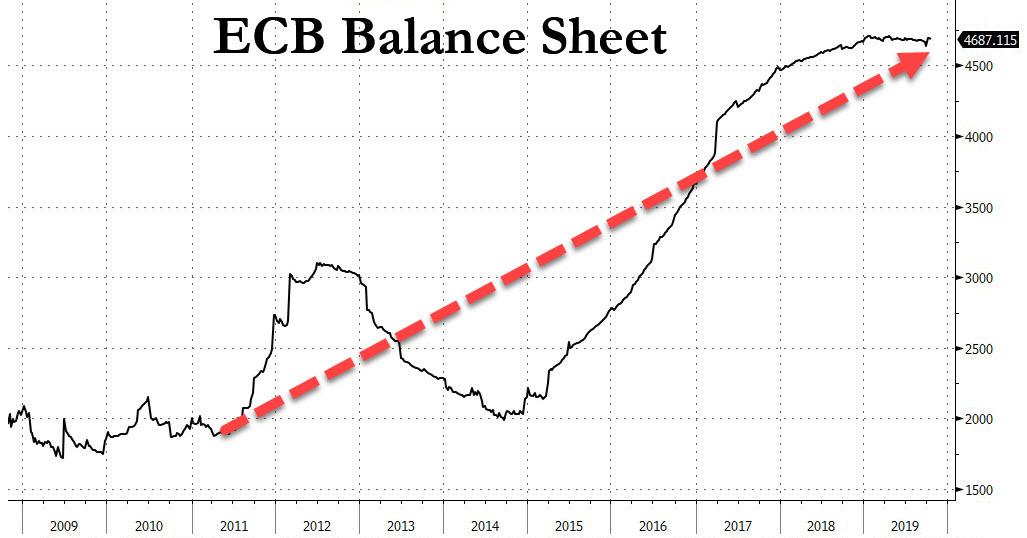
Draghi’s 8 years. Instead, the ECB’s balance sheet exploded to €4.7
trillion euros, as the world’s largest central
bank-cum-hedge fund 
bought every bond in sight in hopes
of keeping asset prices artificially elevated.

In
October, the ECB, less than a year after it ended QE
*
in a failed attempt to “renormalize” monetary policy,
announced it would cut rates to a record -0.5% and unveiled
open-ended plans to start buying €20bn of bonds starting in
November.

Needless
to say, the comments by the former French finance minister confirm
market expectations that she is likely to pursue similar monetary
policy strategy to Draghi who flooded the financial system with cheap
money to fight slowing growth and inflation while calling on
governments to do more through fiscal policy to take the burden off
the central bank.


In
the end, the consequences of Draghi’s monetary policy, as we
explained before, 
will
be catastrophic
,
but the former Goldman partner was wise enough to get off the
European Titanic before it hit the iceberg. It will now be Lagarde’s
task to save as many people as possible once the ship starts sinking,
and judging by her remarks, she is perfectly fine of not only going
down with the ship, but also being blamed for the collision.


Tags:
Business
Finance

===============================


*
Hieronder de uitleg over QE of: Quantitative Easing, geschreven door Jim
Chappelow en gepubliceerd op Investopedia (zie ook het eerste
staatje in het artikel van Durden):


Quantitative
Easing (QE)

REVIEWED
BY 
JIM
CHAPPELOW
Updated
Sep 6, 2019

What
Is Quantitative Easing? (QE)

Quantitative
easing is an unconventional 
monetary
policy
 in
which a central bank purchases 
government
securities
 or
other securities from the market in order to increase the money
supply and encourage lending and investment. When short-term
interest rates are at or approaching zero, normal 
open
market operations
,
which target interest rates, are no longer effective, so instead a
central bank can target specified amounts of assets to purchase.
Quantitative easing increases the 
money
supply
 by
purchasing assets with newly created bank reserves in order to
provide banks with more 
liquidity.

KEY
TAKEAWAYS

  • Quantitative
    easing (QE) is the name for a strategy that a central bank can use
    to increase the domestic money supply.

  • QE
    is usually used when interest rates are already near 0 percent and
    can be focused on the purchase of government bonds from banks.

  • QE
    programs were widely used following the 2008 financial crisis,
    although some central banks, like the Bank of Japan, had been using
    QE for several years prior to the financial crisis.

Understanding
Quantitative Easing

To
execute quantitative easing, 
central
banks
 increase
the supply of money by buying 
government
bonds
 and
other securities. Increasing the supply of money is similar to
increasing supply of any other asset—it lowers the cost of money.
A lower cost of money means 
interest
rates
 are
lower and banks can lend with easier terms. This strategy is used
when interest rates approach zero, at which point central banks have
fewer tools to influence economic growth.

If
quantitative easing itself loses effectiveness, 
fiscal
policy
 (government
spending) may be used to further expand the money supply. In effect,
quantitative easing can even blur the line between monetary and
fiscal policy, if the assets purchased consist of long term
government bonds that are being issued to finance counter-cyclical
deficit spending.

The
Drawbacks of Quantitative Easing

If
central banks increase the money supply, it can cause 
inflation.
In a worst-case scenario, the central bank may cause inflation
through QE without economic growth, causing a period of
so-called 
stagflation.
Although most central banks are created by their countries’
government and are involved in some regulatory oversight, central
banks can’t force the banks to increase lending or force borrowers
to seek loans and invest. If the increased money supply does not
work its way through the banks and into the economy, QE may not be
effective except as a tool to facilitate deficit spending (i.e.
fiscal policy).

Another
potentially negative consequence is that quantitative easing
can 
devalue the
domestic currency. For manufacturers, this may help stimulate growth
because exported goods would be cheaper in the global market.
However, a falling currency value makes imports more expensive,
which can increase the cost of production and consumer price levels.

Is
Quantitative Easing Effective?

During
the QE programs conducted by the 
U.S.
Federal Reserve
 starting
in 2008, the Fed increased the money supply by $4 trillion. This
means that the asset side of the 
Fed’s
balance sheet
 grew
significantly as it purchased bonds, mortgages, and other assets.
The Fed’s liabilities, primarily 
reserves at
U.S. banks, grew by the same amount. The goal was that the banks
would lend and invest those reserves to stimulate growth.

However,
as you can see in the following chart, banks held onto much of that
money as excess reserves. At its peak, U.S. banks held $2.7 trillion
in excess reserves, which was an unexpected outcome for the Fed’s QE
program.

(voor de staat die hier hoort te staan, zie het origineel)

Most
economists believe that the Fed’s QE program helped rescue the U.S.
(and world) economy following the 2008 financial crisis. However, the
magnitude of its role in the subsequent recovery is more debated and
impossible to quantify. Other central banks have attempted to deploy
QE 
to
fight recession
 and deflation with
similarly cloudy results.

Following
the 
Asian
Financial Crisis of 1997
,
Japan fell into an economic 
recession.
Beginning in 2000, the 
Bank
of Japan (BoJ)
 began
an aggressive QE program to curb deflation and to stimulate the
economy. The Bank of Japan moved from buying Japanese government
bonds to buying private debt and stocks. The QE campaign failed to
meet its goals. Ironically, the BoJ governors had concluded that “QE
was not effective” just months before launching their program
in 2000. 
Between
1995 and 2007
,
Japanese GDP fell from $5.45 trillion to $4.52 trillion in nominal
terms, despite the BoJ’s efforts.

The Swiss
National Bank (SNB)
 also
employed a QE strategy following the 2008 financial crisis.
Eventually, the SNB owned assets nearly equal to annual economic
output for the entire country, which made the SNB’s version of QE
the largest in the world as a ratio to 
GDP.
Although economic growth has been positive during the subsequent
recovery, how much the SNB’s QE program contributed to that recovery
is uncertain. For example, although it was the largest QE program in
the world as a ratio to GDP and interest rates were pushed below 0%,
the SNB was still unable to achieve its inflation targets.

In
August 2016, the 
Bank
of England (BoE)
 announced
that it would launch an additional QE program to help alleviate
concerns over “
Brexit.”
The plan was for the BoE to buy 
60
billion pounds
 of
government bonds and 10 billion pounds in corporate debt. If
successful, the plan should have kept interest rates from rising in
the U.K. and stimulated business investment and employment.


From
August 2016 through June 2018, the 
Office
for National Statistics
 in
the U.K. reported that gross fixed 
capital
formation
 (a
measure of business investment) was growing at an average quarterly
rate of 0.4 percent, which was lower than the average from 2009
through 2018. The challenge for economists is to detect whether
growth would have been worse without quantitative easing.

ING is alweer zo groot dat ze niet failliet mag gaan, met dank aan topgraaier Hamers

Al tijdens de bankencrisis die in 2008 in alle hevigheid toesloeg, waarvoor de belastingbetaler miljarden in banken moest steken om ze op poten te houden, beloofde de regering dat banken in de toekomst nooit weer zo groot mochten zijn dat ze niet failliet mochten gaan, je weet wel: de ‘too big to fail’ regel.

Intussen zijn zowel staatsbank ABN Amro en ING al weer een paar jaar ‘too big to fail’, ofwel bij een volgende bankencrisis zullen wij weer de portemonnee moeten trekken om de banken op poten te houden, terwijl de top van die banken zich helemaal scheel verdient en continu bezig is om in het buitenland klanten te werven…..

Vanmorgen op BNR (rond 9.12 u.) Ralph Hamers van ING die trots vertelde dat ING de laatste 5 jaar in Polen maar liefst 1 miljoen klanten heeft getrokken voor haar bank…… En dat beste bezoeker is nog maar het spreekwoordelijke topje van de ijsberg…… (Hamers werd gehoord over de slechte cijfers van ING…)

Hoe is het mogelijk dat het Nederlandse volk zo wordt besodemieterd door grofgraaiers die schijt hebben aan de gewone mens, waarbij het waardeloze afbraakkabinet Rutte toekijkt zonder iets te doen en de toezichthouder, De Nederlandse Bank onder plork Klaas Knot, niet eens de moeite neemt om banken op de vingers te tikken……

Eén en ander is een herhaling van zetten, voorafgaand aan de eerder genoemde crisis die bijna de hele wereld in een diepe crisis stortte, een crisis die niet slechts een paar jaar duurde, zoals men je wil laten geloven, maar minstens tot 2016 haar vernietigende spoor achterliet, een spoor van mensen die hun baan verloren, mensen die uit hun huis werden gezet, plus oude en zieke mensen die hun hulp verloren en in diepe en eenzame ellende wegzakten……. (van wie velen intussen zijn overleden….)

De neoliberale PvdA grofgraaier Wouter Bos durfde destijds te zeggen dat hij veel financiële producten niet begreep en dat dit niet nog eens zou gebeuren, intussen zijn er weer voldoende financiële producten waar Bos en anderen geen snars van begrijpen, voorts worden er weer herverpakte leningen verhandeld, een zaak waarmee de bankencrisis begon….. Voorts hebben de banken alweer meegeholpen om de huizenprijs op een zo waanzinnig niveau te krijgen, dat de ellende niet is te overzien als het echt misgaat……

Nederland heeft alweer een hypotheekschuld die de 700 miljard euro heeft benaderd, een bedrag waarvoor het IMF en de Wereldbank Nederland meermaals hebben gewaarschuwd, gezien ons totale bruto nationaal product…… Bovendien als het fout gaat, zal de werkelijke prijs van een huis tot zelfs meer dan 70% moeten worden afgewaardeerd, waarna de eigenaren in de stront komen te zitten….

Hoe is het mogelijk dat de reguliere media geen woord aan deze zaak vuilmaken….?? Simpel: daar hun echte bazen, plutocraten en investeringsmaatschappijen, geen kritiek dulden op het ijskoude, inhumane neoliberalisme dat de maatschappij ontwricht, maar waaraan zij zich verrijken……… Een maatschappij waar vooral maatregelen worden genomen die voornoemde plutocraten, aandeelhouders en (middelgrote en) grote bedrijven ten goede komen, maar die ten koste gaan van de grote onderlaag en de mensen die nog een paar centen hebben weten te sparen…….

Meer dan schandalig!!

Voor meer berichten over de bankencrisis, de hypotheekschuld, ING, ABN Amro of Ralph Hamers, klik op het betreffende label, direct onder dit bericht.