Om
ten overvloede te laten zien, wat een enorme schoft Guaidó is, je
weet wel de figuur die de VS als ‘president’ van Venezuela wil zien
en voor hem bezig is met een staatsgreep in dat land, heeft hij de VS
laten weten dat de grote oliemaatschappijen van de VS de beschikking
zullen krijgen over de Venezolaanse olievoorraad………
Daarbij
maakte de fascistische plork Guaidó bekend dat dit goed zou zijn voor
het Venezolaanse volk dat hij zo heeft verraden……. Alsof de
ploert niet weet dat de economische oorlog van de VS, de EU en een
paar Latijns-Amerikaanse staten, Venezuela naar de rand van de
afgrond hebben gebracht en velen in ellende hebben gestort……
Dan
opmerken dat de beschikking over de Venezolaanse olievoorraad (tegen
een appel en een ei) door de oliemaffia van de VS goed zou zijn voor
de bevolking is een gotspe!!! Kortom: de VS heeft Venezuela naar de
rand van faillissement gebracht en krijgt daarvoor als beloning een
giga deal ten gunste van haar oliemaffia……… (VS
oliemaatschappijen, als Halleburton en Chevron, die ook al kapitalen
verdienden aan de oorlog in Irak….*)
Uiteraard
zal Guaidó als hij daadwerkelijk de macht in handen gespeeld krijgt
door de VS, het staatsoliebedrijf de
Venezolaanse oliemaatschappij Petróleos de Venezuela (PDVSA),
privatiseren en oude wetgeving veranderen waarin is verordonneerd dat
de winning door buitenlandse oliemaatschappijen voor 51% tegoed komt
aan PDVSA…… Je snapt dat dit percentage niet zal worden verhoogd,
maar aanzienlijk zal worden verlaagd. alsof dat in het belang is van
het Venezolaanse volk………
Kortom
Guaidó is niet alleen door de VS geselecteerd als vervanger voor
Maduro, maar ook als stroman voor de grote oliemaatschappijen…….
Wat verder niet vergeten moet worden is dat Venezuela beschikt over
grote hoeveelheden coltan, daarvoor is afgelopen jaar zelfs een
fabriek geopend in Venezuela >> coltan is een erts dat van
groot belang is voor de vervaardiging van smartphones, ofwel twee neokoloniale vliegen in één klap……..
Nogmaals
wil ik erop wijzen dat het ronduit schandalig is dat de westerse
landen zich zo hysterisch gedragen tegen Venezuela, alsof daar een
genocide plaatsvindt….. Sterker nog: een plaatsvindende genocide in
Jemen laat datzelfde westen koud, terwijl men na Rwanda uitermate
hypocriet beloofde dat dit nooit weer zou gebeuren……**
Nee
het westen heeft alleen aandacht voor wingewest Venezuela en zal geen
traan laten als de VS en de NAVO (o.a. vanuit Colombia, waar de NAVO
2 militaire bases heeft) Venezuela aanvallen en daarbij grote
aantallen burgers vermoorden met hun dan illegale oorlog tegen
dat soevereine land……
Hoe
is ‘t allemaal mogelijk mensen, om schijtziek van te worden!!
Juan
Guaido Promises Oil Deals for US Gas Giants If He Takes Power
(GPA) – Making
the empires ambitions clear, US stooge Juan Guaidó has promised
Venezuelan oil to US corporations.
The
US-backed Venezuelan “government” of Juan Guaidó has said there
will be plenty of money to be made for Wall Street under a government
without the current President, Nicolas Maduro.
According
to reports, this offer was made during a meeting between US officials
and delegates of the Guaidó cabinet in Washington. Apparently,
Guaidó has promised that if he should take control of the actual
levers of state power in Venezuela he would end the control over
Venezuelan oil projects currently
given to the state oil
company, PDVSA.
The
current law in Venezuela states that any projects involving
Venezuelan oil that PDVSA must have, at least, a 51% stake. According
to the delegates in Washington, this is the best way to reinvigorate
Venezuelan oil production.
In
an interview following their official meetings in Washington, one
Guaidó envoy, Carlos Vecchio, explained this strategy as a part of a
broader policy “to go to an open economy.” Vecchio then went on
to say that this “openness” would be what brings the oil sector
back and reassured US speculators that “the majority of the oil
production that we want to increase will be with the private sector.”
While
this is obviously the reason backs the Guaidó “government” it is
stunning to hear it so openly. Vecchio was just as brazen when asked
about whether PDVSA’s North American subsidiary, Citgo would go
bankrupt or not.
Vecchio
explained that Guaidó “wants to keep the operation running”
which likely reflects on recent moves by Guaidó and his cheerleaders
to try to hand
control of Citgo’s US
assets and profits to the fraudulent president. This has been a
common measure proposed by many analysts to try to create a slightly
less-illegal-looking way to steal Venezuelan money.
Yet
now that we have confirmation that Guaidó does, in fact, intend to
immediately begin selling off rights to Venezuela’s resources if he
should ever get power, we know exactly where Citgo’s profits will
go in the future. Guaidó may desperately want to control some Citgo
and PDVSA assets for now, but he is also all too willing to sell them
to Wall Street should he get the chance.
This
idea that selling off PDVSA to companies like Exxon – one of the
oil giants kicked out of Venezuela by Hugo Chavez – will somehow
make things better for average citizens of the country, is obviously
ridiculous. Beyond the sheer stupidity and obvious theft, however,
this narrative put forth by Guaidó and the US media totally
whitewashes what is, for all intents and purposes, a US
economic blockade of
Venezuela and the host of sanction on the nation’s oil industry.
This
pattern of abusive sanctions on Venezuelan oil production has carried
on for years and continues to be a regular tactic imperial powers use
on Venezuela. The Trump regime just enacted their own new sanctions
in this vein last week, strictly restricting the export of oil, which
is expected to further harm
the Venezuelan economy and
people.
All
of this lays bare just what the US is doing to Venezuela. Washington
has no real concern of the average people actually being hurt in
Venezuela. Instead, Washington is out to rip whatever resources it
can away from the Venezuelan people.
The
oil coming out of the ground in Venezuela could easily be in the
global market right now if it weren’t for Washington’s meddling.
If that oil was on the market, the Bolivarian government would likely
return to deploying the policies they’ve always championed like
public housing, subsidized medicine, price controls, health care, and
other social welfare programs. Looking at it this way, it becomes
obvious the only people holding the Venezuelan people back is the
same people promising freedom, the opposition’s supposed “friends
in Washington”
**
Niet alleen de Saoedische terreurcoalitie, inclusief mededaders VS en
GB, zouden vervolgd moeten worden door het Internationaal Strafhof in
Den Haag (het ICC), maar ook de westerse landen die op de hoogte zijn
van de genocide in Jemen, maar daar niet op reageren, of erger nog als
Nederland wapens dan wel onderdelen voor wapensystemen leveren aan
de Saoedische terreurcoalitie die deze genocide uitvoert…….
(de opgeblazen oorlogshitser en oorlogsmisdadiger Pompeo beweert dat Hezbollah werkzaam is in Venezuela en daar een leger heeft dat gezien zijn woorden amper onder doet voor de gezamenlijke NAVO troepen… ha! ha! ha! Ook hier is totaal geen bewijs voor deze belachelijke beschuldiging…)
De coup
die de VS tegen de regering van Maduro in Venezuela al jaren geleden
heeft opgezet, middels een economische oorlogsvoering, bevindt zich
in het laatste stadium……. Althans dat lijkt er zwaar op als je de
gebeurtenissen in Venezuela aan je oog en oor voorbij ziet dan wel
hoort gaan……..
Middels
de economische oorlog van de VS die al vele jaren duurt en waarbij de
VS levensmiddelen winkelketens van VS origine onder druk heeft gezet
hun voorraden in Venezuela niet meer aan te vullen, hetzelfde geldt
voor medicijnen van VS makelij, dan wel de belastingontduikers onder
hen die bijvoorbeeld in Europa een ‘hoofdkantoor’ hebben
(brievenbusfirma’s)……..
Uiteraard
wordt sinds een paar jaar door waarschijnlijk het VS ministerie van buitenlandse en binnenlandse zaken in samenwerking met andere overheidsorganen van de VS, druk op
alle bedrijven uitgeoefend die zaken deden en doen met Venezuela, zo
van: ‘als je hiermee doorgaat kan je op een zwarte lijst belanden,
zodat je elk zakendoen met de VS kan vergeten’ en als dat niet helpt
dreigt de VS gewoon zo’n bedrijf als misdadig af te schilderen,
waarna de leiding zelfs kan worden gearresteerd in een ander land,
zoals onlangs de topvrouw van Huawei is overkomen, waar het wel een
gotspe is dat de Canadese regering aan deze ontvoering heeft
meegeholpen…….. Voorts zullen banken niet graag geld lenen aan dergelijke bedrijven, daar zij anders ook op de zwarte lijst komen….. Zo chanteert de VS terreurentiteit een fiks deel van de wereld, waartegen niemand actie onderneemt, alsof dit een normale gang van zaken is……
De
zoveelste keer dat de VS grote mensenmassa’s op straat heeft weten te
krijgen in Venezuela, waar voorafgaand aan de voorlaatste protesten zelfs
terroristen Venezuela werden binnengesmokkeld, terroristen die tijdens de demonstraties uiterst gewelddadig optraden tegen de politie….. Opvallend
genoeg vonden deze gewelddadige demonstraties plaats in de welgestelde delen van Venezolaanse steden…..
De
nieuwste truc van de CIA: laat een oppositieleider zichzelf uitroepen
tot interim president, inclusief de hele mikmak die erbij hoort, ik
durf te wedden dat dit de VS een enorme bak belastinggeld heeft
gekost, zoals de 4 miljard die Hillary Clinton (onder Obama minister
van BuZa) uittrok voor de opstand en daaropvolgende coup in
Oekraïne……
Niet
vreemd ook dat andere fascistische, of bijna fascistische
Latijns-Amerikaanse staten, in navolging van de VS en Canada, de interim regering van Juan Guaidó
erkenden als officiële regering van Venezuela…….
Overigens heeft Guaidó eerder om ingrijpen van de VS verzocht….*
Gisteren
op Radio1, BNR, WDR en BBC de hele dag ‘sfeerimpressies’ van de
gebeurtenissen in Venezuela, waarbij Maduro werd afgeschilderd als de grote misdadiger, die de
hand heeft in het geweld tegen demonstranten…… Geweld als bij de hiervoor
beschreven demonstraties met ingehuurde psychopaten, waar de reguliere massamedia rapporteerden dat dit geweld van de overheid kwam, terwijl men op de hoogte was van de waarheid….. Geen wonder dat deze media nooit een rectificatie plaatsten, nee men hield stug
vol dat de Venezolaanse politie en leger op elkaar en op demonstranten hadden geschoten, immers naast gedode demonstranten
werden er o.a. politieagenten doodgeschoten en verwond…….
Volgens
een WDR correspondent (kreeg niet mee hoe ze
heet, haar voornaam is Ulla) heeft Maduro het land naar de afgrond
geleid, alsof de hele VS boycot, beter gezegd economische oorlog, niet bestaat, terwijl ze dat toch
echt zou moeten weten……. Ongelofelijk wat men allemaal durft te
spuien, zo sprak deze ‘correspondent’ op straat met ‘een arme
Venezolaan’, die ook achter de coup van Guaidó zou staan…..
Uiteraard
haalt men zulke trucs uit: terwijl Chavez (waarschijnlijk vermoord door of i.o.v. de CIA) en Maduro de enige presidenten zijn die ooit echt
iets voor de armen in Venezuela hebben gedaan……. Dat feit zal niet
snel vergeten worden door de arme bevolking van Venezuela….. De
hoofdmoot van demonstranten zijn dan ook de midden en hogere klasse
in dat Zuid-Amerikaanse land…….
Intussen
staan NAVO-troepen klaar aan de andere kant van de Venezolaanse grens
in Colombia, dat belachelijk genoeg is toegelaten tot deze Noord-Atlantische terreur organisatie (ofwel NATO…)…….. Je kan er donder op
zeggen dat de CIA de boel regisseert, immers deze terroristenbende
heeft al zo vaak met deze bijl gehakt………
Handen
af van Venezuela en bevoorraad dit land met levensmiddelen en
medicijnen!!
Het is te hopen dat Rusland het niet over haar kant
laat gaan en haar poot stijf houdt als de VS terreurcoalitie het
soevereine land Venezuela wil binnenvallen……..
Het
volgende artikel is van Kit Knightly, hij werd eerder gecensureerd door The
Guardian en werkt nu voor OffGuardian, die het
artikel publiceerde:
Open
Thread: US Backs anti-Maduro Coup in Venezuela
Caracas,
Venezuela January 23, 2019. REUTERS/Carlos Garcia Rawlins
In
a move that many of us saw coming, the US has backed efforts to force
Nicolas Maduro from the Presidency of Venezuela. Earlier today Donald
Trump officially recognised Juan Guaido, the leader of Venezuela’s
defunct National Assembly as “interim President”.
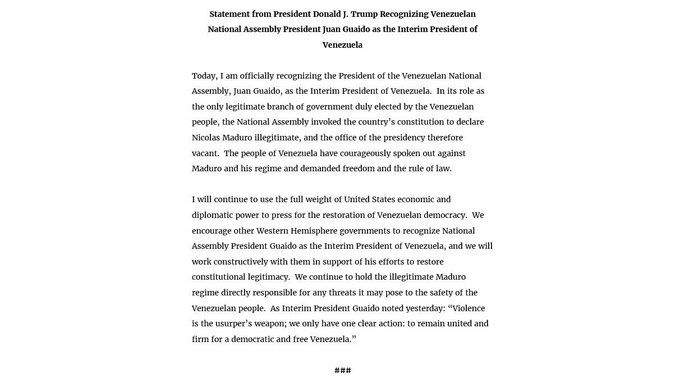
The citizens of Venezuela have suffered for too long at the hands of the illegitimate Maduro regime. Today, I have officially recognized the President of the Venezuelan National Assembly, Juan Guaido, as the Interim President of Venezuela.
This
move was backed by Canada, Brazil, Argentina, Costa Rica, Ecuador,
Chile and Peru. The EU were also quick to back
regime change,
although leaders of specific EU states are yet to make their
positions know. It is doubtful any of us will be surprised when they
do.
The
noteworthy – and predictable – rebels on American continent were
the leftist governments of Mexico and Bolivia.
This
move has been on the cards for a while, with John Bolton – Trump’s
National Security Advisor – tweeting this just last week:
The National Assembly is the only legitimate, democratically elected government entity in Venezuela, and the U.S. supports its important decisions yesterday. We urge all Venezuelan leaders, including the military, to uphold the rule of law and constitutional order.
This
is very clearly a call for open revolution – note the language:
“including the military”.
Obviously
any coup needs the military backing it to be successful. Though there
are reports of large protests on the streets of Caracas – both for
and against the President – the military have not got involved on
the ground so far. Howver, they did release a statement disavowing
Guaido and
the “dark interests” supporting him.
They
went on to declare that they stand by President Maduro in support of
Venezuela’s national sovereignty.
Lacking,
for now, the support of Venezuela’s own military the only way the
coup can succeed is with military help from a foreign power, the
obvious candidates being the US, NATO and Brazil’s new President
Jair Bolsonaro – a cross between Pinochet and a used car salesman.
He has previously said he would back a military invasion
of Venezuela.
What
the US/NATO/whoever need is
a pretext to invade – enter The
Guardian et
al.
“[Maduro
might] turn sharpshooters on crowds and try to scare everybody back
home”
Guardian
reporter Tom Philips then says this:
“If
that happened, the US and the international community would be forced
to react”.
Which
is their way of saying if anyone gets shot, or even injured, in these
protests then the US (and allies?) will move to intervene militarily.
They would be “forced” to, apparently.
Expect
this angle to replayed, a lot, all throughout the mainstream media in
the coming days. Op-eds will remind us of the “cost of inaction”
in Syria. Some people will write that though Trump is a monster, he
is at least elected and we should stand with him in defense of
democracy. Stuff like that.
The
bottom line will be – we NEED to act in Venezuela because Maduro is
“massacring” his own people to hold onto power.
They’ve
tipped their hand with a reference to “sharpshooters” killing
civilians.
This
is, of course, the exact scenario we saw play out in Ukraine in 2014.
“Sharpshooters”
were “turned loose” on the crowd, killing several dozen people
(police and protestors alike). This violence was used to declare
Victor Yanukovych’s government “illegitimate”, and replace him
with a leader more to the US’s liking. Evidence
has since emerged showing
the shots were likely fired by non-government marksmen in a bid to
escalate the violence.
The
same fate awaits Venezuela and Maduro – except Venezuela doesn’t
have a super-power on its borders, so the US won’t have to keep the
gloves on this time. Venezuela could feel the full force of America’s
“humanitarian” armed forces. There are people on the streets –
all it needs is one tiny spark, one slight act of violence, and the
whole situation will explode.
The
US Deep State has shown before that they are more than able to create
a spark when they need one.
Important
questions:
Will
the Venezuelan military continue to stand by Maduro?
Will
there be violence on the streets?
If
so, how long before there are calls for “humanitarian
intervention”?
What
will the position of the European leaders be?
Will
the US try to get a UN mandate to act in Venezuela? Would they be
successful if they did?
Will
“The Resistance” criticise Trump for interfering in Venezuela’s
democracy?
(de vraag wat de positie is van de EU leiders is wel duidelijk, immers een flink aantal van hen is NAVO lid en hebben Columbia als nieuw NAVO-lid toegelaten, zodat er nu vanuit Columbia ook NAVO troepen tegen Venezuela kunnen worden ingezet. Bovendien kraait een groot aantal van hen gewoon mee in het leugenkoor van de VS en de reguliere westerse massamedia. Daarnaast veroordelen ook zij het Maduro bewind, dat de VS het land naar de afgrond heeft geholpen interesseert hen geen zier……)
(de opgeblazen oorlogshitser en oorlogsmisdadiger Pompeo beweert dat Hezbollah werkzaam is in Venezuela en daar een leger heeft dat gezien zijn woorden amper onder doet voor de gezamenlijke NAVO troepen… ha! ha! ha! Ook hier is totaal geen bewijs voor deze belachelijke beschuldiging…)
Onlangs
kwam The Guardian met het verhaal dat Paul Manafort contact zou
hebben gehad met Julian Assange in de Ecuadoraanse ambassade in
Londen. Een verhaal dat als onzin werd doorgeprikt met aantoonbare
leugens in The Guardian. Zelfs reguliere mediaorganen twijfelden aan
het artikel.
Blijkbaar
vond The Guardian het gebrachte artikel daarna zelf ook dubieus, daar
men de tekst heeft aangepast, zonder daar echter melding van te
maken. In de aangepaste tekst wordt nu gesproken over anonieme, niet
te controleren bronnen……. De schrijver van het Guardian
propagandistische artikel, Luke Harding, stelde in het artikel dat
Manafort meermaals werd gezien in de Ecuadoraanse ambassade en dat
één keer ‘zelfs met 2 Russen….’
Met het
Guardian artikel toonde Harding zogenaamd aan dat Assange contacten
had met de Russen en dat die na het hacken van de DNC server, de emails van Hillary Clinton zouden
hebben doen toekomen aan WikiLeaks, ofwel één van ‘de
smoking guns’ in het Russiagate sprookje….. Kortom de Russen en
Assange zouden hebben samengespannen om Clinton haar presidentschap
door de neus te boren…..
Uiteraard
gebruiken ook de democraten in de VS het fantasie verhaal van Harding om te
stellen dat Assange en Rusland de presidentsverkiezingen van hen
hebben gestolen, terwijl echte deskundigen en ingewijden uitvoerig
stellen, dat de emails werden gelekt vanuit het campagneteam van
Clinton, waar de naam Seth Rich telkens weer opduikt……
Seth Rich
was medewerker van het campagneteam, hij was zwaar gefrustreerd over
de smerige spelletjes van Clinton en de top van haar campagneteam, om de voorverkiezing in 2016 van Bernie Sanders te stelen…….. Sanders was
de tweede belangrijke democratische kandidaat voor het presidentschap
in de VS. Zelfs Obama gaf toe dat e.e.a door het campagneteam werd gelekt naar WikiLeaks….*
Rich
werd vermoord, kort nadat de mails waren gelekt naar WikiLeaks, volgens de politie ging het om een roofmoord, waarbij Rich vreemd genoeg niet werd beroofd
en zelfs dure sieraden niet werden gestolen…….. De poging om Sanders buiten
spel te zetten is gelukt, zoals we al en paar jaar weten.
Manafort
heeft ontkent dat hij zelfs maar één keer met Assange heeft
gesproken en Assange heeft The Guardian gedreigd met een proces
wegens laster…… De bedoeling in het hele Russiagate verhaal is
dan ook Assange als spion neer te zetten, ofwel hij heeft geen recht op bescherming zoals dit het geval zou moeten zijn met (onderzoeks-) journalisten, waarbij WikiLeaks wordt weggezet als een staatsvijandig
vehikel van de Russen…… Waarmee de democraten dan de schuld van het
verlies van de verkiezingen in de schoenen schuiven van WikiLeaks,
haar oprichter Assange en uiteraard de Russen…..**
Met
artikelen als die van Harding in The Guardian moet de publieke opinie
voorbereid worden op het uit de Ecuadoraanse ambassade zetten van
Assange en de arrestatie van deze journalist, die zich met niets anders dan
zijn werk bezighield, dit in sterke tegenstelling tot het overgrote deel van de
journalisten, die voor de reguliere westerse (massa-) media
werken…….
Deze
media hebben i.p.v. Assange te steunen, een taak van onafhankelijke mediaorganen en hun journalisten, hem zwart gemaakt in de publieke opinie,
waarbij zelfs werd gesteld dat Assange alleen de Ecuadoraanse
ambassade in vluchtte, om publiciteit te genereren…. Gelukkig voor
Assange werd ook die belachelijke claim doorgeprikt, toen per
ongeluk stukken werden gepubliceerd waaruit bleek dat de VS een
aanklacht heeft opgesteld voor Assange en op grond waarvan Assange
een lange gevangenisstraf te wachten staat…….
The
Guardian ging zelfs zover dat het een VN panel met experts
belachelijk probeerde te maken, die stelden dat het totaal
onwettelijk was dat Assange niet zonder gearresteerd te worden de
ambassade zou kunnen verlaten…..
De
schrijver van het artikel hieronder, Jonathan Cook, haalt ook Glenn
Greenwald aan, waar het om de claim gaat dat Manafort Assange zou
hebben bezocht. Deze stelt dat het onmogelijk is om ongezien de
Ecuadoraanse ambassade binnen te komen, daar Londen propvol camera’s
hangt en de Ecuadoraanse ambassade, sinds Assange daar binnen
vluchtte, van alle kanten in de gaten werd en wordt gehouden, niet alleen
door camera’s, de politie, maar ook door journalisten……
Als
Manafort inderdaad in de ambassade zou zijn geweest, volgens The
Guardian 3 keer, in 2013, 2015 en 2016, zouden daar zeker bewijzen
voor zijn…….
Intussen is The Guardian gekomen met een volgens deze fake news brenger nog betere fundering van de (ongefundeerde) beschuldigingen aan het adres van Assange (en WikiLeaks) en zijn zogenaamde verbintenis met Rusland, ook nu weer geen enkel bewijs……. Assange zal en moet hangen en in dit geval door een mediaorgaan dat stelt onafhankelijk te zijn en haar berichtgeving dubbel zou checken….. ha! ha! ha! ha! ha! ha! ha! ha!
Lees het
artikel van Cook, eerder gepubliceerd op Creative Commons en door mij
overgenomen van Anti-Media, waarin Cook verder nog aandacht besteedt aan het nep-journalistenforum Bellincat (daaronder nog een kort artikel en video van een interview van Aby Martin met Randy Credico aangaande de zaak Assange):
The
Guardian Continues to Escalate Its Vilification of Julian Assange
The
Guardian did not make a mistake in vilifying Assange without a shred
of evidence. It did what it is designed to do.***
(CD) — It
is welcome that finally there has been a little pushback, including
from leading journalists, to the Guardian’s long-running
vilification of Julian Assange, the founder of Wikileaks.
Reporter
Luke Harding’s latest article, claiming that
Donald Trump’s disgraced former campaign manager Paul Manafort
secretly visited Assange in Ecuador’s embassy in London on three
occasions, is so full of holes that even hardened opponents of
Assange in the corporate media are struggling to stand by it.
Faced
with the backlash, the Guardian quickly – and very quietly – rowed
back its
initial certainty that its story was based on verified facts.
Instead, it amended the text, without acknowledging it had done so,
to attribute the claims to unnamed, and uncheckable, “sources”.
The
propaganda function of the piece is patent. It is intended to provide
evidence for long-standing allegations that Assange conspired with
Trump, and Trump’s supposed backers in the Kremlin, to damage
Hillary Clinton during the 2016 presidential race.
The
Guardian’s latest story provides a supposedly stronger foundation
for an existing narrative: that Assange and Wikileaks knowingly
published emails hacked by Russia from the Democratic party’s
servers. In truth, there is no
public evidence that
the emails were hacked, or that Russia was involved. Central actors
have suggested instead that the emails were leaked from within the
Democratic party.
Nonetheless,
this unverified allegation has been aggressively exploited by the
Democratic leadership because it shifts attention away both from its
failure to mount an effective electoral challenge to Trump and from
the damaging contents of the emails. These show that party
bureaucrats sought to rig
the primaries to
make sure Clinton’s challenger for the Democratic nomination,
Bernie Sanders, lost.
To
underscore the intended effect of the Guardian’s new claims,
Harding even throws in a casual and unsubstantiated reference to
“Russians” joining Manafort in supposedly meeting Assange.
Manafort
has denied the
Guardian’s claims, while Assange has threatened to sue the
Guardian for libel.
‘Responsible
for Trump’
The
emotional impact of the Guardian story is to suggest that Assange is
responsible for four years or more of Trump rule. But more
significantly, it bolsters the otherwise risible
claim that
Assange is not a publisher – and thereby entitled to the
protections of a free press, as enjoyed by the Guardian or the New
York Times – but the head of an organisation engaged in espionage
for a foreign power.
The
intention is to deeply discredit Assange, and by extension the
Wikileaks organisation, in the eyes of right-thinking liberals. That,
in turn, will make it much easier to silence Assange and the vital
cause he represents: the use of new media to hold to account the old,
corporate media and political elites through the imposition of far
greater transparency.
The
Guardian story will prepare public opinion for the moment when
Ecuador’s rightwing government under President Lenin Moreno forces
Assange out of the embassy, having already withdrawn most of his
rights to use digital media.
It
will soften opposition when the UK moves to arrest Assange
on self-serving
bail violation charges and
extradites him to the US. And it will pave the way for the US legal
system to lock Assange up for a very long time.
For
the best part of a decade, any claims by Assange’s supporters that
avoiding this fate was the reason Assange originally sought asylum in
the embassy was ridiculed by corporate journalists, not least at the
Guardian.
Even
when a United Nations panel of experts in international law ruled in
2016 that Assange was being arbitrarily – and unlawfully –
detained by the UK, Guardian writers led efforts to discredit the UN
report. See here and here.
Now
Assange and his supporters have been proved right once again. An
administrative error this month revealed that the US justice
department had secretly
filed criminal charges against
Assange.
Heavy
surveillance
The
problem for the Guardian, which should have been obvious to its
editors from the outset, is that any visits by Manafort would be
easily verifiable without relying on unnamed “sources”.
Glenn
Greenwald is far from alone in noting that
London is possibly the most surveilled city in the world, with CCTV
cameras everywhere. The environs of the Ecuadorian embassy are
monitored especially heavily, with continuous filming by the UK and
Ecuadorian authorities and most likely by the US and other actors
with an interest in Assange’s fate.
The
idea that Manafort or “Russians” could have wandered into the
embassy to meet Assange even once without their trail, entry and
meeting being intimately scrutinised and recorded is simply
preposterous.
According
to Greenwald: “If Paul Manafort … visited Assange at the Embassy,
there would be ample amounts of video and other photographic proof
demonstrating that this happened. The Guardian provides none of
that.”
Former
British ambassador Craig Murray also points
out the
extensive security checks insisted on by the embassy to which any
visitor to Assange must submit. Any visits by Manafort would have
been logged.
In
fact, the Guardian obtained the
embassy’s logs in May, and has never made any mention of either
Manafort or “Russians” being identified in them. It did not refer
to the logs in its latest story.
Murray:
The
problem with this latest fabrication is that [Ecuador’s President]
Moreno had already released the visitor logs to the Mueller inquiry.
Neither Manafort nor these ‘Russians’ are in the visitor logs …
What possible motive would the Ecuadorean government have for
facilitating secret unrecorded visits by Paul Manafort?Furthermore
it is impossible that the intelligence agency – who were in charge
of the security – would not know the identity of these alleged
‘Russians’.
No
fact-checking
It
is worth noting it should be vitally important for a serious
publication like the Guardian to ensure its claims are unassailably
true – both because Assange’s personal fate rests on their
veracity, and because, even more importantly, a fundamental right,
the freedom of the press, is at stake.
Given
this, one would have expected the Guardian’s editors to have
insisted on the most stringent checks imaginable before going to
press with Harding’s story. At a very minimum, they should have
sought out a response from Assange and Manafort before publication.
Neither precaution was taken.
I
worked for the Guardian for a number of years, and know well the
layers of checks that any highly sensitive story has to go through
before publication. In that lengthy process, a variety of
commissioning editors, lawyers, backbench editors and the editor
herself, Kath Viner, would normally insist on cuts to anything that
could not be rigorously defended and corroborated.
And
yet this piece seems to have been casually waved through, given a
green light even though its profound shortcomings were evident to a
range of well-placed analysts and journalists from the outset.
That
at the very least hints that the Guardian thought they had
“insurance” on this story. And the only people who could have
promised that kind of insurance are the security and intelligence
services – presumably of Britain, the United States and / or
Ecuador.
It
appears the Guardian has simply taken this story, provided by spooks,
at face value. Even if it later turns out that Manafort did visit
Assange, the Guardian clearly had no compelling evidence for its
claims when it published them. That is profoundly irresponsible
journalism – fake news – that should be of the gravest concern to
readers.
A
pattern, not an aberration
Despite
all this, even analysts critical of the Guardian’s behaviour have
shown a glaring failure to understand that its latest coverage
represents not an aberration by the paper but decisively fits with a
pattern.
Glenn
Greenwald, who once had an influential column in the Guardian until
an apparent, though unacknowledged, falling out with his employer
over the Edward Snowden revelations, wrote a series of baffling
observations about the Guardian’s latest story.
First,
he suggested it
was simply evidence of the Guardian’s long-standing (and
well-documented) hostility towards Assange.
“The
Guardian, an otherwise solid and reliable paper, has such a pervasive
and unprofessionally personal hatred for Julian Assange that it has
frequently dispensed with all journalistic standards in order to
malign him.”
It
was also apparently evidence of the paper’s clickbait tendencies:
“They
[Guardian editors] knew that publishing this story would cause
partisan warriors to excitedly spread the story, and that cable news
outlets would hyperventilate over it, and that they’d reap the
rewards regardless of whether the story turned out to be true or
false.”
And
finally, in a bizarre tweet, Greenwald opined, “I hope the story
[maligning Assange] turns out true” – apparently because
maintenance of the Guardian’s reputation is more important than
Assange’s fate and the right of journalists to dig up embarrassing
secrets without fear of being imprisoned.
The reason it will be so devastating to the Guardian if this story turns out false is because the Guardian has an institutional hatred for Assange. They’ve proven they’ll dispense with journalistic standards for it. And factions within Ecuador’s government know they can use them.
What
this misses is that the Guardian’s attacks on Assange are not
exceptional or motivated solely by personal animosity. They are
entirely predictable and systematic. Rather than being the reason for
the Guardian violating basic journalistic standards and ethics, the
paper’s hatred of Assange is a symptom of a deeper malaise in the
Guardian and the wider corporate media.
Even
aside from its decade-long campaign against Assange, the Guardian is
far from “solid and reliable”, as Greenwald claims. It has been
at the forefront of the relentless, and unhinged, attacks on Labour
leader Jeremy Corbyn for prioritising the rights of Palestinians over
Israel’s right to continue its belligerent occupation. Over the
past three years, the Guardian has injected credibility into the
Israel lobby’s desperate efforts to tar Corbyn as an anti-semite.
See here, here and here.
Similarly,
the Guardian worked tirelessly to promote Clinton and undermine
Sanders in the 2016 Democratic nomination process – another reason
the paper has been so assiduous in promoting the idea that Assange,
aided by Russia, was determined to promote Trump over Clinton for the
presidency.
The
Guardian’s coverage of Latin America, especially of populist
leftwing governments that have rebelled against traditional and
oppressive US hegemony in the region, has long grated with analysts
and experts. Its especial venom has been reserved for leftwing
figures like Venezuela’s Hugo Chavez, democratically elected but
official enemies of the US, rather than the region’s rightwing
authoritarians beloved of Washington.
The
Guardian has been vocal in the so-called “fake news” hysteria,
decrying the influence of social media, the only place where leftwing
dissidents have managed to find a small foothold to promote their
politics and counter the corporate media narrative.
The
Guardian has painted social media chiefly as a platform overrun by
Russian trolls, arguing that this should justify ever-tighter
restrictions that have so far curbed critical voices of the dissident
left more than the right.
Heroes
of the neoliberal order
Equally,
the Guardian has made clear who its true heroes are. Certainly not
Corbyn or Assange, who threaten to disrupt the entrenched neoliberal
order that is hurtling us towards climate breakdown and economic
collapse.
Its
pages, however, are readily available to the latest effort to prop up
the status quo from Tony Blair, the man who led Britain, on false
pretences, into the largest crime against humanity in living memory –
the attack on Iraq.
That
“humanitarian intervention” cost the lives of many hundreds of
thousands of Iraqis and created a vacuum that destabilised much of
the Middle East, sucked in Islamic jihadists like al-Qaeda and ISIS,
and contributed to the migrant crisis in Europe that has fuelled the
resurgence of the far-right. None of that is discussed in the
Guardian or considered grounds for disqualifying Blair as an arbiter
of what is good for Britain and the world’s future.
The
Guardian also has an especial soft spot for blogger Elliot Higgins,
who, aided by the Guardian, has shot to unlikely prominence as a
self-styled “weapons expert”. Like Luke Harding, Higgins
invariably seems ready to echo whatever the British and American
security services need verifying “independently”.
Higgins
and his well-staffed website Bellingcat have taken on for themselves
the role of arbiters of truth on many foreign affairs issues, taking
a prominent role in advocating for narratives that promote US and
NATO hegemony while demonising Russia, especially in highly contested
arenas such as Syria.
That
clear partisanship should be no surprise, given that Higgins now
enjoys an “academic” position at, and funding from, the Atlantic
Council, a high-level, Washington-based think-tank founded to drum up
support for NATO and justify its imperialist agenda.
Improbably,
the Guardian has adopted Higgins as the poster-boy for a supposed
citizen journalism it has sought to undermine as “fake news”
whenever it occurs on social media without the endorsement of
state-backed organisations.
The
truth is that the Guardian has not erred in this latest story
attacking Assange, or in its much longer-running campaign to vilify
him. With this story, it has done what it regularly does when
supposedly vital western foreign policy interests are at stake – it
simply regurgitates an elite-serving, western narrative.
Its
job is to shore up a consensus on the left for attacks on leading
threats to the existing, neoliberal order: whether they are a
platform like Wikileaks promoting whistle-blowing against a corrupt
western elite; or a politician like Jeremy Corbyn seeking to break
apart the status quo on the rapacious financial industries or
Israel-Palestine; or a radical leader like Hugo Chavez who threatened
to overturn a damaging and exploitative US dominance of “America’s
backyard”; or social media dissidents who have started to chip away
at the elite-friendly narratives of corporate media, including the
Guardian.
The
Guardian did not make a mistake in vilifying Assange without a shred
of evidence. It did what it is designed to do.
Zie ook het volgende artikel plus begeleidende video, waarin ook al onterecht beschuldigingen over contacten met Assange en de aanklachten tegen het Trump team, WikiLeaks en Rusland aangaande ‘Russiagate’, een beschuldiging die speciaal aanklager Mueller nooit rond gaat krijgen.
Het gaat hier om Randy
Credico (politiek- en mensenrechtenactivist, programmamaker en komiek), hij wordt door Mueller beschuldigd van banden met WikiLeaks….. (zien beste bezoeker!)
In
this exclusive interview, Abby Martin speaks with Randy Credico
on his role in the Russia investigation, his upcoming interview with
Robert Mueller, and his relationship with Trump campaign advisor
Roger Stone.
With
never before revealed details about Stone and the Mueller
investigation, Credico details his long-standing ties to the
political operative and answers the hard questions about his alleged
coordination with Wikileaks.
The
interview highlights the larger context of the multi-front assault on
Julian Assange, Wikileaks and the future of press freedom.
**
Vergeet niet dat de Obama administratie al lang bezig was om de
Russen te demoniseren, dit onder andere t.b.v. het militair-industrieel complex en waarmee de VS en haar oorlogshond de NAVO ook in Oekraïne aan de grens met Rusland zou komen te staan……..
Zo hebben Hillary Clinton en de CIA de opstand in Oekraïne op poten
gezet, een opstand waarvan de opzet was een staatsgreep te ontketenen
tegen de democratisch gekozen regering Janoekovytsj…… Deze ‘grap’
(een specialiteit van de VS) heeft de VS maar ‘liefst’ 4 miljard
dollar gekost…….
*** Deze toegevoegde tekst later overgenomen van Common Dreams, daar deze niet op Anti-Media werd genoemd en de extra vermelding terecht is (m.i.).
PS: geeft door mensen, er kan niet genoeg feiten worden weergegeven tegenover de enorme berg leugens (met heel veel ‘fake news, of anders gezegd: ‘nepnieuws’) waaruit het kwaadaardige sprookje Russiagate bestaat.
Zie wat betreft het Steele dossier, een spil in de leugens die men ‘Russiagate’ is gaan noemen, de volgende berichten:
‘Campagne Clinton, smeriger dan gedacht…………‘ (met daarin daarin opgenomen de volgende twee artikelen: ‘Donna Brazile Bombshell: ‘Proof’ Hillary ‘Rigged’ Primary Against Bernie‘ en ‘Democrats in Denial After Donna Brazile Says Primary Was Rigged for Hillary‘)
Charles
Redvers, de schrijver van het hieronder opgenomen artikel dat eerder
op Creative Commons werd geplaatst, stelt in zijn schrijven dat de
‘opstand’ in Nicaragua die moest leiden tot een coup tegen de
socialistische regering Ortega, als een soufflé is ingezakt. De
bevolking staat, zoals bij de laatste verkiezingen, voor het grootste
deel achter Ortega.
Redvers
stelt dat de oppositie, die zich eerder meermaals liet fêteren in de
VS, met claims kwam, die het volk aan het twijfelen brachten, daar deze claims eenvoudigweg te fantastisch waren en men er simpel doorheen kon
prikken vanwege de eigen ervaringen met de Ortega regering……
Zo
klopt er van het genoemde aantal doden geen bal en wat geen westerse
regulier medium vertelde: een groot aantal van de doden waren
aanhangers van Ortega en politiepersoneel, waar de laatsten soms op
vreselijke manieren werden vermoord……
Over
de berichtgeving in de reguliere westerse media gesproken, deze was
voor het overgrote deel ronduit vals te noemen, waar de meeste
‘journalisten/correspondenten’ niet eens vanuit Nicaragua
berichtten/berichten……. Zoals de zwaar gekleurde berichtgeving van Koopman op Radio1, die je het best kan zien als grootlobbyist voor VS ingrijpen…..* Nog steeds berichten dit soort correspondenten en journalisten over Nicaragua als dat het land in één grote chaos is gedompeld, terwijl het gewone dagelijkse leven al lang is teruggekeerd in Nicaragua……. Ook wordt Nicaragua afgeschilderd als een land waar de misdaad welig tiert, terwijl het land tot april dit jaar het op één na veiligste land van Zuid-Amerika was…..
Al
een aantal jaren is de VS bezig de sociale golf in te dammen die
Latijns Amerika overspoelde met mensen als Chavez van Venezuela en
Lula da Silva in Brazilie. Het geijkte recept: eerst een niet
welgevallige regering onder druk zetten en als dat niet lukt een economische
oorlog tegen het land ontketenen, waar de VS haar macht zo misbruikt
dat zelfs bedrijven uit Europa geen handel meer durven te drijven met
nu bedrijven in Nicaragua, maar zoals eerder al gebeurde in Venezuela (waar de VS
voorlopig ook geen poot aan de grond krijgt, al is de NAVO nu in
buurland Columbia en reken maar dat men broedt op een plan om de
regering Maduro omver te werpen……..)
Vandaar
ook alle leugens die de wereld in worden geholpen door de CIA, NSA,
Pentagon, politici en uiteraard de reguliere (massa-) media over de
situtatie in landen als Venezuela, Nicaragua en Bolivia (met de
socialistische president Evo Morales).
Niets
nieuws, daar de VS een geschiedenis heeft met het omverwerpen van
regimes in Latijns Amerika, waar geen middelen worden geschuwd en een
mensenleven niet veel meer waard is dan dat van een malaria
mug…….. Of anders gezegd: de VS baadt in het bloed van mensen uit
Latijns Amerika……
Opvallend
ook: over een grote pro-Ortega demonstratie in Nicaragua, waar men vervolging eiste voor moorden begaan door ‘de oppositie’, werd niet
eens bericht in de reguliere westerse media, nee de leugens worden
keer op keer herhaald….
Lees
het volgende artikel van Redvers met veel verwijzingen, waarin hij een aantal leugens
feilloos doorprikt, voorts stelt Redvers dat Nicaragua het wel moeilijk heeft en wellicht te maken zal krijgen met sancties van de VS, echter deze sancties zijn al lang een feit, ook al werd dit (nog) niet officieel uitgesproken door de VS, zo worden winkelketens met een VS achtergrond al niet meer bevoorraad, zoals de VS dit o.a. eerder deed met dit soort ketens in Venezuela:
Nicaragua’s
Failed Coup: What You’re Not Being Told
While
the international pressure continues, by mid-July it became clear
that, for the time being at least, the opposition in Nicaragua no
longer has sufficient local support to achieve its goal.
(OD Op-ed) — For
three months Daniel Ortega and his government in Nicaragua were under
intense pressure to resign – from protesters and opposition groups,
from local media and from right-wing politicians in the US. But by
mid-July it became clear that, despite persistent images of
near-collapse painted by the international press, the country appears
to be returning to something close to normality. How did a protest
that seemed so strong when it began, lose momentum so quickly?
Daniel
Ortega has been in power since 2007, in the last election won 72% of
the vote and until recently was running high in independent opinion
polls. Despite this, a casual reader of the national and
international media would get the impression that he’s deeply
despised.
In
Open Democracy, the international protest group SOS
Nicaragua calls
him a “tyrant hell-bent on the bloody repression of the nation.”
His local detractors agree. For example, on July 10 Vilma Núñez, a
longstanding opponent of Ortega’s who was originally his ally, told
the BBC that he is rolling out an “extermination plan” for
Nicaragua.
When
rebels briefly held one of Nicaragua’s cities a few weeks ago,
their leaders said they had ended “eleven years of repression”.
SOS Nicaragua even claims that Ortega is a “more hated and more
long-lived tyrant than Nicaragua’s former dictator” (Anastasio
Somoza and his family, who ruled Nicaragua ruthlessly for more than
40 years).
A
casual glance at social media will show that plenty of people share
these views, and at the peak of the opposition’s popularity they
clearly had considerable traction. But the opposition’s first
mistake might have been its overblown rhetoric, as people began to
question whether it squared with their own perceptions.
For
example, until April this year, Nicaragua was the second safest
country in Latin America despite also being one of the poorest. Its
police were renowned for their community-based methods in which
(unlike in the “northern triangle” countries of Honduras, El
Salvador and Guatemala) killings by police officers were a rarity.
Drugs-related crime was at a minimum and the violent gangs found in
neighbouring countries didn’t exist.
Of
course the police weren’t perfect, but people could safely report
problems such as domestic violence without expecting a violent
response from police themselves. Yet the same police are now labelled
“assassins” by the opposition and blamed for the majority of the
deaths since the protests started.
No
one has questioned how a force with a record of limited violence was
transformed overnight into ruthless murderers, supposedly capable of
torture and even of killing children.
That
there have been violent deaths in the past three months is not in
doubt.
Bloomberg repeated
the claim from
local human rights groups that 448 had died by the end of July.
However, a detailed analysis of those reported in the first two
months of the crisis showed how the numbers were being manipulated.
By then nearly 300 deaths had been recorded by the two main human
rights organisations or by the Inter-American Human Rights
Commission.
A
claim made right from the beginning by the protesters was that they
were either unarmed or at best had only homemade weapons to
protect themselves. Again, the international media were convinced.
But local people could see otherwise.
A case-by-case
analysis showed
that of those listed only about 120 were definitely attributable to
the protests, with many unrelated to the events or having unclear
causes, or involved bystanders or resulted from double-counting.
Of course, the exaggerated picture is still held in many people’s
minds (only the other day someone told my wife that “hundreds of
students have been killed”), but many others have gradually
realised that no massacre
has in fact occurred.
In
an important respect the opposition succeeded. They created what The
Guardian calls
“a widespread and growing consensus within the international
community that Nicaragua’s government is in fact largely
responsible for the bloodshed.” While human rights NGOs repeat the
message that the police and security forces (in Amnesty
International’s words)
“shoot to kill”, the people themselves mostly know otherwise.
Whatever the provenance of the deaths in the April protests, recent
victims have often been government supporters or the police
themselves.
In
an analytic
interview,
Nils McCune explained to journalist Max Blumenthal how the opposition
violence grew and Sandinistas were persecuted. Examples include a
little reported incident on July 12, in which opposition gunmen
killed four police and a schoolteacher in the small town of Morrito,
kidnapping nine others.
On
July 15, protesters captured a policeman from Jinotepe while he was
on his way home, tortured him and burnt his body. Of the deaths
verified in the analysis above, about half are of government
officials, police or Sandinista supporters. On August 4 there was a
massive march in Managua of government supporters calling for justice
for these deaths, which are little reported internationally.
A
claim made right from the beginning by the protesters was that they
were either unarmed or at best had only
homemade weapons to protect themselves.
Again, the international media were convinced. But local people could
see otherwise. The dangerous homemade mortars were soon being
supplemented by more serious weapons. In the places where the
protesters rested control of the streets, AK47s and other arms were
being carried openly.
This
was not surprising, as what started as mainly a student protest
quickly changed to one in which trouble-makers were recruited from
outside. There were reports from various cities of youths being paid
to man the barricades; in some cases, more serious criminals became
involved.
One
of the student leaders of the protest, Harley Morales, admitted on
June 10 that they had lost touch with what was happening on the
streets. It was increasingly clear to local people that the coup
attempt was leading to danger and insecurity of a kind they hadn’t
experienced for years.
An
initially successful element of the opposition’s campaign was
building road blocks (“tranques”) on city streets and on the
country’s half-dozen main highways. At one point the country was
effectively paralysed and the government was forced to demand the
lifting of the tranques before it would continue with the “national
dialogue” aimed at resolving the crisis (hosted by Catholic bishops
and involving both opposition and government supporters).
If
the opposition had been sensible, it would have taken the government
at its word, lifted the blockades and insisted that the dialogue
proceed at pace. But either it was hooked on the power that the
blockades had given it, or it couldn’t control those who were
manning them. As well as simply being intimidating for local people
to cross and very disruptive for local businesses, by this stage the
tranques were the main focus of violence.
They
quickly turned from being an opposition asset to being the main
reason why people wanted a quick return to “normality” (a plea
frequently heard in the streets). In the space of only a week or two,
the opposition lost perhaps the best chance it had to influence the
outcome of the crisis. When police and paramilitaries finally moved
in to clear the tranques, people were out celebrating
in Leon, Carazo and Masaya.
Another
area in which the opposition wasted its initial gains was in use of
social media. The starting point for the crisis was a forest fire in
one of the country’s remote reserves. The opposition accused the
government of ignoring the fire and turning down offers of help to
fight it. By the time these were shown to be false, attention had
moved on to a much more inflammatory issue, reforms to the social
security system.
The
strength and pace of the protests were fuelled by a stream of real
and fake news, principally via Facebook. Of course government
supporters were doing the same, but the opposition proved far more
effective.
Again,
there were distorted messages both about the reforms themselves and
the subsequent protests. In perhaps the first example of mass
manipulation of social media in Nicaragua since smartphones became
widely available a couple of years ago, the strength and pace of the
protests were fuelled by a stream of real and fake news, principally
via Facebook. Of course government supporters were doing the same,
but the opposition proved far more effective.
Any
death was of a protester. Scenes were staged of tearful students
uttering their “last messages” while under fire or people
“confessing” to doing the government’s dirty work. While
manipulation by the government side was more obvious and less
sophisticated, many people became sceptical about what they saw on
their phones and began to place more trust in their own experiences.
As
the opposition became more desperate, social media took a turn for
the worse, with instructions to track down and kill government
“toads” (“zapos”), leading to the victimising and even
torturing of
government workers and supporters. The intolerance has spread
to the US and Europe, with SOS Nicaragua members shouting down anyone
speaking about Nicaragua who does not support their line (as happened
in early August in San
Francisco).
Yet
another opposition tactic that misfired was in calling strikes. That
these came about was due to big business, which for long was happy to
live with the Ortega government but was called to action by the US
ambassador in March, when she told
them they
needed to get involved in politics. From day one they supported the
opposition, even at the cost of their own businesses.
But
Nicaragua is unique in Latin America in having only modest reliance
on big firms. Thanks both to the nature of its economy and support
from the Ortega government, small businesses, artesan workshops,
co-ops and small farmers have grown in number.
What’s
known as the “popular economy” contributes 64% of national
income, far higher than is the case with Nicaragua’s neighbours. As
well as being strangled by the tranques, small businesses couldn’t
cope with strikes. Some observed them (perhaps under threat) but many
did not, and the opposition lost other potential allies.
The
protest marches, tranques and strikes were all aimed at putting
pressure on the government, with the (televised) national dialogue as
the public platform. Here, the opposition not only missed its best
chance to secure reforms but its attacks misfired in other ways. It
had only one argument, repeatedly put forward, that the government
was responsible for all the deaths that were happening and must
resign forthwith.
In
other words, it didn’t really want dialogue at all. A belligerence
that found approval among its hard-core supporters was simply
off-putting to the majority of people who desperately wanted a
negotiated outcome that would end the violence. The national dialogue
now receives little attention, in part because the government has
regained control of the streets but also because it is obvious that
the opposition were using it only to insult and criticise, with no
real intention of engaging properly.
Furthermore,
instead of the Catholic church staying to one side as mediators,
their priests have again and again been found to support the
protests, so their role as neutral actors in the dialogue is no
longer credible, if it ever was.
By
aligning itself with the right wing of the US Republican party
through its well-publicised trips to Washington and Miami, and its
acceptance of US government finance, the opposition points to a
change of political direction for Nicaragua which would be anathema
to most Sandinistas and even to many of its own supporters.
By
having to speak publicly in the dialogue, the opposition has also
exposed other weaknesses. While it is united in wanting Ortega to go,
it is divided on tactics and even more fundamentally in its politics.
Whatever one thinks of the Ortega government, it can be seen to have
taken the country in a certain direction and to have accumulated many
social achievements during its eleven years in power.
What
would happen to these? Even on the issue that ostensibly began the
protests, the national social security fund, the opposition offers no
clear alternative. Worse, by aligning itself with the right wing of
the US Republican party through its well-publicised trips to
Washington and Miami, and its acceptance of US government finance
(detailed by the Grayzone
Project),
the opposition points to a change of political direction for
Nicaragua which would be anathema to most Sandinistas and even to
many of its own supporters.
There
is a paradox here, because a tactic which backfired in Nicaragua may
yet serve the opposition’s cause internationally and damage both
Nicaragua and the Ortega government in a different way. While for the
Trump administration Nicaragua is hardly a priority, there is
long-running resentment about the success of Sandinista governments
within the US establishment, awoken by the recent protests.
The
same establishment also sees an opportunity to attack an ally of
Venezuela’s. It has been working hard in bodies like the
Organisation of American States, aided by its new allies in the
region, to restrict Nicaragua’s support to the small number of
Latin American countries that refuse to play the US game. While the
OAS/OEA can take few concrete steps itself, it is contributing to an
image of Nicaragua among US lawmakers that may allow sanctions to be
imposed that could be very damaging to its economy and hence to its
people.
As
a result of all the opposition’s mistakes, and of the government’s
concerted action to regain control, Nicaragua’s real situation has
shifted markedly in the few weeks since mid-July. But international
commentators are failing to keep up. The New York Times, Huffington
Post, Guardian and other media continue to talk about
the tyranny, or the
mounting political violence,
or (in the case of Huffpost) even the
rise of fascism in
Nicaragua.
In
Open Democracy, José Zepeda claims that
“the majority of the Nicaraguan people have turned their backs on
[Ortega]”. In Canada, the Ottawa Citizen talked about
Nicaragua imploding.
But most of these correspondents are not in the country. In practice
the violence has slowed almost to a halt, Nicaraguan cities are clear
of barricades and normal life is being resumed. The prevailing
feeling is one of relief, and better-informed commentators have begun
to conclude that the
attempted coup has failed.
Of
course there are enormous challenges, and huge potential pitfalls for
a government now having to repair the country’s infrastructure with
reduced tax revenues, scarce international investment and near-zero
tourism, as well as facing open hostility from its neighbours and
possible economic sanctions by the United States. But in terms of the
strength of its core support among Nicaraguan people, Daniel Ortega’s
government may even be stronger now than it was before the crisis
began.
* Edwin Koopman die zich godbetert journalist en analist durft te noemen, werkt zowel voor Trouw, de VPRO en Clingendael (Clingendael is een lobbyorgaan voor de VS, de NAVO en het militair-industrieel complex)….. ha! ha! ha! ha! ha! Nee, echt een ‘geheel onafhankelijk journalist’ die Koopman…..
John Oliver heeft onlangs een heel
programma gewijd aan Venezuela. Op een meer dan belachelijke manier
heeft deze ‘lolbroek’ alle CIA, NSA leugens en die van de reguliere (massa-) media over Venezuela nog eens overdreven op een rij gezet.
Gelukkig heeft Empire Files van Abby Martin deze anti-Venezolaanse propaganda stap voor stap ontleed en zoals bekend is bij mensen die echt nieuws volgen: de situatie
ziet er heel anders uit dan de meeste mensen denken (wat dan weer
logisch is gezien de algehele anti-Maduro campagne in de hiervoor
aangehaalde media en zoals gebracht door het grootste deel van de westerse
politici, al helemaal door de politici in de VS)……
De schijtlollige John Oliver zou vooral
de intellectuelen bedienen, maar gezien zijn succes in de VS moet de definitie intellectueel drastisch worden bijgesteld (overigens is dat ook in Nederland een dringende noodzaak….).
Zo spreekt Oliver over wanhopige mensen
die dito maatregelen/middelen aanwenden in hun protest….
Echter die wanhopige mensen komen uit het welgestelde deel van de
Venezolaanse bevolking, de arme bevolking die het meest lijdt door de
economische oorlog die de VS voert tegen Venezuela, heeft massaal
gestemd op Maduro!! (ondanks de ellende)
Oliver stelt dat je naar Chavez moet
kijken als je de situatie wilt begrijpen, lullig voor Oliver, maar je moet juist de situatie van vóór Chavez goed
bekijken, neem de kindersterfte, armoede, werkloosheid en
analfabetisme, deze cijfers waren voor Chavez gigantisch hoog, waar het
aantal ouderen dat een pensioen had onder de 400.000 mensen lag….. De genoemde zaken werden uiterst succesvol
aangepakt en voor een groot deel opgelost door Chavez!
In
het hieronder opgenomen artikel aandacht voor alle (gewelddadige)
bemoeienis van de VS met Midden- en Zuid-Amerika. Naar aanleiding van
de verkiezingen in Venezuela is de aandacht met name op dit land
gericht, een land dat zich probeert te verdedigen tegen de
economische oorlogvoering van de VS, een oorlogvoering die al jaren
duurt en die m.n. het volk keihard treft….
Zo
bevoorraden de VS winkelketens voor levensmiddelen al een paar jaar
hun winkels niet meer, dit onder druk van de VS regering (ingevoerd
onder ‘vredesduif’ Obama….). Medicijnen, veelal afkomstig uit de VS
zijn bijna niet meer te krijgen, intussen zijn door het gebrek aan medicijnen zelfs al mensen overleden…. Je had het al begrepen: dit alles om zo een
ontevreden bevolking te kweken, die zich tegen de democratisch
gekozen regering zou moeten keren…..
Lullig
voor de VS, maar ook nu weer heeft de
Venezolaanse bevolking gekozen voor een regering onder Maduro, de
huidige linkse president….. Niet zo vreemd, zeker als je ziet wat
Chavez, de voorganger van Maduro en Maduro zelf hebben gedaan voor de
grote arme onderlaag: fatsoenlijke huisvesting, scholing en medische
zorg, plus een inkomen waar men mee rond kan komen (al is dat door de eerder genoemde VS
bemoeienis een stuk moeilijker geworden)….
Voornoemde
zaken, belangenbehartiging voor het arme deel van Venezuela, zijn uiteraard een doorn in het oog van de VS, dat zelf kampt
met een enorm grote arme onderlaag, die men maar al te graag onder de
duim houdt…… Een zaak waarvan het beest Trump een sport heeft gemaakt,
met veel leugens wist hij deze mensen te paaien om op hem te stemmen, maar zoals verwacht: van
zijn beloften komt niet veel terecht, iets dat hij aan anderen wijt
en niet aan het smerige onmenselijke neoliberale beleid dat hij
voert…..
Afgelopen zondag, werden er verkiezingen gehouden in Venezuela, reden voor de reguliere media in ons land in dit geval Radio1 en de nationale radiozenders van Duitsland en Groot-Brittannië (plus uiteraard de andere westerse massamedia) de laatste weken Venezuela en dan met name president Maduro te demoniseren….. De oppositie boycot deze verkiezingen, daar men van tevoren wist dat Maduro deze verkiezingen zou winnen…..
Volgens deze nationale radiozenders zouden deze verkiezingen niet eerlijk zijn verlopen >> dat de VN deze verkiezingen controleerde noemde men er maar niet bij……. (daarover zo meer)
OP WDR liet men een correspondent horen die sprak ‘met een willekeurige passant’. Deze liet weten dat er geen voedsel meer te krijgen is en er een groot gebrek is aan medicijnen, dit is de schuld van falend overheidsbeleid, aldus de vrouwelijke passant……. De schuld van de overheid of de schuld van de VS dat al jaren een economische oorlog voert tegen Venezuela, zoals hierboven beschreven….???
Na de verkiezingen is het helemaal bal, de reguliere westerse media schreeuwen het uit met o.a. de volgende woorden: -de verkiezingen zijn frauduleus verlopen, -de verkiezingen zijn gestolen door Maduro, de verkiezingen waren een schijnvertoning en -stemmen zouden zijn gekocht*. Wat al deze media er niet bijvertellen, is het feit dat VN waarnemers deze verkiezingen hebben gecontroleerd en tot op heden heb ik geen verklaring gehoord van internationale waarnemers dat de verkiezingen frauduleus zijn verlopen, zoals dot ook in 2012 niet het geval was, terwijl ook toen veel organen van diezelfde media stelden dat de verkiezingen waren gestoken…..
Marc Bessems van de ´onafhankelijke´ NOS kon natuurlijk niet achterblijven en bakte ze donkerbruin, volgens hem stond de uitslag al maanden geleden vast….. Ja Bessems, het was maanden geleden al bekend dat Maduro zou winnen, vandaar ook dat oppositiepartijen de verkiezingen hebben geboycot, oppositiepartijen die willens en wetens geweld op de straten van Venezuela brachten (zo hebben ze zelfs tegenstanders met benzine overgoten en in brand gestoken, dit nog naast het in brand steken van een geboortekliniek, terwijl daar moeders met baby’s aanwezig waren….)…..
´Helaas´ voor deze figuren was en is het grootste deel van de bevolking arm en ja voor die groep heeft Maduro, zoals zijn voorganger Chavez, heel veel gedaan nadat ze een enorm lange tijd werden vertrapt door uiterst rechtse regeringen en dictaturen, kijk dat vergeet het overgrote deel van deze mensen niet!
Bessems durft als vele anderen te stellen dat het Maduro regime een wanbeleid heeft gevoerd en dat dit de oorzaak is van de economische ellende in Venezuela…… Bessems moet weten dat de VS hiervoor één op één verantwoordelijk is, ongelofelijk dat deze ´onafhankelijke journalist´ dergelijke leugens keer op keer durft te herhalen, sterker nog: hij durft in feite zelfs te stellen dat de regering Maduro liegt als het de VS beschuldigt van economische oorlogvoering tegen Venezuela………. (wedden dat Bessems goed bevriend is met welgestelde, anti-socialistische, anti-Maduro Venezolanen??)
Lees
het volgende uitgebreide (prima) artikel over de smerige rol die de
VS de laatste decennia in Midden- en Zuid-Amerika heeft ‘gespeeld’,
bewerkt door Roger Harris, dat eerder op Consortium News werd
gepubliceerd:
The
US is Definitely Meddling in the Venezuelan Election
(CN Op-ed) — Venezuelan
President Nicolás Maduro is the frontrunner in the presidential
elections that will take place on Sunday. If past pronouncements and
practice by the United States are any indication, every effort will
be made to oust an avowed socialist from the the U.S. “backyard.”
This
week, the leftist president of Bolivia, Evo Morales, tweeted:
“Before the elections they (U.S. and allies) will carry out violent
actions supported by the media and after the elections they will try
a military invasion with Armed Forces from neighboring countries.”
U.S.
antipathy towards the Venezuelan government started with the election
of Hugo Chávez in 1998, followed by a brief and unsuccessful
U.S.-backed coup in 2002. Chávez made the magnanimous, but
politically imprudent, gesture of pardoning the golpistas,
who are still trying to achieve by extra-parliamentary means what
they have been unable to realize democratically. After Chávez died
in 2013, the Venezuelans elected Maduro to carry on what has become
known as the Bolivarian Revolution.
The
Phantom Menace
In
2015 then U.S. President Barack Obama declared “a national
emergency” because of a supposed Venezuelan threat to the U.S. The
U.S. has military bases to the west of Venezuela in Colombia and to
the east in the Dutch colonial islands. The Fourth Fleet patrols
Venezuela’s Caribbean coast. Yet somehow in the twisted logic of
imperialism, the phantom of Venezuela posed a menacing,
“extraordinary threat” to the U.S.
Each
year Obama renewed and deepened sanctions against Venezuela under the
National Emergencies Act. Taking no chances that his successor might
not be sufficiently hostile to Venezuela, Obama prematurely renewed
the sanctions his last year in office even though the sanctions would
not have expired until two months into Trump’s tenure.
The
fear was that presumptive U.S. Secretary of State Rex Tillerson might
try to normalize U.S. -Venezuelan relations to negotiate an oil deal
between Venezuela and his former employer Exxon. As it turns out, the
Democrats need not have feared Trump going soft on regime change.
Last
August, Donald Trump publicly raised the “military option” to
overthrow Venezuela’s democratically-elected government. Then David
Smilde of the Washington Office on Latin America (WOLA) counseled for
regime change, not by military means, but by “deepening the current
sanctions” to “save Venezuela.” The somewhat liberal,
inside-the-beltway NGO argued against a direct military invasion
because the Venezuelan military would resist, not because such an act
is the gravest violation of international law.
Meanwhile
the sanctions have taken a punishing toll on the Venezuelan people,
even causing
death.
Sanctions are designed, in Richard Nixon’s blood-curdling words, to
“make the economy scream” so that the people will abandon their
democratically elected government for one vetted by the U.S.
Maduro:
Phony threat to the U.S.
In
January, Trump’s first State of the Union address called for regime
change of leftist governments in Latin America, boasting, “My
government has imposed harsh sanctions on the communist and socialist
dictatorships of Cuba and Venezuela.” Hearing these stirring words,
both Democrats and Republicans burst out in thunderous applause.
“Dictatorships,”
as the term is wielded by the U.S. government and mainstream media,
should be understood as countries that try to govern in the interests
of their own peoples rather than privileging the dictates of the U.S.
State Department and the prerogatives of international capital.
Attack
of the Clones
In
addition to summoning Venezuela’s sycophantic domestic opposition,
who support sanctions against their own people, the U.S. has gone on
the offensive using the regional Lima Group to destabilize Venezuela.
The group was established last August in Lima, the capital of Peru,
as a block to oppose Venezuela.
The
eighth Summit of the Americas was held in Lima in April under the
lofty slogan of “democratic governance against corruption.”
Unfortunately for the imperialists, the president of the host country
was unable to greet the other U.S. clones. A few days earlier he had
been forced to resign because of corruption. Venezuelan President
Maduro was barred from attending.
Along
with Peru and the U.S. ’ ever faithful junior partner Canada, other
members of the Lima Group are:
Mexico,
a prime participant of the U.S. -sponsored War on Drugs, is plagued
with drug cartel violence. The frontrunner for the July presidential
election is left-of-center Andrés Manuel López Obrador (AMLO), who
is widely believed to have won the last two elections only to have
them stolen from him.
Panama’s
government is a direct descendent of the one installed on a U.S.
warship when the U.S. invaded Panama in 1989. Recall the triggering
incident that
unleashed U.S. bombs and 26,000
troops into
Panama against a defense force of 3,000: a GI in civilian clothes
was fatally shot running a military checkpoint and another GI and
his wife were assaulted. What similarly grave affront to the global
hegemon might precipitate a comparable military response for
Venezuela? Panama imposed sanctions against Venezuela in a spat in
April, accusing Venezuela of money laundering. Panama is a regional
money laundering center for the illicit drug trade (some alleged
through a Trump-owned
hotel).
Argentina
elected Mauricio Macri president in 2015. He immediately sold the
country out to the vulture funds and the IMF while imposing severe
austerity measures on working people. The economy has tanked,
reversing the gains of the previous left-leaning presidencies of
Néstor Kirchner and Cristina Fernández. Military and diplomatic
deference to the U.S. has become the order of the day. Macri has
negotiated installation of two U.S. military bases in Argentina,
first with Obama and now with Trump.
Brazil
deposed its left-leaning, democratically elected President Dilma
Rousseff in a 2016 parliamentary coup. Her successor, the unelected
Michel Temer, has imposed austerity measures and cooperated with the
U.S. in joint military exercises along the Brazilian border with
Venezuela. Temer suffers from single digit popularity ratings and is
barred from running for public office due to a corruption
conviction. Former left-leaning president “Lula” da Silva is the
frontrunner in October’s presidential election but was imprisoned
in April by Temer’s government.
Chile
was the victim of the U.S. -backed coup, which overthrew the elected
left-leaning government of Salvador Allende in 1973. A reign of
terror followed with the extreme rightwing government of Gen.
Augusto Pinochet killing thousands. An economic and diplomatic
destabilization campaign coordinated by Washington set the stage for
the coup. The Chilean regime-change scenario could be the model for
Venezuela. The rightwing opposition in Venezuela torched a maternity
hospital with mothers and babies inside and even poured gasoline on
suspected Chávez supporters, burning
them alive.
Colombia
is the U.S. ’ closest ally in the region, the recipient of the
most U.S. military aid, and the source of the greatest amount of
illicit drugs afflicting the U.S. . The Colombian government has
flaunted its recent peace accords with the FARC and continues to be
a world leader with 7
million internally
displaced persons and political assassinations of trade union
leaders, human rights workers, and journalists. In cooperation with
the U.S. , Colombia has been provocatively massing troops along its
border with Venezuela.
Costa
Rica is a neoliberal state that has been a staunch silent partner of
U.S. imperialism ever since it served as a base for the Contra war
against the Sandinista government of Nicaragua.
Guatemala
is a major source of undocumented immigrants fleeing violence into
the relative safety of the U.S. . Femicide is rampant as is criminal
impunity, all legacies of the U.S. -backed dirty war of genocide
from the 1960s through the ‘80s, which claimed some 200,000 Mayan
lives.
Honduras’
left-leaning President Zelaya was deposed in a U.S. -backed coup in
2009. In the aftermath of rightwing repression and domestic
violence, Honduras earned the title of murder capital of the world.
The current rightwing president was reelected last November in an
election so blatantly fraudulent that even the Organization of
American States (OAS) failed to
endorse the results.
Paraguay
is the site of the first of the rightwing parliamentary coups in the
region when left-leaning President Fernando Lugo was deposed in
2012.
Pinochet:
Torturer and Murderer backed by U.S.
Such
is the nature of the right-wing states allied against Venezuela in
contemporary Latin America. Perhaps the most dangerous aspect of this
right tide is the willingness of Brazil and Argentina to allow U.S.
military installations in their border areas as well as conducting
joint U.S. -led military exercises with contingents from Panama,
Colombia and other countries.
Cuba,
Bolivia, and Nicaragua are Venezuela’s few remaining regional
allies, all of which have been subject to U.S. -backed regime-change
schemes. Most recently, the Nicaraguan government undertook modest
measures to increase workers’ and employers’ contributions but
lower benefits. It led to violent demonstrations. Some sources
hostile to
the Ortega government labelled the protests as “made in the U.S.
A.” In the face of such protests, the government rescinded the
changes on April 23.
The
Empire Strikes Back
In
early April, the U.S. Southern Command conducted a series of military
exercises, dubbed “Fused Response,” just 10 miles off the
Venezuelan coast, simulating an invasion.
Later
that month, Juan Cruz, Special Assistant to President Trump and
Senior Director for Western Hemisphere Affairs, was asked whether the
U.S. government supports
a military coup in
Venezuela. Speaking for the White House and dripping with imperial
arrogance, he responded affirmatively:
“If
you look at the history of Venezuela, there’s never been a seminal
movement in Venezuela’s history, politics, that did not involve the
military. And so it would be naïve for us to think that a solution
in Venezuela wouldn’t in some fashion include a very strong nod –
at a minimum – strong nod from the military, a whisper in the ear,
a coaxing or a nudging, or something a lot stronger than that.”
Across
the Atlantic on May 3, the European Parliament demanded Venezuela
suspend presidential elections. Four days later, U.S. Vice President
Pence called on the OAS to expel Venezuela. Adding injury to insult,
the U.S. announced yet another round of sanctions. Then the next day,
U.S. ambassador to the UN Nikki Haley joined the chorus calling on
President Maduro to cancel the presidential election and resign.
Haley:
End Venezuelan election. (UN Photo/Eskinder Debebe)
Far
more blatant and frightening is the Plan
to Overthrow the Venezuelan Dictatorship – Masterstroke, dated
February 23, 2018.Masterstroke was
leaked on the website Voltairenet.org and
picked up by Stella Calloni in the reliable and respected Resumen
Latinoamericano.
Although Masterstroke is
unverified, the contents as reported by Calloni are entirely
consistent with U.S. policy and pronouncements:
“The
document signed by the head of the U.S. Southern Command demands
making the Maduro government unsustainable by forcing him to give up,
negotiate or escape. This Plan to end in very short terms the
so-called ‘dictatorship’ of Venezuela calls
for, ‘Increase internal instability to critical levels,
intensifying the decapitalization of the country, the escape of
foreign capital and the deterioration of the national currency,
through the application of new inflationary measures that increase
this deterioration.’”
That
is, blame the Venezuelan government for the conditions imposed upon
it by its enemies.
Masterstroke calls
for, “Continuing to harden the condition within the (Venezuelan)
Armed Forces to carry out a coup d’état, before the end of 2018,
if this crisis does not cause the dictatorship to collapse or if the
dictator (Maduro) does not decide to step aside.”
Failing
an internal coup, Masterstroke plans an international
military invasion: “Uniting Brazil, Argentina, Colombia and Panama
to contribute a good number of troops, make use of their geographic
proximity…”
A
New Hope
With
the urging of the Pope and under the auspices of the government of
the Dominican Republic, the Maduro government and elements of the
opposition agreed to sit down to negotiate last January in the hopes
of ending the cycle of violence and the deterioration of living
conditions in Venezuela.
By
early February they had come to a tentative agreement to hold
elections. The Maduro government initially opposed a UN election
observation team as a violation of national sovereignty, but then
accepted it as a concession to the opposition. The opposition in turn
would work to end the unilateral sanctions by the U.S. , Canada, and
the EU, which are so severely crippling the daily life of ordinary
Venezuelans. Two years of adroit diplomacy by the Maduro government
with the less extreme elements of the opposition were bearing fruit.
The
agreement had been crafted and a meeting was called for the
government and the opposition to sign on. The government came to the
final meeting, but not the opposition. The opposition as good clones
of Washington had gotten
a call from
their handlers to bail.
In
a damned-if-you-do/damned-if-you-don’t scenario, the U.S. first
accused Venezuela of not scheduling presidential elections. Then
elections were scheduled, but too early for the U.S. . Then the date
of the elections was moved to April and then extended to May. No
matter what, the U.S. would not abide by any elections in
Venezuela.Ipso factoelections are considered fraudulent by
U.S. if the people might vote for the wrong candidate.
Mesa
de la Unidad Democrática(MUD),
the coalition of Venezuelan opposition groups allied with and
partially funded by the U.S., are accordingly boycotting Sunday’s
election and are putting pressure on Henri Falcón to withdraw his
candidacy. Falcón is Maduro’s main competition in the election.
MUD has already concluded that the election is fraudulent and are
doing all they can to discourage voting.
CNBC,
reflecting the Washington consensus, expects the U.S. to directly
target the Venezuelan oil industry immediately after the election in
what they describe as “a huge sucker
punch to
Maduro’s socialist administration, which is depending almost
entirely on crude sales to try and decelerate a deepening economic
crisis.”
Ever
hopeful and always militant, Maduro launched the new Petro
cryptocurrency and revalued the country’s traditional currency, the
Bolivar, in March. The Petro is collateralized on Venezuela’s vast
mineral resources: the largest petroleum reserves in the world and
large reserves of gold and other precious metals. The U.S.
immediately accused Venezuela of sinisterly trying to circumvent the
sanctions…which is precisely the intent of the Petro and other
economic reforms, some of which are promised for after the
presidential election.
The
Force Awakens
Latin
America has been considered the U.S. empire’s proprietary backyard
since the proclamation of the Monroe Document in 1823, reaffirmed by
John F. Kennedy’s Alliance for Progress in 1961, and asserted by
today’s open military posturing by President Trump.
The
so-called Pink Tide of left-leaning governments spearheaded by
Venezuela in the early part of this century served as a
counter-hegemonic force. By any objective estimation that force has
been ebbing but can awaken.
Before
Chávez, all of Latin America suffered under neoliberal regimes
except Cuba. If Maduro is overthrown, a major obstacle to
re-establishing this hemispheric wide neoliberalism would be gone.
The
future of Venezuela’s Bolivarian Revolution is pivotal to the
future of the counter-hegemonic project, which is why it is the
empire’s prime target in the Western Hemisphere. If the Venezuelan
government falls, all Latin American progressive movements could
suffer immensely: AMLO’s campaign in Mexico, the resistance in
Honduras and Argentina, maybe the complete end of the peace
accords in Colombia, a left alternative to Lenin Moreno in Ecuador,
the Sandinista social programs in Nicaragua, the struggle for Lula’s
presidency in Brazil, and even Morales and the indigenous
movements in Bolivia.
Kissinger:
Issue too important for democracy.
As
U.S. National Security Advisor Henry Kissinger said in 1970: “I
don’t see why we need to stand by and watch a country go communist
due to the irresponsibility of its people. The issues are much too
important for the Chilean voters to be left to decide for
themselves.”
* Terwijl de VS zoals gezegd al een aantal jaren bezig is de bevolking tegen de socialistische regering op te zetten middels een economische oorlog, die zoals gewoonlijk de gewone bevolking het hardst treft……. Over het beïnvloeden van verkiezingen gesproken……..
Op 18 juni 2018 kop veranderd: zag tot mijn schrik dat ik het woord ‘door’ per abuis 2 keer heb vermeld (doordat de koptekst in concept werd veranderd), mijn excuus.
Na
alle moeite die de VS zich al 20 jaar getroost om een eind te maken
aan het democratisch gekozen socialistisch bewind van Venezuela,
wijst alles erop dat de VS bezig is met Peru, Colombia en Brazilië, van wie de laatste twee landen grenzen aan Venezuela, een invasie voor te bereiden in dat land……..
Er
hebben in 2017 al vier grote militaire oefeningen plaats gevonden in Latijns Amerika en
zelfs de NAVO schijnt nu een militaire basis te hebben in
Brazilië, waarschijnlijk dezelfde als de ‘tijdelijke’ militaire VS basis in Brazilië, in de buurt waar Venezuela, Brazilië en Colombia aan elkaar grenzen…… Zoals gezegd: vorig jaar hebben er maar liefst 4 grote militaire oefeningen plaatsgevonden, met deelname van Colombia, Brazilië en Peru, alles o.l.v. de VS….. Eén van die oefeningen, ‘Operation: America United’ was zelfs de grootste militaire oefening ooit gehouden in Midden- en Zuid-Amerika (Latijns Amerika)………
Overigens heeft de VS al militaire bases in Colombia en het Caraïbisch gebied, onderhoudt daarnaast innige banden met andere landen in de buurt van Venezuela, wat dat betreft is Venezuela al omsingeld met VS militaire bases (uiteraard speelt ook Nederland weer ‘een mooie rol’ in deze…)
De
VS is al meer dan 18 jaar bezig met een economische oorlog tegen
Venezuela, al heeft deze tot nu toe weinig of niets opgeleverd wat betreft ‘regime change’. Al
onder ‘vredesduif’ Obama heeft de VS deze oorlog verscherpt en VS
bedrijven ‘dringend aangeraden’ hun supermarktketens in Venezuela
niet langer te bevoorraden. Hetzelfde deed de VS met buitenlandse
investeerders en je weet het waarschijnlijk wel, als de VS dreigt, gehoorzamen de bedrijven en instellingen, daar ze het anders wel
kunnen vergeten als bedrijf of instelling……..
Als gevolg van deze boycot is er niet alleen een groot tekort aan levensmiddelen, maar bijvoorbeeld ook aan medicijnen. Daarmee kan de VS ten overvloede nog eens worden aangewezen als een terreurstaat, die schijt heeft aan ellende onder de gewone bevolking en aan mensenrechten, zoals dit gestolen land al zo vaak elders heeft laten zien, maar zeker in Zuid- en Midden-Amerika…….
De gewelddadige demonstraties in Venezuela van vorig jaar, werden ook al door de VS georganiseerd, waar zelfs gewapende groepen uit het buitenland werden ingezet tegen politie en leger van Venezuela……
In 2002 heeft er al een militaire coup plaatsgevonden in Venezuela, die met hulp van de (arme) bevolking de kop werd ingedrukt, een coup die zoals gewoonlijk werd geregisseerd door de CIA…….
Een
militaire coup nu lijkt zeer onwaarschijnlijk ,daar het leger voor het
overgrote deel achter de socialistische regering Maduro staat.
Lees
het volgend uitstekende en sterk onderbouwde artikel dat duidelijk maakt waar de VS mee bezig is
t.a.v. Venezuela, een artikel van Kevin Zeese en Maragaret Flowers, door
Anti-Media overgenomen van Consortium News:
US
Regime Change Fails in Venezuela: Military Coup or Invasion Next?
(CN) — Several
signals point to a possible military strike on Venezuela, with
high-ranking officials and influential politicians making clear that
it is a distinct possibility.
Speaking
at his alma mater, the University of Texas, on February 1, Secretary
of State Tillerson suggested a
potential military coup in in the country. Tillerson
then visited
allied Latin American countries urging
regime change and more economic sanctions on Venezuela. Tillerson is
also reportedly considering banning the processing or sale of
Venezuelan oil in the United States and is discouraging other
countries from buying Venezuelan oil.
In
a series of tweets, Senator Marco
Rubio,
the Republican from Florida, where many Venezuelan oligarchs live,
openly called for a military coup in Venezuela. “The world would
support the Armed Forces in #Venezuela if
they decide to protect the people & restore democracy by removing
a dictator,” the former presidential candidate tweeted.
How
absurd — remove an elected president with a military coup to
restore democracy? Does that pass the straight face test? This
refrain of Rubio and Tillerson seems to be the nonsensical public
position of U.S. policy.
The
U.S. has been seeking
regime change in
Venezuela since Hugo Chavez was elected in 1998. Trump joined
Presidents Obama and Bush before
him in continuing efforts to change the government and put in place a
U.S.-friendly oligarch government.
They
came closest in 2002
when a military coup removed Chavez. The
Commander-in-Chief of the Venezuelan military announced Chavez had
resigned and Pedro
Carmona,
of the Venezuelan Chamber of Commerce, became interim president.
Carmona dissolved the National Assembly and Supreme Court and
declared the Constitution void. The people surrounded the
presidential palace and seized television stations, Carmona resigned
and fled to Colombia. Within 47 hours, civilians and the military
restored Chavez to the presidency. The
coup was a turning point that
strengthened the Bolivarian Revolution, showed people could defeat a
coup and exposed the US and oligarchs.
U.S.
Regime Change Tactics Have Failed In Venezuela
The
U.S. and oligarchs continue their efforts to reverse the Bolivarian
Revolution. The United States has a long history of regime change
around the world and has tried all of its regime change tools in
Venezuela. So far they have failed.
Economic
War
Destroying
the Venezuelan economy has been an ongoing campaign by the US and
oligarchs. It is reminiscent
of the US coup in Chile which
ended the presidency of Salvador Allende. To create the environment
for the Chilean coup, President Nixon ordered the CIA to “make
the economy scream.”
Henry
Kissinger devised the coup noting a billion dollars of investment
were at stake. He also feared the “the insidious model effect” of
the example of Chile leading to other countries breaking from the
United States and capitalism. Kissinger’s top deputy at the
National Security Council, Viron Vaky, opposed the coup saying,
“What we propose is patently a violation of our own principles and
policy tenets .… If these principles have any meaning, we normally
depart from them only to meet the gravest threat … our survival.”
These
objections hold true regarding recent US coups, including in
Venezuela and Honduras, Ukraine and Brazil, among others. Allende
died in the coup and wrote
his last words to the people of Chile,
especially the workers, “Long live the people! Long live the
workers!” He was replaced by Augusto Pinochet, a
brutal and violent dictator.
Wealthy
Venezuelans have been conducting economic sabotage aided by the US
with sanctions and other tactics. This includes hoarding
food, supplies and other necessities in
warehouses or in Colombia while Venezuelan markets are bare. The
scarcity is used to fuel protests, e.g. “The March of the Empty
Pots,” a carbon copy of marches in Chile before the September 11,
1973 coup. Economic warfare has escalated through
Obama and under
Trump,
with Tillerson now urging economic sanctions on oil.
President
Maduro recognized the economic hardship but also said sanctions
open up the opportunity for a new era of independence and
“begins the stage of post-domination by the United States, with
Venezuela again at the center of this struggle for dignity and
liberation.” The second-in-command of the Socialist Party, Diosdado
Cabello, said, “[if
they] apply sanctions, we will apply elections.”
Opposition
Protests
Another
common US regime change tool is supporting opposition protests.
The Trump
administration renewed regime change operations in
Venezuela and the anti-Maduro protests, which began under Obama, grew
more violent. The opposition protests included barricades,
snipers and murders as well as widespread injuries. When police
arrested those using violence, the US claimed Venezuela opposed free
speech and protests.
The United
States has also educated leaders of opposition movements,
e.g. Leopoldo
López was
educated at private schools in the US, including the CIA-associated
Kenyon College. He was groomed at the Harvard Kennedy School of
Government and made repeated visits to the regime change agency, the
National Republican Institute.
Elections
While
the US calls Venezuela a dictatorship, it is in fact a strong
democracy with an excellent voting system. Election observers monitor
every election.
In
2016, the economic crisis led to the opposition winning a majority in
the National Assembly. One of their first acts was to pass
an amnesty law.
The law described 17 years of crimes including violent felonies and
terrorism committed by the opposition. It was an admission of crimes
back to the 2002 coup and through 2016. The law demonstrated violent
treason against Venezuela. One month later, the Supreme Court of
Venezuela ruled
the amnesty law was unconstitutional.
U.S. media, regime change advocates and anti-Venezuela human rights
groups attacked
the Supreme Court decision,
showing their alliance with the admitted criminals.
Years
of violent protests and regime change attempts, and then admitting
their crimes in an amnesty bill, have caused those opposed to the
Bolivarian Revolution to lose power and become unpopular. In
three recent elections Maduro’s party won
regional, local and
the Constituent
Assembly elections.
Now,
the United States says it will not recognize the presidential
election and urges a military coup. For two years, the opposition
demanded presidential elections, but now it is unclear whether they
will participate. They know they are unpopular and Maduro is likely
to be re-elected.
Is
War Against Venezuela Coming?
A
military coup faces challenges in Venezuela as the people, including
the military, are well educated about US imperialism. Tillerson
openly urging a military coup makes it more difficult.
A
military attack on Venezuela from its Colombian and Brazilian borders
is not far fetched. In January, the
NY Times asked,
“Should the US military invade Venezuela?” President Trump
said the US is considering US military force against
Venezuela. His chief of staff, John Kelly, was formerly the general
in charge of Southcom. Tidd
has claimed the crisis,
created in large part by the economic war against Venezuela, requires
military action for humanitarian reasons.
The
United States is targeting Venezuela because the Bolivarian
Revolution provides an example against U.S. imperialism. An
invasion of Venezuela will become another war-quagmire that kills
innocent Venezuelans, U.S. soldiers and others over control of oil.
People in the United States who support the self-determination of
countries should show solidarity with Venezuelans, expose the U.S.
agenda and publicly denounce regime change. We need to educate people
about what is really happening in Venezuela to overcome the false
media coverage.
Gisteren in het BBC World Service nieuws van 1.00 u. het bericht dat zijne psychopathische ellendigheid Rex Tillerson, godbetert VS minister van Buitenlandse Zaken*, China beschuldigt van imperialistische gedrag o.a. in Zuid-Amerika, waar hij ook Argentinië noemde……..
De VS: -een land met meer dan 700 militaire bases over de wereld, -een ‘land’ dat de ene na de andere illegale oorlog begint, -een ‘land’ dat opstanden en staatsgrepen plant en/of uitvoert en/of regisseert (als de bestaande regering niet in de VS smaak valt), deze VS durft een ander land te beschuldigden van imperialistisch handelen………. Het moet niet gekker worden!! (hè, fascistje Eerdmans)
Tillerson versprak zich overigens onlangs op het World Economic Forum (WEF) in Davos, toen hij daar opmerkte dat het leger van Venezuela zich wel eens tegen Maduro zou kunnen keren…….. Gegarandeerd dat de VS de belangrijkste hoge militairen al heeft omgekocht, om zich zo te verzekeren van hun kandidaat van keuze, nadat Maduro is afgezet (waarbij deze bijna zeker zoals Chavez** zal worden vermoord, immers hij is veel te geliefd bij het arme deel van de Venezolaanse bevolking…….)…….
Over Maduro en Venezuela gesproken: toevallig had Radio1 voor 8.30 u. gistermorgen een Venezolaan in de uitzending die een beetje Nederlands sprak. Een waardeloos gesprek, maar hoe kan het anders met de lmislukkeling op presentatiegebied, Jurgen van den Berg, die van interviewen al helemaal geen kaas heeft gegeten. Als ik me niet vergis was de naam van de man Henriquez Gustav (zoals gewoonlijk is er niets over te vinden op de site van Radio1 en heb geen zin de kul nog een keer aan te horen)
Volgens deze Gustav is de regering Maduro de schuld van alle ellende in Venezuela en ja, van den Berg had zijn huiswerk weer ‘s niet gedaan en zich dus niet verdiept in de situatie, anders zou hij weten van de economische oorlog die de VS al wat jaren voert tegen Venezuela. Zo wordt bedrijven uit de VS al een paar jaar ‘sterk aangeraden’ geen medicijnen en levensmiddelen*** te leveren aan Venezuela…… Ook investeerders uit de VS (en elders) wordt onder fikse druk ‘aangeraden’ geen geld meer te steken in Venezuela……. Waar de VS bedrijven uiteraard voor worden gecompenseerd via de belastingen, daar mogen dan m.n. ‘de minder betaalkrachtigen’, ofwel het ‘klootjesvolk’ (mensen als jou en ikzelf) in de VS voor opdraaien…… (overigens ook de zwaar gesubsidieerde olie- en gaswinning in de VS middels fracken is een vorm van oorlog voeren tegen landen als Venezuela landen met grote olie- en gasvoorraden)
Overigens is deze kennis al helemaal niet aanwezig bij de meeste zendgemachtigden op Radio1, waar ook de zogenaamd onafhankelijke NOS deel van uitmaakt…….. En al zou die kennis aanwezig zijn, hier dient men over te zwijgen in het algemene neoliberale belang…….
Gustav sprak over de noodzaak om medicijnen het land in te smokkelen, alsof Venezuela zelf de import van medicijnen heeft stilgelegd…….. Wel gaf hij aan wat dit betekent: gewone ziekten kunnen daardoor dodelijk worden…… Boycot? ‘Leve’ het ijskoude, inhumane neoliberalisme………
* Al waren de voorgangers van Tillerson geen haar beter……………
** Chavez is vrijwel zeker vermoord door de CIA……
*** Trouwens de hele voorraad van een groot aantal supermarkten worden al sinds Obama niet meer aangevuld, het betreft hier VS supermarktketens die ook in Venezuela winkels hebben…..
Het
volgende uitstekende artikel van Paul Street handelt over de lessen
van Martin Luther King (in de VS vaak aangeduid als MLK) waarover men in de VS en de rest van het westen
liever niet spreekt, dit daar in zijn visie o.a. alleen echte gelijkheid kan
ontstaan in een vorm van socialisme………
Het is op 4 april a.s. 50 jaar geleden dat de staat dr. Martin Luther King liet vermoorden….. Vandaar veel aandacht dit jaar voor deze vrijheid en gelijkheidsstrijder. In de VS is 15 januari, de geboortedag van MLK, een vrije dag: ‘Martin Luther King Day’. Een uiterst hypocriet gebeuren als je het Paul Street vraagt, daar men vooral niet spreekt over de ideeën die King had over de ideale maatschappij en de vorm van bestuur die alle burgers ten goede zou komen, niet alleen de witte midden en hoge inkomens. Een wereld waarin arbeiders niet langer uitgebuit worden door en voor de ondernemers en aandeelhouders (en welgestelden in het algemeen).
Zo is echt socialisme of communisme een oplossing voor veel van de huidige ellende in de wereld. Vergeet niet dat communisme tot nu toe nooit heeft bestaan in onze wereld. Wat betreft socialisme kan je het Chili van Allende, Cuba van Fidel Castro en Venezuela onder Chavez en Maduro aanwijzen als voorbeelden (ook al was en is dit nog niet zoals het zou moeten zijn, echter wel zo goed dat de arme bevolking een veel beter leven kreeg, inclusief gezondheidszorg, een fatsoenlijk dak boven het hoofd en alfabetisering. Vandaar ook dat de VS zo haar best doet daar een eind aan te maken, wat tot nu toe al een aantal keren is gelukt, neem de uiterst bloedige staatsgreep tegen de democratisch gekozen regering van president Salvador Allende op 11 september 1973 in Chili, waarbij Allende strijdend werd vermoord…….. (betaald door- en onder regie en mede verantwoording van de CIA…..)
Momenteel is de VS naast het voeren van illegale oorlogen bezig met een economische oorlog tegen Venezuela, helaas is een heel groot deel van de Venezolaanse bevolking op de hoogte van de smerige streken die de VS het land levert (stop op leveringen van medicijnen en levensmiddelen) dat ze aan de kant van Maduro blijven staan. (dit nog naast de door de CIA georganiseerde gewelddadige protesten in Venezuela….)
De kijk van MLK op de wereld was volgens de schrijver van het volgende artikel, Paul Street, de reden waarom de overheid in de VS King alleen wil herdenken als strijder voor gelijke rechten t.b.v. gekleurde burgers……. Men leidt willens en wetens de aandacht af van de visie die King had op de VS en de wereld in het groot. Street spreekt dan ook (terecht) van een voortdurende morele en intellectuele moord op Martin Luther Kung………. (‘vreemd genoeg’ is er ook in de EU amper of geen aandacht voor de linkse kant van King….)
Zijn visie op de wereld, gecombineerd met zijn charisma is dan ook de reden waarom Martin Luther King ‘een bedreiging was’ voor de overheid en ‘wel vermoord moest worden…..’
As
the 50th anniversary of Dr. Martin Luther King’s violent death (on
April 4, 1968) grows closer, you can expect to hear more and more in
U.S. corporate media about the real and alleged details of his
immediate physical assassination (or perhaps execution). You
will not be told about King’s subsequent and ongoing moral,
intellectual, and ideological assassination.
I
am referring to the conventional, neo-McCarthyite, and whitewashed
narrative of King that is purveyed across the nation every year,
especially during and around the national holiday that bears his
name. This domesticated, bourgeois airbrushing portrays King as
a mild liberal reformist who wanted little more than a few basic
civil rights adjustments in a supposedly good and decent American
System – a loyal supplicant who was grateful to the nation’s
leaders for finally making noble alterations. This year was no
exception.
The
official commemorations never say anything about the Dr. King who
studied Marx sympathetically at a young age and who said in his last
years that “if we are to achieve real equality, the United States
will have to adopt a modified form of socialism.” They delete
the King who wrote that “the real issue to be faced” beyond
“superficial” matters was the need for a radical social
revolution.
It
deletes the King
who went on the Canadian Broadcasting Corporation (CBC) in late
1967 to
reflect on how little the Black freedom struggle had attained beyond
some fractional changes in the South. He deplored “the arresting of
the limited forward progress” Blacks and their allies had attained
“by [a] white resistance [that] revealed the latent racism that was
[still] deeply rooted in U.S. society.”
“As
elation and expectations died,” King explained on the CBC, “Negroes
became more sharply aware that the goal of freedom was still distant
and our immediate plight was substantially still an agony of
deprivation. In the past decade, little has been done for Northern
ghettoes. Al the legislation was to remedy Southern conditions –
and even these were only partially improved.”
Worse
than merely limited, King felt, the gains won by Black Americans
during what he considered just the “first phase” of their freedom
struggle (1955-1965) were dangerous in that they “brought whites a
sense of completion” – a preposterous impression that the
so-called “Negro problem” had been solved and that there was
therefore no more basis or justification for further black activism.
“When Negroes assertively moved on to ascend to the second rung of
the ladder,” King noted, “a firm resistance from the white
community developed…In some quarters it was a courteous rejection,
in others it was a singing white backlash. In all quarters
unmistakably, it was outright resistance.”
Explaining
to his CBC listeners the remarkable wave of race riots that washed
across U.S. cities in the summers of 1966 and 1967, King made no
apologies for Black violence. He blamed “the white power
structure…still seeking to keep the walls of segregation and
inequality intact” for the disturbances. He found the leading cause
of the riots in the reactionary posture of “the white society,
unprepared and unwilling to accept radical structural change,”
which” produc[ed] chaos” by telling Blacks (whose expectations
for substantive change had been aroused) “that they must expect to
remain permanently unequal and permanently poor.”
King
also blamed the riots in part on Washington’s imperialist and
mass-murderous war on Vietnam. Along with the misery it inflicted on
Indochina, King said, the United States’ savage military aggression
against Southeast Asia stole resources from Lyndon Johnson’s
briefly declared and barely fought “War on Poverty.” It sent poor
Blacks to the front killing lines to a disproportionate degree. It
advanced the notion that violence was a reasonable response and even
a solution to social and political problems.
Black
Americans and others sensed what King called “the cruel irony of
watching Negro and white boys on TV screens as they kill and die
together for a nation that has been unable to seat them together in
the same school. We watch them in brutal solidarity burning the huts
of a poor village, but we realize that they would never live on the
same block in Detroit,” King said on the CBC, adding that he “could
not be silent in the face of such cruel manipulation of the poor.”
Racial
hypocrisy aside, King said that “a nation that continues year after
year to spend more money on military defense [here he might better
have said “military empire”] than on programs of social uplift is
approaching spiritual doom.”
Did
the rioters disrespect the law, as their liberal and conservative
critics alike charged? Yes, King said, but added that the rioters’
transgressions were “derivative crimes…born of the
greater crimes of the…policy-makers of the white society,”
who “created discrimination…created slums [and] perpetuate
unemployment, ignorance, and poverty… [T]he
white man,”
King elaborated, “does
not abide by law in
the ghetto. Day in and day out he violates welfare laws to deprive
the poor of their meager allotments; he flagrantly violates building
codes and regulations; his
police make a mockery of law;
he violates laws on equal employment and education and the provision
of public services. The slums are a handiwork of a
vicious system of
the white society.”
Did
the rioters engage in violence? Yes, King said, but noted that their
aggression was “to a startling degree…focused against property
rather than against people.” He observed that “property
represents the white power structure,
which [the rioters] were [quite understandably] attacking and trying
to destroy.” Against those who held property “sacred,” King
argued that “Property is intended to serve life, and no matter how
much we surround with rights and respect, it has no personal being.”
What
to do? King advanced radical changes that went against the grain of
the nation’s corporate state, reflecting his agreement with New
Left militants that “only
by structural change can current evils be eliminated, because the
roots are in the system rather in man or faulty operations.”
King advocated an emergency national program providing either
decent-paying jobs for all or a guaranteed national income “at
levels that sustain life in decent circumstances.” He also called
for the “demolition of slums and rebuilding by the population that
lives in them.”
His
proposals, he said, aimed for more than racial justice alone. Seeking
to abolish poverty for all, including poor whites, he felt that “the
Negro revolt” was properly challenging each of what he called “the
interrelated triple evils” of racism, economic injustice/poverty
(capitalism) and war (militarism and imperialism).
The Black struggle had thankfully “evolve[ed] into more than a
quest for [racial] desegregation and equality,” King said. It
had become “a challenge to a system that has created miracles of
production and technology” but had failed to “create justice.”
“If
humanism is locked outside the [capitalist] system,” King said
on CBC five months before his assassination (or execution), “Negroes
will have revealed its inner core of despotism and a far greater
struggle for liberation will unfold. The United States is
substantially challenged to demonstrate that it can abolish not only
the evils of racism but the scourge of poverty and the horrors of
war….”
No
careful listener to King’s CBC talks could have missed the
radicalism of his vision and tactics. “The dispossessed of this
nation – the poor, both White and Negro – live in a
cruelly unjust society,”
King said. “They must organize
a revolution against
that injustice,” he added.
Such
a revolution would require “more than a statement to the larger
society,” more than “street marches” King proclaimed. “There
must,” he added, “be a
force that interrupts [that society’s] functioning at some key
point.”
That force would use “mass civil disobedience” to “transmute
the deep rage of the ghetto into a constructive and creative force”
by “dislocate[ing]
the functioning of a society.”
“The
storm is rising against
the privileged minority of
the earth,” King added for good measure. “The storm will not
abate until [there is a] just
distribution of the fruits of the earth…”
The “massive,
active, nonviolent resistance to the evils of the modern system”
that King advocated was “international in scope,” reflecting the
fact that “the poor countries are poor primarily because [rich
Western nations] have exploited them through political or economic
colonialism. Americans in particular must help their nation repent of
her modern economic imperialism.”
King
was a democratic socialist mass-disobedience-advocating and
anti-imperialist world revolution advocate. The guardians of
national memory don’t want you to know about that when they purvey
the official, doctrinally imposed memory of King as an at most
liberal and milquetoast reformer. (In a similar vein, our ideological
overlords don’t want us to know that Albert Einstein
[Time magazine’s
“Person of the 20th Century”] wrote a
brilliant essay making the case for socialism in
the first issue of venerable U.S.-Marxist magazine Monthly Review
– or that Helen Keller was a fan of the Russian Revolution.)
The
threat posed to the official bourgeois memory by King’s CBC
lectures – and by much more that King said and wrote in the last
three years of his life – is not just that they show an officially
iconic gradualist reformer to have been a democratic socialist
opponent of the profits system and its empire. It is also about how
clearly King analyzed the incomplete and unfinished nature of the
nation’s progress against racial and class injustice, around which
all forward developments pretty much ceased in the 1970s, thanks to a
white backlash that was already well underway in the early and
mid-1960s (before the rise of the Black Panthers, who liberal
historians like to blame for the nation’s rightward racial drift
under Nixon and Reagan) and to a top-down corporate war on
working-class Americans that started under Jimmy Carter and then went
ballistic under Ronald Reagan.
The
“spiritual doom” imposed by U.S. militarism has lived on, with
Washington having directly and indirectly killed untold millions of
Central Americans, South Americans, Africans, Muslims, Arabs, and
Asians in many different ways over the years since Vietnam.
Accounting for roughly 40 percent of the world’s military
expenditure, the U.S. maintains Cold War-level “defense” (empire)
budgets to sustain an historically unmatched global empire (with at
least 800 military bases spread across more than 80 foreign
countries and
“troops or other military personnel in about 160 foreign
countries and territories”) even as a near-record 45 million
U.S.-Americans remain
stuck under
the federal government’s notoriously inadequate poverty level. A
very disproportionate number of the nation’s poor are Black and
Latino/a.
It
is obvious that the racist and white-supremacist real estate baron
Donald J. Trump spoke disingenuously in tongue when he mouthed nice
words about Dr. King last Monday. But what about his
predecessor, Barack Obama, the nation’s first technically Black
president? It was cruelly ironic that Obama kept a bust of King in
the Oval Office to watch over his regular betrayal of the martyred
peace and justice leader’s ideals. Consistent with Dr. Adolph Reed
Jr.’s early (1996) dead-on
description of
the future President as “a smooth Harvard lawyer with impeccable
credentials and vacuous to repressive neoliberal politics,” Obama
consistently backed top corporate and financial interests (whose
representatives filled and dominated his administrations, campaigns,
and campaign coffers) over and against those who would undertake
serious programs to end poverty, redistribute wealth (the savage
re-concentration of which since Dr. King’s time has produced a New
Gilded Age in the U.S.), grant free and universal health care,
constrain capital, and save livable ecology as it approached a number
of critical tipping points on the accelerating path to irreversible
catastrophe. Thus is that one of Obama’s supporters (Ezra
Klein)
was moved in late 2012 to complain that a president “whose platform
consists of Romney’s health care bill, Newt Gingrich’s
environmental policies, John McCain’s deficit-financed payroll tax
cuts, George W. Bush’s bailouts of filing banks and corporations,
and a mixture of the Bush and Clinton tax rate” was still being
denounced as a “leftist.”
Obama
opposed calls for any special programs or serious federal attention
to the nation’s savage racial inequalities, so vast now that the
median of white households was 20 times that of black households and
18 times that of Hispanic households near the end of his presidency.
He did this while the fact of his ascendency to the White House
deeply reinforced white America’s sense that racism was over as a
barrier to black advancement and generated its own significant white
backlash that only worsened the situation of less privileged black
Americans.
Obama
made it crystal clear in ways that no white president could that what
Dr. King in 1963 called America’s unpaid “promissory note” and
“bad check” to Black America would remain un-cashed. This was all
too sadly consistent with Obama’s preposterous 2007 campaign claim
(at a commemoration of the King-led 1965 Selma Voting Rights March)
to believe that Blacks had already come “90
percent” of
the way to equality in the U.S.
Completing
the “triple evils” hat trick, Obama – the self-appointed
chief-executioner atop the Special Forces Global War on (of) Terror
Kill List – embraced and expanded upon the vast criminal and
worldwide spying and killing operation he inherited from Dick Cheney,
Donald Rumsfeld, Paul Wolfowitz, and George W. Bush. He tamped down
Bush’s failed ground wars only to ramp up and inflate the role of
unaccountable special force and drone attacks in the spirit of his
dashing and reckless imperial role model John Fitzgerald Kennedy.
Obama’s drone program, Noam Chomsky noted in early
2015,
was “the most extreme terrorist campaign of modern times.” It
“target[ed] people suspected of perhaps intending to harm us some
day, and any unfortunates who happen to be nearby,” Chomsky wrote.
In
waging his deadly and disastrous, nation-wrecking and regionally
destabilizing air war on Libya, Obama (unlike Bush prior to the
invasion of Iraq) did not even bother with the pretense of seeking
Congressional approval. “It should be a scandal,”
Stansfield Smith wrote
on CounterPunch one
year ago,
“that left-liberals paint Trump as a special threat, a war mongerer
– [but] not Obama who is the first president to be at war every day
of his eight years, who is waging seven wars at present, who dropped
three bombs an hour, 24 hours a day, in 2016.” As Alan
Nairn told Democracy
Now’s
Amy Goodman in early 2010,
Obama kept the nation’s giant imperial machinery “set on kill.”
Meanwhile,
Obama far surpassed the Cheney-Bush regime when it came to repressing
antiwar dissenters, not to mention those who opposed the rule of the
1 percent – smashed by a coordinated federal campaign in the fall
of 2011. “As all kinds of journalists have continuously pointed
out,” Glenn
Greenwald noted in
early 2014, “the Obama administration is more aggressive and more
vindictive when it comes to punishing whistleblowers than any
administration in American history, including the Nixon
administration.”
Furthermore,
and to make matters far worse, Obama helped keep the planet set on
burn. As Stansfield Smith noted two days before the horrid
Trump’s inauguration:
Obama,
who says he recognizes the threat to humanity posed by climate
change, still invested at least $34 billion to promote fossil fuel
projects in other countries. That is three times as much as George W
Bush spent in his two terms, almost twice that of Ronald Reagan,
George HW Bush and Bill Clinton put together…Obama financed 70
foreign fossil fuel projects. When completed they will release 164
million metric tons of carbon dioxide into the atmosphere every year
– about the same output as the 95 currently operating coal-fired
power plants in Ohio, Pennsylvania and Oklahoma. He financed two
natural gas plants on an island in the Great Barrier Reef, as well as
two of the largest coalmines on the planet… Moreover, under Obama,
the U.S. has reversed the steady drop in U.S. oil production
which had continued unchecked since 1971. The U.S. was pumping just
5.1 million barrels per day when Obama took office. By April 2016 it
was up to 8.9 million barrels per day. A 74% increase.
As
Obama proudly said in 2012, in the film This
Changes Everything:
‘Over
the last three years I’ve directed my administration to open up
millions of acres for gas and oil exploration across 23 different
states. We’re opening up more than 75% of our potential oil
resources offshore. We’ve quadrupled the number of operating rigs
to a record high. We’ve added enough oil and gas pipelines to
encircle the earth and then some. So, we are drilling all over the
place, right now.’
“Drill,
baby, drill!”
Perhaps
the dismal neoliberal Obama presidency – a key midwife to the Trump
atrocity – was at least an object lesson on how real progressive
and democratic change is about something bigger than a change in the
party or color of the people in nominal power. That is certainly
something King (who would be 88 today) would have understood very
well had he been able to witness the endless mendacity of the
nation’s first half-white president first-hand.
“The
black revolution,” King wrote in a
posthumously published 1969 essay titled
“A Testament of Hope” (embracing a very different, authentically
progressive sort of hope than that purveyed by Brand Obama in 2008)
“is much more than a struggle for the rights of Negroes. It is
forcing America to face all its interrelated flaws – racism,
poverty, militarism, and materialism. It is exposing evils that are
rooted deeply in the whole structure of our society. It reveals
systemic rather than superficial flaws and suggests that radical
reconstruction society of society itself is the real issue to be
faced.”
Those
words ring as true as ever today, with heightened urgency as it
becomes undeniable that the profits system is driving
humanity over an environmental cliff. They
are words we never hear during official King Day commemorations.
King,
it is worth recalling, was recruited by antiwar progressives to run
for the U.S. presidency in 1967. He politely declined, claiming that
he’d have little chance of winning and that he preferred to serve
as a force of moral conscience for all the nation’s political
parties.
The
deeper truth, clear from his late-life writing and speeches, is that
he had no interest in climbing into the power elite: his passion was
directed toward a “revolution” of “the dispossessed” and a
mass grassroots movement for the redistribution of wealth and power –
a “radical reconstruction of society itself” – from the bottom
up. Dr. King was interested in what the late radical U.S.
historian Howard
Zinn considered the
more urgent politics of “who’s
sitting in the streets,”
very different from what Zinn saw as the comparatively superficial
politics of “who’s
sitting in the White House.”
King’s
officially deleted radical record and Zinn’s clever and sage
dichotomy are worth bearing in mind in coming months and years as we
watch the nation’s “left” liberals try to call forth and herald
a new Obama (Oprah perhaps?) in 2020. That is certainly one of
the last things we need.
Via het blog van Stan van Houcke kreeg ik een artikel over de Venezolaanse regionale verkiezingen onder ogen. Dit artikel, van Nino Pagliccia, op Global Research, wijst op het feit dat deze verkiezingen een overwinning zijn voor de Venezolaanse president Maduro (ondanks het verlies van een paar districten).
De partij van Maduro, die samenwerkt in een coalitie met meerdere partijen, de ‘Gran Polo Patriotico’ (GPP) won 17 van de 23 districten in Venezuela en dat in door internationale waarnemers als eerlijk en democratische verlopen verkiezingen*.
Ondanks de economische oorlog die de grootste terreurentiteit op aarde, de VS al jaren voert tegen Venezuela**, ondanks de door de VS georganiseerde uiterst gewelddadige opstanden, ondanks de anti-Venezolaanse propaganda van de westerse reguliere (massa-) media en het grootste deel van de westerse politici, won de GPP van o.a. Maduro. Uiteraard werd deze uitslag niet verwacht en al voor de laatste resultaten bekend werden gemaakt, begonnen de eerder genoemde media en politici te blazen over oneerlijke en gestoken verkiezingen…….
Je zal begrijpen, dat deze media en politici met geen woord repten over de internationale waarnemers en hun conclusie, immers deze paste niet in het straatje van dit geteisem…..
Opperhufter Lubach vond het zelfs wel kies om na deze verkiezingen in Venezuela een belachelijk ‘protestlied’ ten gehore te brengen in zijn flutprogramma…….. Ook de NRC had geen goed woord over voor deze verkiezingen en publiceerde een hele berg leugens in haar neoliberale, afhankelijke prutsblad, uiteraard zonder de internationale waarnemers te noemen…… Voorts durfde de NRC het wel aan om alle geweld tijdens demonstraties in Venezuela in de schoenen van Maduro te schuiven, terwijl er stapels bewijzen liggen, dat de demonstranten van meet af aan uiterst gewelddadig waren en niet zelden uit het buitenland kwamen*** (o.a. ingehuurd door de CIA…)
Lees meer over deze verkiezingen in het uitstekende artikel van Nino Pagliccia:
In
one day, on October 15, Venezuela has achieved several outstanding
landmarks in our region at a time when we face dangerous world
conflicts and unrest. By carrying out fair elections for governors of
the 23 states, Venezuela has shown that people value the opportunity
to participate in decision-making even under hard circumstances.
The
Gran Polo Patriotico (Great Patriotic Pole), a coalition of ten
parties, including the governing United Socialist Party of Venezuela
(Partido Socialista Unido de Venezuela – PSUV), and the Communist
Party of Venezuela (PCV), have won 17 governorships and lost 5 to the
coalition Democratic Unity Roundtable (Mesa de la Unidad Democratica
– MUD) (One State still pending at the time of writing).
This
represents winning a significant battle, but the war may still be
brewing.
The
significance of this victory lies in the different fronts in which
Venezuela has established a clear claim.
On
the democratic front 64% of the voters who participated in the
elections have made an implicit statement that there is no
dictatorship in Venezuela, contrary to the propaganda of Western
right wing corporate media. In fact, there has been no shortage of
elections in Venezuela. This has been the 22nd free, secret ballot in
the last 18 years, including a failed referendum to revokeHugo
Chavez from
the presidency in 2004.
This
display of building democracy flies in the face of the recent action
of the OAS Secretary General, Luis
Almagro,
who staged a swearing in ceremony in Washington, DC of a “supreme
court” whose members are Venezuelans opposing the Maduro government
who have left the country. This is a fragrant illegitimate,
anti-democratic interference in internal affairs of Venezuela. Luis
Almagro has no shame to show his personal antipathy for Nicolas
Maduro but
he should be ashamed to involve the organization he represents.
This
victory for democracy in Venezuela has been succinctly expressed by
Bolivian President, Evo
Morales,
who posted a tweet that said,
“Democracy
has won over intervention and conspiracy. The people defend their
sovereignty and dignity.”
The
second front where this election can claim a victory is likely the
most welcome: Desire of people to live in peace. The large turn out
of voters is both a testimonial to fearless defiance and a statement
of aspiration for a country at peace. Around 10 million Venezuelans
have agreed to engage in this electoral dialogue in the understanding
that violence cannot be a bargaining chip.
Telesur
reported the president of the National Constituent Assembly, Delcy
Rodriguez praising
the Venezuelan people for going to the polls and ratifying their
desire to live in peace.
“This
was an election convened by the National Constituent Assembly and we
were not mistaken,” said Rodriguez. “This election has allowed us
to consolidate the peace and to defend (our) sovereignty.”
The
victory of Chavismo on the political front is perhaps the most
tangible for political analysts. Despite the economic hardship in
Venezuela caused by harsh US sanctions, despite negative media
propaganda, and despite months of street violence triggered by the
opposition that caused 126 deaths, Venezuelans are still putting
their trust in support of the governing party, the PSUV, with a 54%
overall popular vote. Considering that the PSUV is a party openly
anti-imperialist that fiercely advocates for independence and
sovereignty, the vote signals a rejection of any direct intervention
by the United States.Evo
Morales rightly
interpreted this sentiment in his tweet,
“the
people triumphed over the empire. Luis Almagro lost with his boss
Trump.”
The
opposition MUD has not performed badly if we take into account that
they gained two more states compared to the three they had in the
2012 elections. (States gained by the opposition in the 2017
elections: Anzoategui, Merida, Nueva Esparta, Tachira and Zulia)
However,
early indications suggest that the opposition will not respect the
democratic process in the days to come, will reject the offer of
peace and dialogue, and will not recognize the elections results. In
fact, they have already called for a recount and at the same time for
“street actions” in protest.
In
a true democracy differences in state politics is not a ground for
revolt, but the continued belligerent attitude of the opposition MUD
is dangerously fueled by the US, Canada and increasingly by the EU.
This is precisely the kind of interference that Venezuela does not
need and the Bolivarian Revolution is fighting back. Under these
circumstances, the opposition cannot be trusted and nobody can lower
the guard.
For
now, we join all Venezuelans in a vigilant celebration for their
victory for democracy over violence.
The
original source of this article is Global Research
** Zo gelaste de VS een paar jaar gelden de grote VS bedrijven met winkels in Venezuela, hun winkels niet meer te bevoorraden, winkels waaronder die van een paar grote supermarktketens……… Niet alleen voedsel werd op deze manier het Venezolaanse volk ontzegd, maar daardoor zijn ook medicijnen schaars geworden……… Een ‘economische oorlog?’ Beter gezegd: ‘economische terreur!’ Al is dat logisch, immers deze economische oorlog van de VS is (zoals gewoonlijk) gebaseerd op leugens en is daarmee onmiddellijk grootschalige terreur, uitgeoefend op het Venezolaanse volk……..