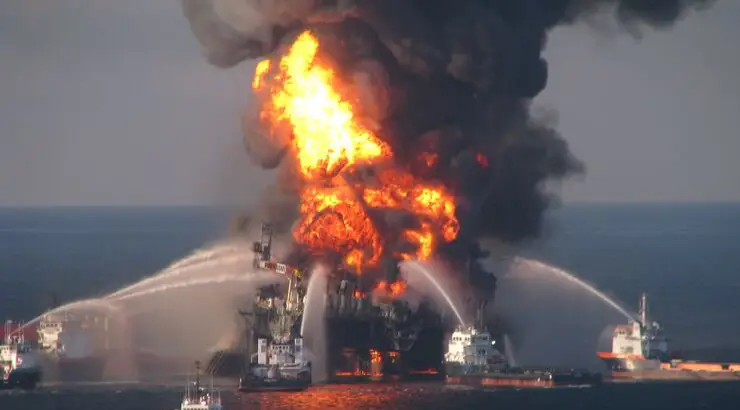
BP daagt Greenpeace voor de rechtbank

Komende
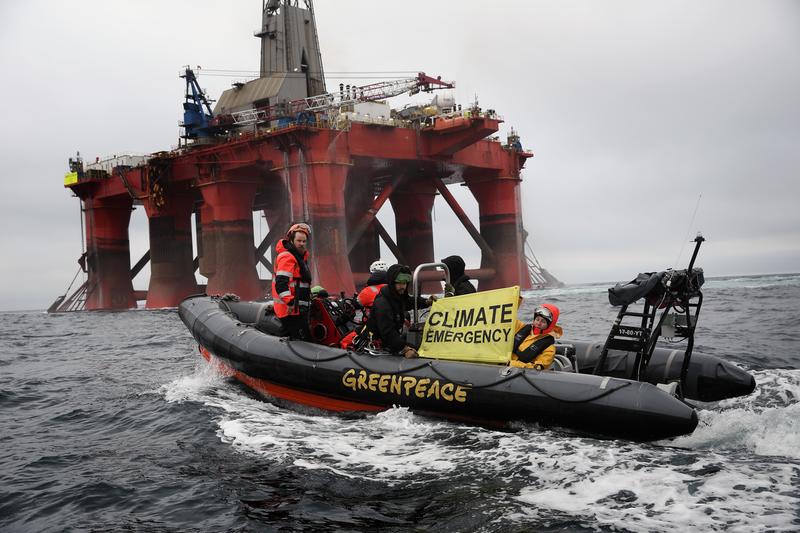
maandag staat Greenpeace voor de rechter, BP heeft een zaak
aangespannen tegen deze milieuorganisatie, dit wegens het ‘blokkeren’
van een olieplatform dat naar zee zou worden gesleept……

Alweer
de omgekeerde wereld: degenen die ons aller huis, de aarde, willen
behoeden voor vernietiging worden gedaagd terwijl de daders met
zijden handschoenen bij de arm worden genomen in hun wil Greenpeace
onderuit te halen, beter gezegd om alle burgers van goede wil op deze
kleine aarde onderuit te halen…….

Afbeeldingsresultaat voor Greenpeace houdt peperduur BP-boorplatform 11 dagen lang tegen

BP heeft
een graf gemaakt van een fiks deel van de Golf van Mexico en alsof
het de normaalste zaak van de wereld is mag dit bedrijf doorgaan met
haar vernietigende werk, waarmee ook nog eens de klimaatverandering onevenredig snel wordt aanjaagd….. Waar de gevolgen van die klimaatverandering al duizenden doden hebben geëist en een enorme schade hebben aangericht, iets waarvoor de superrijke oliemaatschappijen als BP belachelijk genoeg niet worden vervolgd…… 

Moet je nagaan, dan zijn er nog de intussen miljoenen doden die in een aantal decennia, jaren eerder zijn overleden door de luchtvervuiling met producten van o.a. BP, je zou dit zelfs massamoord kunnen noemen, voorts kan BP als Exxon en Shell al lang weten dat de verbranding van fossiele brandstoffen leidt tot de huidige klimaatverandering en de daardoor optredende weergerelateerde rampen….. (Exxon en Shell wisten dit uit eigen onderzoek al in respectievelijk de 70er en 80er jaren van de vorige eeuw…..)

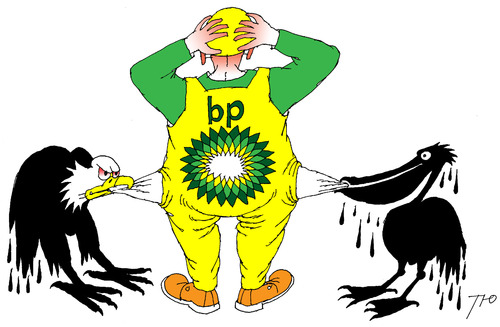
Afbeeldingsresultaat voor BP cartoon

Greenpeace
vraagt ons een video via Facebook te verspreiden, zodat zoveel
mogelijk mensen voor a.s. maandag hebben gezien waarom BP denkt
boven en onder de wet te staan, wat feitelijk bijna het geval is. In
de korte video zie je de bezetting van het platform met begeleidende Engelse tekst. Ben niet echt een fan van moloch Greenpeace, maar deze zaak mag de klimaatactiegroep niet verliezen!! (althans als de rechters nog enig ethisch en moreel besef in hun donder hebben….)

We’ve been served 

Sam
Wockner, Greenpeace

This
Monday, we’ll be in court because we stood up to one of the biggest
climate destroyers on earth – BP.

In
June last year, brave activists boarded a BP oil rig that was heading
out to sea to drill for around 30 million barrels of new oil.
[1]

Now the rig operators are taking us to court and
threatening us with huge fines and possible imprisonment.

It’s
outrageous. Instead of focusing on tackling the climate crisis (which
they played a role in creating) the oil industry is trying to scare
us off and silence us.

But the bottom line is, if we don’t
stand in their way, they’ll keep driving us towards climate
breakdown.

BP’s oil rig operators are taking us to court. Will you share this
video on Facebook and help make it clear to the oil industry that we
won’t be silenced?

Share on Facebook

Not on Facebook?
Think of a few friends who are and pass on this email. If they can
make some noise about this it’ll be thanks to you!

In order to bring us back
from the brink of climate chaos, we need governments and companies
like BP to wake up and make serious changes: like immediately
stopping plans to dig for new oil and gas.

But,
instead of making those changes, BP and their buddies are still on
the hunt for new oil that would likely drive us further into climate
breakdown.

That’s
why back in June, brave activists boarded the BP oil rig and stopped
it heading out to sea for as long as possible. 

Now
the same oil rig operators that were responsible for the Deepwater
Horizon disaster are taking us to court.

But, if they think they can silence us, they’re missing a crucial
bit of intel: this movement is bigger than anything they can throw at
it.
 

We
tried to stop a BP oil rig from drilling for new oil – now we’re
being taken to court. Can you share this video on facebook and help
it get seen by as many people as possible?
We
need to expose to the world how far the oil industry is willing to go
to stop climate action.

Share on Facebook

The
court case is set for Monday the 24th of February. I’ll be sure to
keep you updated on the outcome when it happens.

Until then,
thank you.

Sam Wockner

PS – If you want to know more
about the case or the action, you can read this blog: On
trial for challenging BP’s lust for oil in an age of climate change

[1] Why
I’m blocking a BP oil rig

================================

Zie ook:

CDA wenst geen EU ‘green deal’ en ‘klimaatambassadeur’ de Boer weet niet waar hij over spreekt‘     

Frits Böttcher een ‘klimaatsceptische wetenschapper’ die zich liet betalen door o.a. Shell, KLM en AkzoNobel‘ (en zie de links in dat bericht)

Het IEA is verworden tot een lobbyorganisatie voor de oliemaatschappijen 

Schildpad animatievideo over plastic- en olievervuiling oceanen >> door makers: Wallace and Gromit >> Greenpeace Nederland laat het alweer afweten

Greenpeace GB heeft samen met de makers van Wallace and Gromit een animatievideo met zeeschildpadden uitgebracht, hierin aandacht voor de vervuiling van de oceanen met de nadruk op de plastic- en olievervuiling. (inclusief niet te vergeten het belachelijk grote aantal gekapte visnetten en honderden kilometers aan vislijn, deze vallen overigens onder de noemer plastic…..)

Ontving gisteren de mail plus video en dacht dat Greenpeace Nederland de versie met onze taal wel klaar had staan, plus de petitie die je kan tekenen om ‘onze regering’ te pressen actie te ondernemen, maar helaas (zoals zo vaak) niets daarvan op de site van deze milieuorganisatie, al schijnt men gisteren wel de ondertitelde versie te hebben geplaatst. Via via vond ik deze op het net, echter op de site van Greenpeace NL was en is deze niet te vinden, nog wat langer gezocht en kwam er toen achter dat de ondertitelde versie van Greenpeace… België komt! 

Daar ik toch op de site van Greenpeace Nederland ‘zat’ even gekeken wat men nog meer had en zo zag ik een petitie voor de Australische regering i.v.m. met de bosbranden, waarvoor je kon tekenen, helaas de petitie is bedoeld voor Australiërs en was opgesteld in het Engels…..Australië is de grootste steenkool exporteur van de wereld, nu al wordt er 1 miljoen ton per dag geëxporteerd en als Siemens* en andere bedrijven klaar zijn met de grootste kolenterminal ter wereld, waarvoor een kanaal dwars door het Grote Barrièrerif wordt gegraven, zal deze al achterlijk grote hoeveelheid nog flink worden overtroffen…..

De regelmatige lezer van dit blog weet wel dat ik niet veel op heb met het luie Nederlandse Greenpeace en helaas ben ik ten overvloede nog eens bevestigd in mijn oordeel…… Ook leuk op de Nederlandse site: een gerecht voor de kerst…… Tja het is 16 januari 2020, helaas zit Greenpeace Nederland nog voor de kerst, vandaar ook dat men de animatievideo niet had en men geen tijd had om een petitie voor de Australische regering in het Nederlands op te stellen,…..’Logisch toch’ e.e.a. heeft natuurlijk alles te maken met de jaarlijkse drukte voor de kerst bij Greenpeace……. Ongelofelijk……

Hier de Britse versie, je hoeft niet naar de petitiepagina te gaan daar we toch niet kunnen tekenen, echter de korte video kan je starten vanaf deze pagina: 

Turtle Film

Sophie
Durant, Greenpeace via bounce.bluestatedigital.com

Right
now, only
1%
of our global oceans are protected.

Overfishing, plastic pollution, oil drilling and climate breakdown
are gutting our oceans of life and destroying delicate ecosystems.
It’s
a tragedy we need to act on before it’s too late.

That’s
why we’ve worked with a great cast of actors including Dame
Helen Mirren
and
Olivia
Colman

and the
creators
of Wallace and Gromit

to make a powerful short film about the impact reckless industries
are having on ocean life.
It
tells the heartbreaking story of a turtle family trying to get home,
in an ocean that desperately needs protection.

We need as many people as possible to know about the urgent crisis
unfolding in our oceans if we’re going to change it. Will
you take 2 minutes to watch this video and share it with your friends
and family?


WATCH AND SHARE


Not on Facebook? Check out the video here.


The plight of sea
turtles represents the suffering of our oceans as a whole. Like the
turtle family in the film, sea turtles in real life are under intense
stress from destructive industries.
Six
out of the seven sea turtle species are threatened with extinction
due to the pressures of multiple ocean threats [1].

And
it’s more than just turtles at risk. Studies
have shown marine life is disappearing at twice the speed of life on
land [2].
This
is a reality we can’t accept — and crucially we don’t have
to.
 

Scientists
have a plan that would help heal our oceans.

If we can create a vast network of sanctuaries – areas off-limit to
destructive industries – we’ll give wildlife a chance to recover
and thrive [3]. And for the first time in history, there’s a
process underway to make this possible: a UN Global Ocean Treaty.

To
secure a strong treaty, we need as many people as possible to show
the world why our oceans matter. Will
you watch and share this powerful short video to help spread the
word?

WATCH AND SHARE


Not on Facebook? Check out the video here.

It’s
a little-known fact that keeping our oceans healthy and teeming with
life is not just the right thing to do,
it’s
crucial for ensuring our survival too [4].
This
is because the vast array of amazing life in our oceans is one of our
best allies in the fight against climate breakdown.
Sea
creatures naturally capture climate-wrecking carbon and store it
away. This is why it’s so important that we give our oceans a
fighting chance.
We can change the fate of our oceans, but first we need people to
know that they’re in crisis. Will you help get the word out?

                             WATCH AND SHARE

                      Not on Facebook? Check out the video here.

Thanks
for all you do,

Sophie and the Oceans team
Greenpeace UK

Notes:
[1]
https://iucn-mtsg.org/about-turtles/
[2]
https://www.smithsonianmag.com/smart-news/ocean-dwelling-species-are-disappearing-twice-quickly-land-animals-180972040/
[3]
https://www.greenpeace.org.uk/challenges/ocean-sanctuaries/
[4]
https://www.greenpeace.org.uk/news/30×30-groundbreaking-scientific-study-maps-protect-third-worlds-oceans-2030/


====================================

* Siemens heeft de laatste jaren al een aantal keren geprobeerd zich een duurzaam imago aan te meten, maar weigert botweg het contract voor de kolenterminal op te zeggen……. Laten we producten van Siemens de komende jaren niet meer aanschaffen, boycotten dat tuig!!

Zie ook:

Australië: steenkoollobby werkt samen met de regering nog veel meer bosbranden in de hand‘ (De Australische tak van Greenpeace werkt heel wat beter dan de Nederlandse versie. Voor meer berichten over o.a. de bosbranden in Australië, klik op de links in dat bericht)

Voor meer berichten over de plasticvervuiling, diepzeemijnbouw, luchtvervuiling , waterverontreiniging, klimaattoppen, klimaatverandering enz., klik op het betreffende label, waar ik tevens de grootste onverantwoorde smeerpijpen noem, die men als oliemaatschappij aanduidt.

Krijg de opmaak niet op orde, mijn excuus.

Australië staat olieboringen toe in de Grote Australische Bocht, inclusief seismische ontploffingen

Terwijl het land zucht onder record
temperaturen en Sydney bijna geheel is omsloten door bosbranden, die het leven in
deze stad deels tot stilstand hebben gebracht, heeft de neoliberale regering
van Australië olieboringen goedgekeurd in het belangrijke
natuurgebied de Grote Australische Bocht….. Olieboringen die
gepaard gaan met seismische ontploffingen die het uiterst belangrijke
dierenleven in de kuststrook op grote schaal zal verstoren……

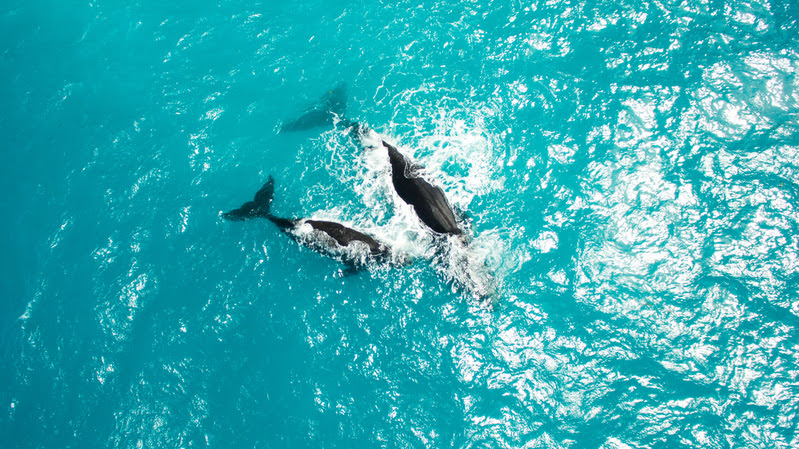
Onder andere walvissen zijn te vinden
in dit natuurgebied, waar de kalveren van deze dieren door de enorme
seismische knallen (alsof er een bom afgaat in je huis en dat om de 10 seconden) niet langer
in staat zullen zijn te communiceren met hun moeder die zich in de
buurt ophoudt….. Uiteraard zal dit het hele onderwaterleven in de
Bocht verstoren en deels vernietigen, zo is bekend dat plankton op grote schaal sterft door deze ontploffingen…… Onderwaterleven dat zo belangrijk is ook voor de
prooidieren die hier op af komen, zoals
zeehonden…..

Hoe is het mogelijk dat een regering zo
blind is dat het dit soort zaken toestaat, in 2016 maakte de
Australische regering bekend dat het Grote Barrièrerif een
extra beschermde status wil geven, echter nadat diezelfde regering
toestemming gaf om de grootste kolenhaven ter wereld te bouwen, pal
voor dat rif, waarvoor een kanaal t.b.v. zeeschepen dwars door het
rif wordt aangelegd….. Steenkool dat door Australië en de VS massaal tegen
dumpprijzen op de wereldmarkt wordt verkocht…. Niet voor niets ook
dat in Nederland al jaren alle gascentrales zijn uitgeschakeld en de
kolencentrales op volle toeren draaien……. Nogmaals: en dat in en door Australië
dat ongemeen hard wordt getroffen door de klimaatverandering….

Onbegrijpelijk dat het Australische
volk deze totaal onverantwoorde regering blijft steunen…….

Het volgende artikel en vraag om geld
komt van de Australische tak van Greenpeace:

BREAKING:
Equinor has just been approved by the Federal regulator to drill in
the Great Australian Bight. 

A
whale sanctuary destroyed. A habitat containing 85% unique species
decimated. Australia’s coastlines at risk.
 

Not
if we can help it. We must act now.

Image

For
whales and other marine mammals, life is a symphony of sound. They
use sound to find food, mates, evade predators and generally navigate
the vast ocean. 

 Donate

Today!


The
relationship a whale calf has with its mother is particularly
special. Just like any other species the young rely on their mother’s
protection and direction to navigate the wild.

What’s
unique about whales is how they achieve this in such dark oceans with
no sight. In a recent study from Aarhus University, Denmark
(conducted in the Great Australian Bight) found that whale calves
will “whisper” to their Mother. This helps them stay close, stay
safe as they can’t be overheard by any predators.

“We
discovered that the calves don’t make a lot of noise—they use
very short and weak sounds. We think that it’s because they only
intend for their mother to hear them,”

-Simone
Videsen, research assistant at Aarhus University.

So
what would happen if a mother could not hear her young? When a family
of whales rely on noise to eat, speak, protect each other.

Oil
drilling does not need drills to be fatal to marine life. 


The
noise of seismic blasting has been compared to a bomb repeatedly
going off in their home every 10 seconds—a home they can’t flee.
It’s not just whales that are affected; for fish, seismic blasting
can be deadly, resulting in deafness. Even shellfish, like lobsters
and scallops have their immune systems suppressed as a result of
this. These blasts have been shown to cause massive mortality in
plankton, the tiny organisms that form the base of all marine food
chains.


Seismic
blasting happens before oil drilling even commences. It happens at
the research stage. With equinor’s drilling approved, we are only
weeks away from this being a reality. That’s why we need
your help today!

 Become a

Regular Giver!

Image

Drone
footage of Bunda Cliffs in the Great Australian Bight. It is a
globally significant whale nursery, home to one of only two southern
right whale calving grounds in the world, and a feeding area for blue
whales, humpback whales, orcas and sea lions.

It
breaks my heart to think oil drilling could take place in one of the
largest whale sanctuaries in the world. Oil drilling must be stopped
in the Bight, in Australia.


It’s
amazing to think that it very easily can get worse. But all it takes
is a spill. A spill means utter devastation. 9 years on from
Deepwater Horizon, the world’s most infamous oil spill, has
anything regenerated?

As
one scientist recorded:

“what we observed was a homogenous wasteland, in great contrast to
the rich heterogeneity of life seen in a healthy deep sea. Crabs
showed clearly visible physical abnormalities … Once these
crustaceans reach the site, they may become too unhealthy to leave.”


And
for what? Fossil fuels, a depleting resource that damages the planet
and provokes extreme weather events.  


I
don’t want to believe this is happening in Australia. It is
deplorable to me that while our country is being ravaged by bushfires
that the RFS and Bureau of Meteorology have linked to man made
climate change. Our government has approved oil drilling for more
fossil fuel. We must act now. 

 Donate

Today!


As
one of our supporters, you are likely aware that Greenpeace has a
history of protecting oceans and saving whales. It’s what we do.
You may not be aware that Greenpeace began in 1971 when a group of 8
protesters sailed into the Aleutian Islands of Alaska to force the US
army to call off nuclear weapons testing in that area.

You
might be asking yourself, ‘this is awful, but can Equinor really be
stopped?’

In the past Greenpeace has infiltrated nuclear test sites, shielded
whales from harpoons, protected fur seals from clubs and blocked
ocean-going barges from dumping radioactive waste. We have also
kicked 2 oil companies out of the Bight already and look forward to
having your support to kick out another one. 

Donate today, help save the whales, end oil drilling and stop seismic
blasting in the Bight.

I
want to thank you so much for your continued support in the past. As
you probably know, Greenpeace is a fully independent entity meaning
that we do not accept donations from governments, organisations or
other large bodies. This is what makes us incorruptible and truly a
voice of the people. People like you who understand how deadly oil is
to the planet.


Thank
you for everything you do,

Tom 

P.S
Seismic blasting and oil drilling for more fossil fuel. With your
help, we can, we will, we must stop oil drilling in the Bight. 


Sources: 

https://sciencenordic.com/animals–plants-denmark-videnskabdk/hear-a-whale-calf-speak-to-its-mother/1445261https://www.smithsonianmag.com/smart-news/deepwater-horizon-site-wasteland-populated-sickly-crabs-180973181/

======================================

Zie ook:

Oliemaatschappijen in Australië maken misbruik van de Coronacrisis om hun smerige wereldvernietigende agenda door te drukken

Australische autoriteit geeft toestemming voor dumpen van 1 miljoen ton giftig havenslib in Groot Barrièrerif (Werelderfgoed)‘ 

Scott
Morrison (premier Australië) moest bezoek aan door bosbrand getroffen
gebied afbreken en vertrok met de staart tussen de benen

Australië: film ‘Dirty Power: Burnt Country’ maakt gehakt van regeringsbeleid en media misinformatie

Australië
staat in brand terwijl de regering milieuactivisten straft voor het
zich uitspreken tegen de oorzaken van de klimaatverandering

Filipijnen geen orkaanseizoen, maar het jaarrond tropische cyclonen

BP stelt in milieuplan dat een olieramp op zee goed is voor de lokale economie……….

Australië slaat alarm over koraalriffen…….. AUW!!!

Australië geeft toestemming tot uitbaten enorm grote kolenmijn

Redt het Groot Barrièrerif, zet uw handtekening a.u.b.!

Het Groot Barrièrerif, dreigt te worden gesloopt voor een grote kolenhaven……..

Australië heeft VN gedwongen een passage uit een klimaatrapportage te verwijderen………..

Leard Forest: grootste kolenmijn ooit dreigt gerealiseerd te worden in dit vele duizenden jaren oude Australisch bos……… 

Australië exporteert dagelijks één miljoen ton steenkool, dit i.h.k.v. de klimaatverandering en de afgelopen klimaattop……..‘ (daar wordt jaarlijks nog eens 10 miljoen ton aan toegevoegd….)

Coca-Cola betaalt wetenschappers om haar producten te promoten en voor weerleggen kritiek……

Shell, ExxonMobil en andere oliemaatschappijen gaan 180 miljard dollar investeren in plasticproductie………

Bas Heijne weet, geenszins ‘onbehagelijk’, niet wat te denken van de klimaatverandering……. OEI!!!

ExxonMobil vervolgd voor ‘misleiding…’ Nou zeg maar het op grote schaal bedonderen van de kluit!!

Shell was al in 1989 overtuigd van klimaatverandering………….

Exxon lobbyist (politicus) dagvaardt milieugroepen voor kennis bij Exxon over klimaatverandering…….

Mijn excuus, het is tegenwoordiug blijkbaar hip om gepersonaliseerde oproepen te versturen, dus telkens met herhaling van je voornaam, dacht dat is ze allemaal had verwijderd, maar helaas, bij deze hersteld. (14.50 u.)

Deepwater Horizon heeft een apocalyptisch onderwaterlandschap nagelaten met misvormde dieren

Het is
bijna 10 jaar geleden (20 april 2010) dat de ramp met het Deepwater Horizon
olieplatform plaatsvond, de reden voor
Louisiana
University Marine Consortium (LUMCON)

een onderzoek te doen naar de omstandigheden op de bodem van een groot
gebied in de Golf van Mexico, rond de plek waar deze olieramp plaatsvond en beste bezoeker de bevindingen zijn
niet mis….

Onderwatercamera’s
tonen een dor landschap, of beter nog een geasfalteerd gebied, waar
alleen nog misvormde zeedieren als krabben e.d. zijn te zien, misvormd veelal
door het ontbreken van ledematen…..

BP heeft vele miljarden besteed aan het opruimen van de troep aan land en voor het
schadeloosstellen van vissers*, echter als je de bevindingen in het
hieronder opgenomen artikel van The Mind Unleashed leest, kan je
zelfs met nog eens 100 miljard de boel onderwater niet schoonmaken, ofwel de door BP betaalde schadevergoeding is een
lachertje…….

En dan probeert smeerpijp BP zich voor te doen als duurzaam bedrijf….** ha! ha! ha! ha! ha! ha! ha! ha!

Lees het
volgende artikel dat werd geschreven door Elias Marat en zegt het
voort, elke oliewinning in (diep-) zee of arctisch gebied dient
gestopt te worden, daar een ramp als die met Deepwater Horizon zo
weer kan gebeuren, waarna de schade niet of nauwelijks is te herstellen, zo blijkt eens te meer in de Golf van Mexico:

ANIMALS
ENVIRONMENT
NEWSSEP
25, 2019 AT 2:39 PM.

Deepwater
Horizon Spill Created Horrific Mutant Creatures in the Gulf of Mexico

The
Deepwater Horizon spill has turned the Gulf of Mexico into an
apocalyptic wasteland.

Elias Marat

Deepwater Horizon

(TMU) — As
the 10-year anniversary of the horrific Deepwater Horizon oil spill
approaches, the area’s ocean floor 
has
been transformed
 into
a fetid wasteland coated in tar and populated by handfuls of
deformed, tumor-ridden crustaceans.

The
explosion on a BP oil platform in the Gulf of Mexico on April 20,
2010, was one of the most
 catastrophic
disasters
 to
hit the ocean in human history, with the U.S. government estimating
that 4.9 million barrels (210 million gallons) were discharged across
hundreds of square miles.

But new
video footage
 from
a 2017 expedition has confirmed the worst fears regarding the
catastrophic spill, showing that the Gulf is not only still reeling
from the disaster but may have been rendered a permanent dead zone.

The
footage was captured by a camera-mounted remotely operated vehicle
(ROV) operated by a team at the Louisiana University Marine
Consortium, or LUMCON. 
Their
findings
 on
the apocalyptic ruin lying extant across the once-thriving deep sea
was recently published in the journal 
Royal
Society Open Science.

When
marine researcher Clifton Nunnally first saw the footage uncovered by
the ROV, he was blown away by the horrors that he witnessed.

As Atlas
Obscura 
reports:

“’Nothing
prepared us for what we saw,’ [Clifton said.] … a slick black
wasteland, empty of all its usual denizens, such as sea cucumbers and
giant isopods. Instead, the area had been taken over by strange crabs
and shrimp, either tumor-ridden or eerily languid, as if sleepwalking
across the seafloor. The typically white marine snow—detritus that
had drifted down from organisms living above—was jet black and
clumped up. It was clear that the site was toxic, and maybe
irrevocably marred.”

While
the area had previously been known for its rich biodiversity, the
zone surrounding the Deepwater Horizon site was devoid of such
features as sea anemones, sponges and corals typical of that part of
the deep sea.

UGA

@universityofga

“It was like visiting a graveyard. There were even slimey “webs” at the seabed that looked like cobwebs. It was the only time I’ve been in a submarine along the seabed and found myself sad and dreading what was coming next.”- UGA’s @SeepExplorer https://www.atlasobscura.com/articles/deepwater-horizon-oil-spill-aftermath 


How the Deepwater Horizon Disaster Created an Abyssal Wasteland

A nightmare at 6,000 feet.

atlasobscura.com


19

8:00 PM – Sep 25, 2019

Twitter Ads info and privacy

Instead,
they found some shrimp and a number of deformed, mutated crabs with
shells blackened by oil, covered in parasites. In many cases, limbs
and claws were shriveled or entirely missing.

Nunnally
said:

Everywhere
there were crabs just kicking up black plumes of mud, laden with oil
… There were deformities, but mostly things were missing.”

LUMCON
executive director Craig McClain 
told CBC that
his team suspects that as the oil decomposes, it’s likely mimicking
a sex hormone that lures crabs to the sites—a common occurrence at
other oil spills that attract lobsters.

The
researchers compare the area to the La Brea Tar Pits. When the crabs
do manage to find a mate, everything goes downhill from there—they
end up mired in toxic detritus from the oil spill which coats their
shells, preventing them from molting and ridding themselves of
parasites that are naturally accumulated.

The
scientists were shaken to their core by the experience. McClain
explained:

The
prior week, we had done dives across the Gulf of Mexico and saw, you
know, glass sponges and squids and fish and whip corals and
giant isopods, one of my favorite deep sea animals.

It
was the equivalent of walking around in a tropical rainforest and the
next day walking around on a cement parking lot.”

And
while the dire state of the Gulf demands further attention, McClain
worries that nobody is paying attention. And LUMCON, which conducted
its research with its own funds, can’t even afford further
expeditions.

McClain
said:

I’m
concerned that there’s not been an increased effort in and
continued monitoring of the recovery or the lack of recovery at the
site.

We
can’t begin to know what restoration of the deep sea looks like
until we actually get a handle of how fast it’s recovering in the
first place.”

By Elias
Marat
 | Creative
Commons
 | TheMindUnleashed.com

================================================

Ook op zee is BP bezig geweest met kapitalen aan chemicaliën om de olie op te laten lossen, dat gaf extra vervuiling en heeft niets uitgehaald, zoals nu is aangetoond……. 


** Zie: ‘BP launches biggest global campaign in a decade‘ (Greenpeace is in Groot-Brittannië onlangs een petitie gestart tegen deze zwaar misleidende campagne, helaas kunnen wij deze niet tekenen)

Waarschuwing voor Britse regering: diepzeemijnbouw van grondstoffen kan uitsterven unieke soorten teweegbrengen

Alsof
de mens de wereld nog niet genoeg naar de knoppen heeft geholpen en
nog steeds helpt, kwam ik het hieronder opgenomen artikel tegen,
waarin op het gevaar van ‘deep sea mining’ (diepzeemijnbouw) wordt gewezen,
bijzonder soorten die daardoor dreigen uit te sterven, soorten die veelal onder aan de
voedselketen staan, maar daarom niet minder belangrijk zijn voor het
totale ecosysteem van oceanen. (zo zijn een paar walvissoorten echte diepzeeduikers)

Zoals
je wellicht weet, elke manier van delving, of dat nu door graven
gebeurt, door mijnbouw, dan wel middels olie en gaswinning, brengt
vervuiling met zich mee, in de goudwinning is het gevaarlijkst
gebruikt middel zelfs kwik, wat al jaren te vinden is in Surinaamse
rivieren…….

Uiteraard
hoe dieper hoe moeilijker en gevaarlijker diverse soorten van delving
zijn, of je het nu over mijnbouw hebt zoals we die kennen, met alle
gevaren voor de arbeiders (kompels) van dien, of over diepzeeboringen
waar het zeeleven het slachtoffer is…..

De
gevaren die kleven aan het boren in diepzeeën, of op welke andere
manier dan ook delven van grondstoffen is vooral een gevaar voor de
bestaande bijzondere dieren (die we veelal niet eens kennen…) en de
dieren die daarvan afhankelijk zijn en vervolgens de dieren die daarvan weer verantwoordelijk zijn (enz.)….. Neem de ramp in de Golf van Mexico met het door BP gebruikte Deepwater Horizon platform (de naam alleen al….) Nog steeds is in
het grootste deel van het besmette gebied een visverbod van kracht en veel gedupeerden
wachten nog steeds op een fatsoenlijke vergoeding…….

Onbegrijpelijk
dat GB samenwerkt met wapenfabrikant Lockheed Martin voor het delven
van grondstoffen onder oceanen en zeeën…… Alsof Lockheed Martin
als wapenfabrikant niet al één van de grote verantwoordelijken is
voor het om zeep helpen van ons klimaat en het vervuilen van lucht,
bodem, grond- en oppervlaktewater, dit nog naast het vermoorden van miljoenen
mensen in de illegale oorlogen die de VS met haar oorlogshond NAVO
voert in landen waar de VS noch andere NAVO-lidstaten ook maar iets
te zoeken hebben……

Het
volgende artikel komt van GreenPeace (Unearthed):

UK
government warned deep sea mining could cause ‘potential extinction
of unique species’, documents reveal

The
UK’s joint project with American military firm Lockheed Martin is
the largest in the world but poses risks to deep sea ecosystems
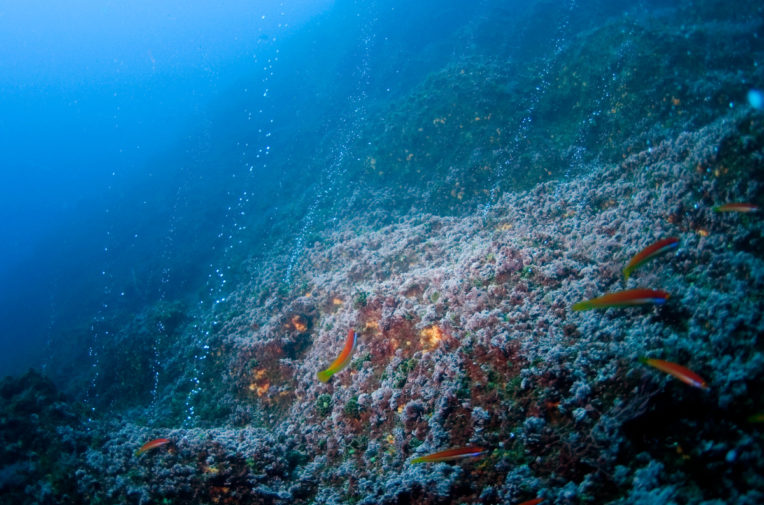
Afbeeldingsresultaat voor Here is a map of all the deep sea mining licenses held, and which country and company holds them (data: ISA)

Hydrothermal
vents at Dom João De Castro in the central north Atlantic Ocean
(2006) Photo: Greenpeace, Gavin Newman.

Deep
sea mining could lead to “the potential extinction of unique
species which form the first rung of the food chain,” according to
a report commissioned by an arm of the British government.

The
Subsea Mining Capability Statement’ – obtained by Unearthed using
freedom of information rules – was produced by the National Subsea
Research Initiative in 2017 and circulated amongst the UK
government’s deep sea mining working group at key stakeholder
meetings.

The
British government has licenses for exploratory mining of
polymetallic nodules in the Pacific Ocean as part of a joint venture
with UK Seabed Resources, a subsidiary of US defence firm Lockheed
Martin.

The
statement’s environmental warnings echo those heard from the
scientific community, many of whom fed into the UK parliament’s
‘sustainable seas’ inquiry which 
concludeddeep
sea mining “would have catastrophic impacts on the seafloor site
and its inhabitants.”

What
is deep sea mining?

The
process of gathering the minerals that lie atthe bottom of the
ocean 
whichincludes
cobalt, a key ingredient in the batteries that power smartphones,
laptops and electric cars – by deploying massive remote controlled
vehicles to hoover up mineral deposits from the seabed floor

It
comes as many in the scientific community 
have
been sounding the alarm
 over
the risks posed by deep sea mining, though some cautioned that not
enough is yet known to justify the claim about the extinction of key
species in the capability statement. That, in turn, has led to calls
for further research.  

Kerry
McCarthy, a Labour MP who sits on the Environmental Audit Committee,
told Unearthed: “As the fragility of our planet and its
ecosystems becomes starkly more apparent, it’s difficult to believe
the Government is continuing to promote deep-sea mining in the full
knowledge it could pose risks to unique species that are integral to
the food chain.”

David
Rennie, head of Oil and Gas at Scottish Enterprise, the government
agency that commissioned the Subsea capability statement,
told Unearthed: “This report was commissioned to
highlight the market potential in a range of sectors such as
aquaculture and marine renewables, that Scotland’s subsea
capability could be appropriate for in future market activity. 
We regularly undertake research into markets to understand the
potential these may have for Scotland’s businesses and economy.

As
yet we have not made any decisions, or progressed any activity, on
how we might develop seabed mining. Other sectors such as marine
renewables and aquaculture are likely to offer more immediate
opportunities and any significant developments in seabed mining are
likely to be some years off.”

A
UK government spokesperson said: “The UK continues to press
for the highest international environmental standards, including on
deep sea mineral extraction. We have sponsored two exploration
licences, which allows scientific marine research to fully understand
the effects of deep sea mining and we will not issue a single
exploitation licence without a full assessment of the environmental
impact.”

Here
is the industry report commissioned by the government agency Scottish
Enterprise:

Afbeeldingsresultaat voor pdf UK subsea mining capability statement NSRI

(zie pdf NSRI)

The
distant ocean


Deep
sea mining has yet to start commercially anywhere in the world, but
environmental concerns are based – in part – on the scale of the
projects under consideration, with the UK set to play a leading role
in the industry. 

Mining
exploration licenses have been distributed to 22 projects by the
International Seabed Authority (ISA), the intergovernmental body
responsible for regulating resource extraction in the high seas. Each
of the licenses must be sponsored by a national government. 

The
territories licensed – spanning the polymetallic nodules south of
Hawaii and the cobalt-rich crusts in the Asian Pacific region to the
sulphide deposits around the Atlantic Ocean’s Lost City and even
more nodules in the Indian Ocean – total an area twice the size of
Ukraine.

An Unearthed analysis
of ISA data shows the UK’s venture with Lockheed Martin is the
single biggest project in the world, covering an expanse off Mexico
larger than England itself.

The
Chinese government, which holds 263 licenses with 2 different
companies, controls the most territory, with the UK government at
number 2. The country is reportedly leading efforts to agree on a 
law
allowing mining by 2020

The
United States does not hold licenses since it has not yet ratified
the Law of the Sea Convention (1994) and is thus not a member of the
ISA.
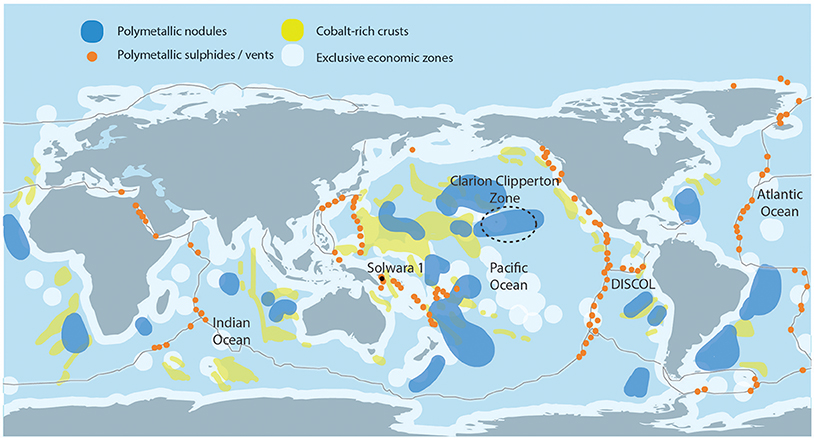
Afbeeldingsresultaat voor Here is a map of all the deep sea mining licenses held, and which country and company holds them (data: ISA)

(de in het origineel opgenomen afbeelding vind ik onduidelijk, vandaar deze)

Environmental
fears

Deep
sea mining at this scale has prompted serious concerns from
scientists who warn that far too little is known about the habitats
it will disrupt. Many are calling for a years-long moratorium whilst
research takes place.  

Rachel
Mills, Professor of Ocean Chemistry at the University of Southampton,
told Unearthed: “We have been interested in mining deep
sea floor since the 1970’s and scientists have long argued that
small scale experiments should be carried out to understand the
impacts of potential extraction techniques.

What
we know is that long after these experiments were conducted, the
seafloor is still scarred, and devoid of the hard nodule substrate
required to support the seafloor communities.  What we don’t
know is what impact this has on the deepest abyssal plains on the
vast ocean floor.”

Though
she said some scientists believe there is already requisite
information to begin mining, Professor Mills called on government to
“abide by the precautionary principle,” arguing that “we are a
long way off from knowing how to conduct adequate and comprehensive
environmental impact assessments.”

If
there’s one thing we’ve learned from mining on land it’s that
you need to know about the environmental impact on different scales
and over time, and we just don’t know enough yet.”

Jessica
Battle, who works on ocean governance for environmental group WWF,
made a similar call for an extended moratorium on deep sea mining
until we better understand what impact it could have.

Scientific
understanding of the ecosystems in the deep sea is still in its
infancy, so much could be destroyed before we even know what’s down
there, or the benefits that these fragile ecosystems provide to the
planet and humanity. We certainly do not think that the case has been
made for seabed mining to progress. We urge all actors involved in
consideration of this form of exploitation to hold back and allow the
science and conservation of these ecosystems to catch up.”

These
concerns are well-known to the officials who lead the ISA, including
its secretary general Michael Lodge, who 
wrote
in 2013
 that
some “ecosystems may never recover” from deep sea mining
activity.

==================================

Overigens ook Nederland houdt zich bezig met onderzoek naar diepzeemijnbouw…….

BP stelt in milieuplan dat een olieramp op zee goed is voor de lokale economie……….

Ja hoor, het was weer zover beste bezoeker: toen ik
het hieronder opgenomen artikel onder ogen kreeg vloog de koffie met een noodsnelheid tegen het raam, dit daar ik me danig
verslikte bij het lezen van de kop…..

British Petroleum, ofwel BP had het gore
lef om bij een bod voor een boorvergunning in een gebied
voor de Australische zuidkust: de Grote Australische Bocht, in feite
een groot zeereservaat, een milieuplan toe te voegen, waarin valt te
lezen hoe men bij BP denkt over een olieramp (zoals bijvoorbeeld die in de
Golf van Mexico, veroorzaakt door BP, een aantal jaren geleden).

In dat plan stond o.a. te lezen dat een
olieramp (die uiteraard niet zo werd genoemd) goed is voor de lokale
economie van het getroffen gebied…. Voorts zou de bevolking geen
probleem hebben met een dergelijke ramp, wat men weergaf met de
woorden ‘sociaal acceptabel….’ Ook aandeelhouders zouden er geen
probleem mee hebben, dat laatste is dan tegelijk een enorme open deur
intrappen, immers aandeelhouders hebben maar één doel: zoveel
mogelijk verdienen en als de aarde daarvoor opgeofferd
moet worden, het zij zo……… Voor dat laatste is bewijs te over……

Hoe durft BP dergelijke zaken alleen al
te denken, laat staan ze pontificaal als een ‘mooie bijkomstigheid’ voor een enorme
milieuramp in de openbaarheid te brengen………. Alsof de dieren die getroffen worden niet meer tellen, bovendien wordt daarmee het toerisme (veelal ook groot in kustgebieden) voor jaren de nek omgedraaid…….

De hoogste tijd dat oliemaatschapppijen
worden aangeklaagd voor hun enorme aandeel in de klimaatverandering,
die men daar godbetert nog durft te ontkennen, terwijl uit eigen
onderzoek (teruggaand tot de 70er jaren van de vorige eeuw) blijkt
dat de verbranding van fossiele brandstoffen inderdaad de
klimaatverandering verooorzaakt…….

Oliemaatschappijen zouden na een giga
boete verplicht moeten worden jaarlijks een fiks deel van de winst af
te staan om de gevolgen van de klimaatverandering nog enigszins te
herstellen en met dat geld proberen de klimaatverandering een beetje af te remmen, wat dat laatste betreft: dat is het enige wat de mens nog kan doen (maatregelen om de klimaatverandering af te remmen: bijvoorbeeld door het bekostigen van
warmtepompsystemen, waterstofontwikkeling, windmolens en
zonnepanelen…)

‘Economische kansen’ door een vreselijke olieramp, veroorzaakt door BP……. Jezus wat een geteisem!! (moet je eens
zien, de enorme bedragen die worden betaald aan de top van die
bedrijven, die maar met één ding bezig zijn, de aarde zo snel
mogelijk om zeep helpen…..)…

BP
Claims Oil Spills Are “Socially Acceptable” and “Boost” Local
Economies

April
18, 2018 at 7:42 am

Written
by 
Truth
In Media

(TIM) — British
Petroleum, better known as BP, sought to convince the National
Offshore Petroleum Safety and Environmental Management Authority
(NOPSEMA) of Australia that a potential oil spill off the country’s
coast 
would
provide
 “a
welcome boost to local economies.” BP made the claim in 2016 in an
environmental plan written to convince NOPSEMA to approve the
company’s bid to drill for oil in the Great Australian Bight, a
pristine region along Australia’s southern coast.

BP
has a troublesome record when it comes to oil spills, having been
responsible for the 2010 Deepwater Horizon spill in the Gulf of
Mexico, the 
largest
marine oil spill
 in
history. The disaster, which leaked 3 million barrels of crude oil
into the surrounding environment, 
created numerous
“dead zones” – or marine areas devoid of oxygen and thus life –
and also 
devastated local
economies, some of which are still struggling to recover.

The
documents, 
obtained
by
 the
London-based website 
Climate
Home News
 through
freedom of information laws, claim that the “increased activity”
that results from oil spill cleanup operations would jump-start local
economies. It further claimed that such environmental disasters were
“socially acceptable” and did not present “unresolved
stakeholder concerns.”

As
an environmental regulator, NOPSEMA 
did
not agree
 with
BP’s rosy picture of the aftermath of a major oil spill, citing the
impact that such a spill would have on the region’s ecosystems,
which are home to many important species and are a key driver for
regional tourism. It also raised concern that the sounds generated by
drilling activity in the area could present a danger to whales and
dolphins.

NOPSEMA
also noted that BP failed to consider several likely ecological
effects of its drilling plan and did not provide a realistic plan of
how the company would respond to an oil spill in the area.
NOPSEMA 
rejected the
2016 plan drafted by BP, and it was the second time NOPSEMA had
rejected a previous environmental safety plan written by BP in 2015.

BP,
when contacted for comment regarding its apparent lack of concern
over oil spills, asserted that the correspondence does not “represent
the final views of BP” and also noted that BP had abandoned its bid
to drill in the area after citing “better options” for investment
elsewhere.

However,
Statoil – a Norway-based oil company – took over BP’s plans for
oil exploration in the area. Statoil has yet to submit an
environmental plan to NOPSEMA. Given the backlash BP has received
over its environmental plan, Statoil’s version is unlikely to argue
that oil spills improve local economies and are considered socially
acceptable by the general public.

By Whitney
Webb
 /
Republished with permission / 
TruthInMedia.com / Report
a typo

============================================

Zie ook: 

Scott
Morrison (premier Australië) moest bezoek aan door bosbrand getroffen
gebied afbreken en vertrok met de staart tussen de benen

Australië
staat in brand terwijl de regering milieuactivisten straft voor het
zich uitspreken tegen de oorzaken van de klimaatverandering

Filipijnen geen orkaanseizoen, maar het jaarrond tropische cyclonen

Australië staat olieboringen toe in de Grote Australische Bocht, inclusief seismische ontploffingen

Australië slaat alarm over koraalriffen…….. AUW!!!

Leard Forest: grootste kolenmijn ooit dreigt gerealiseerd te worden in dit vele duizenden jaren oude Australisch bos……… 

Het Groot Barrièrerif, dreigt te worden gesloopt voor een grote kolenhaven……..

Australië exporteert dagelijks één miljoen ton steenkool, dit i.h.k.v. de klimaatverandering en de afgelopen klimaattop……..‘ (daar wordt jaarlijks nog eens 10 miljoen ton aan toegevoegd….)

Coca-Cola betaalt wetenschappers om haar producten te promoten en voor weerleggen kritiek……

Shell, ExxonMobil en andere oliemaatschappijen gaan 180 miljard dollar investeren in plasticproductie………

Bas Heijne weet, geenszins ‘onbehagelijk’, niet wat te denken van de klimaatverandering……. OEI!!!

ExxonMobil vervolgd voor ‘misleiding…’ Nou zeg maar het op grote schaal bedonderen van de kluit!!

Shell was al in 1989 overtuigd van klimaatverandering………….

Exxon lobbyist (politicus) dagvaardt milieugroepen voor kennis bij Exxon over klimaatverandering…….

BP doet het weer: olieboringen nabij een kwetsbaar zeegebied, wat maakt ‘t tenslotte uit als je een mooi rif grondig vernielt?

Ontving eergisteren een bericht van Greenpeace (GB), waarin wordt gemeld dat BP van zins is te gaan boren naar olie in de monding van de Amazonerivier (Brazilië). Dit dicht in de buurt van een nog niet lang geleden ontdekt rif, waar o.a. 60 soorten zeesponzen zijn te vinden.

In
het koraalrif ontdekten wetenschappers talloze kleurrijke
koraalsoorten, 60 soorten sponzen, 73 vissoorten, kreeftachtigen en
zeesterren.

De kans dat er iets mis zou gaan in de Golf van Mexico werd door BP verwaarloosbaar geacht en toch werd daar onder verantwoording van BP een gigantische olieramp veroorzaakt, die het ook daar kwetsbare gebied voor een groot deel heeft vernield en voor tientallen jaren zwaar heeft vervuild……..

De
olieboringen vormen een gevaar voor de zeedieren die leven in de
monding van de Amazone. De bedreigde zeekoe is één van hen.


Greenpeace vraagt een video van Sponge Bob zoveel mogelijk te verspreiden, Greenpeace heeft die video toegevoegd aan haar verontrustende bericht. Voorts kan u een petitie tekenen, lees deze en teken a.u.b., geeft ook dat door!!

Overigens, ook Total is van plan te gaan boren in hetzelfde gebied……

BP
are at it again.

The
company that 
devastated
the Gulf of Mexico
 with
its Deepwater Horizon disaster wants to drill for oil near the
pristine Amazon Reef. 
What
could possibly go wrong?

Home
to pink corals, sunset-coloured fish and over 60 species of sea
sponge, the Reef has been described as 
an
‘underwater rainforest’ near the mouth of the Amazon River
 
and we’re only just discovering how special it is.

But
if BP’s extreme drilling causes a spill, it could spell disaster
for the Reef and the wider area. We can’t let this happen.

So
starting today, 
we’re
turning up the pressure on BP
 
working together to defend the Reef from risky, spill-prone oil
drilling.

And
now we’ve got some help from an unlikely source. 
The
Amazon Reef has a new champion
 
a celebrity advocate who’ll stand up to BP and fight for
justice.

His
name? 
Spongebob
Squarepants.


Watch + share the video

Why
SpongeBob?

As
a coral reef resident, SpongeBob knows all about caring for our
oceans – and he’s got 
plenty
of campaigning experience
 too.
And with over 60 species of sea sponge living on the Amazon Reef, for
him this is personal.

So check
out the video
 and
share it far and wide. 
It’s
a fun way to introduce new people to the campaign, and definitely not
your usual Greenpeace message!

Want
to be a part of it? 
Sign the petition to get started. (U komt op de Nederlandse Greenpeace webpagina, mijn excuus, zag pas later dat Greenpeace Nederland dezelfde petitie is begonnen. Zoals gewoonlijk is de Nederlandse manier van campagne voeren weer een slap aftreksel  van de Engelse Greenpeace campagne*)


For Sharing: Not
a Facebook user? No problem – we’re on Youtube
too! 
https://secure.greenpeace.org.uk/spongebob-video-youtube

But
the video is just the start.
 Over
the next few weeks, we’ll work together to expose BP’s reckless
drilling plan, and 
put
pressure on them to leave the Amazon Reef in peace.
 And
if you haven’t already, you can share your own campaign
ideas 
here.

Until
next time,
Mal

* Hier de link naar de Nederlandse campagne.

Boycot BP en Total benzinestations!

Mathijs van Ledden (Royal Haskoning) over Katrina en nog wat ‘leuk’ feitenmateriaal…..

Afgelopen vrijdagmorgen voor en na 10.30 u. bij BNR, Mathijs van Ledden van Royal Haskoning, die sprak over orkaan Katrina. Katrina, de orkaan  zo’n grote ravage aanrichtte in Louisiana en in New Orleans in het bijzonder. Ik hoorde voornamelijk het deel na 10.30 u. Volgens van Ledden was er in New Orleans gebrek aan geld en waren de dijken ronduit slecht, waar er op sommige plekken niet eens sprake was van een dijk…….. Dat is waar en er valt niets tegen in te brengen, zou je denken. Toevallig las ik afgelopen woensdag op het blog van Stan van Houcke, een artikel over orkaan Katrina van Greg Palast (inclusief een gratis download voor een film van Palast, over die orkaan)*. Daarin werd gesproken over natuurlijke barrières voor de kust van New Orleans, die in de loop van de tijd zijn gesloopt door Chevron, vanwege olie/gaswinning……. Waar ik wat betreft de dijken overigens aan toe moet voegen, dat de hele infrastructuur in de VS, kloten van de bok is, neem het wegennet en de bruggen viaducten daarin, alleen de privé wegen (tolwegen) zijn goed berijdbaar……..

Uiteraard vertelde van Ledden dat er niet bij, veronderstel dat de autoriteiten van New Orleans dat zouden horen, dat zou van Ledden’s bedrijf zomaar een schop onder de reet kunnen bezorgen. Van Ledden vertelde dat Royal Haskoning al heel lang werkzaam is voor de overheid van New Orleans, om de ‘kustverdediging’ tegen natuurgeweld daar te verbeteren……. Bovendien is het niet ondenkbaar, dat Chevron in de toekomst aan de klantenkring van Royal Haskoning wordt toegevoegd.

En dan gebrek aan geld??? ha! ha! ha! ha! ha! ha! ha! Kijk even wat de federale overheid daar aan geld uitgeeft voor defensie, dat is meer dan het dubbele dat Rusland en China samen uitgeven!!! Dat is nog buiten alle uiterst desastreuze buitenlandse ‘avonturen’  van de VS, neem de illegale oorlog tegen Irak, die honderden miljarden dollars heeft gekost en naast meer dan 1 miljoen doden, één grote chaos heeft opgeleverd, inclusief het ontstaan van IS (= ISIS)……. Trouwens dat geld voor defensie wordt uitgegeven, zogenaamd om het land te verdedigen en de burgers te beschermen, wat heb je daar aan, als die burgers verzopen zijn…..???

Waar van Ledden het ook al niet over had, is ‘de herbouw’ van New Orleans, de gekleurde bevolking is van hun grond gedonderd, omdat ze niet het geld en de middelen hadden, om hun huis te repareren na de storm (weinigen waren verzekerd en verzekerd zijn gaf bepaald geen garantie op een uitkering van het schadebedrag….). Als die bewoners lang genoeg niets hadden gedaan, om hun huis te herbouwen (waar het overgrote del het geld niet voor had), waren zij de plek kwijt waar hun huis stond. Een aantal welgestelde VS burgers heeft deze grond in gebruik genomen voor hun huis en dat was zelfs vaak genoeg voor een tweede, of derde huis…… Ach ja, als er één klassenmaatschappij is, is het wel die van de VS

Ja mensen, tien jaar verder en nog steeds zitten veel gekleurde bewoners van New Orleans zwaar in de ellende en dat in het land hoop en glorie, uh van hopen stront en smurrie!!!

Oh ja, voor half tien hoorde ik afgelopen vrijdag een klein deel, van het programmaonderdeel waarin van Ledden sprak, waarin Bush, de toenmalige (godbetert) president van de VS, ten gehore werd gebracht. Een lullig praatje van deze enorme flapdrol, waarin hij de bewoners nog adviezen durfde te geven ook. Op 2 september, 3 dagen nadat de Orkaan aan land kwam in New Orleans, durfde Bush FEMA directeur, Michael Brown nog een dikke veer in de vieze reet te steken en te stellen dat hij een geweldige actie op touw had gezet, voor het redden van mensen. Natuurlijk was Hemmen, de BNR presentator, die met Ledden sprak, goed te spreken over Bush, terwijl die toespraak niet alleen lullig was, maar ook veel te laat…. Bush vond de vele doden, de ellende van een groot deel van de bewoners en de enorme ravage, in eerste instantie toch niet belangrijk genoeg………

* Hieronder het artikel van Greg Palast:

New Orleans: I’m not celebrating

By Greg Palast 

This
week, to commemorate the 10th anniversary of Hurricane Katrina, The
Palast Investigative Fund is offering my film, Big Easy to Big Empty:
The Untold Story of the Drowning of New Orleans
 as aFREE download

It wasn’t a natural disaster, it was a homicide.  This is the story you’re not supposed to know.  Get it, and pass on the link.

Screw the celebration.  New Orleans hasn’t “come back.”  That is, there
are still the Bourbon Street bars serving “Hurricanes” to sloshed
tourists and Mardi Gras when white Americans can catch trinkets from
floats floating over the ghosts of the drowned.

New
Orleans is back to 79% of its pre-flood population.  Why am I not
cheering? Because the original residents—that is, the majority of the
pre-flood Black residents—are still wandering inAmerica’s cruel economic
desert.

And the pols of Louisiana love it. Louisiana had a Democratic governor.  The purge of the voter rolls by flood has changed that forever.

Watch my film and meet Stephen Smith, who couldn’t swim, but floated on a
mattress from rooftop to rooftop to save the lives of his neighbors. 
Smith brought them to a bridge over the rising waters.  They waited for four days without
food or water, as helicopters buzzed overhead.  Undoubtedly, one was
President Bush’s copter, heading to his self-congratulatory press
conference.

Stephen saved a grandpa and his family.  Almost.  The grandfather gave
his water bottle to his grandkids.  Then the old man died of
dehydration.  Waiting.

Stephen returned to New Orleans, to kick around the rubble that was his
home.  He was bussed off to Texas—and now an immigrant has his job at
the Marriott in the French Quarter.  He was desperately trying to
connect with his children, bussed to another state.

There
are heroes in my film.  In July 2005, Professor Ivor van Heerden of the
Louisiana State University Hurricane center warned on British TV:  “In
one month, this city could be under water.”  In one month, it was.  For
warning of the future – in fact, for calling the White House beforethe
storm to warn them, van Heerden was fired. He was fired because Chevron
Corporation was deeply unhappy that Dr. Van Heerden fingered the
culprit in the city’s drowning.  It wasn’t Katrina, he explained,
Katrina turned 35 miles east of the city.  It was the oil industry—the
killer drillers who, with greedy abandon, chopped and slashed away
dozens of miles of Nature’s protective barrier of bayous which once kept
the Gulf from entering the city.

And there’s Malik Rahim (pictured above), the African-American community
leader, who seized and rebuilt housing over the objection of New
Orleans’ landlords.  He looked over the Lafitte Homes and other choice
property that developers had long coveted.  He told me, “They just
wanted them poor niggers out of there.”

And they got what they wanted.  New Orleans without the New Orleanians.

Download Big Easy to Big Empty for FREE, or get the DVD with extras including my interview with Amy Goodman.

Greg Palast is the author of the New York Times bestseller Billionaires & Ballot Bandits which includes a 48-page comic by Ted Rall, Palast’s other bestsellers are The Best Democracy Money Can Buy, Armed Madhouse and the highly acclaimed Vultures’ Picnic.

HELP US FOLLOW THE MONEY. Visit the Palast Investigative Fund’s store or simply make a tax-deductible contribution to keep our work alive!


Follow Palast on Twitter Like Palast on Facebook | Forward to a friend 
Subscribe to Palast’s Newsletter Podcasts

Share this with Facebook Twitter Digg

Copyright
© 2015 Greg Palast, All rights reserved.

You
are receiving this Newsletter because you are a subscriber.
Our
mailing address is:

Greg
Palast

PO
Box 90

Greenport, NY 11944

Aan de labels heb ik ook BP en Deepwater Horizon toegevoegd, daar dat bedrijf met haar olieplatform de kustwateren van de VS aan de Golf van Mexico ook nog eens professioneel heeft vervuild, voor waarschijnlijk tientallen jaren. Dit met het vergaan van olieplatform ‘Deepwater Horizon’ in 2010, 5 jaar na Katrina………