Wetenschappers denken werkelijk dat je door een zwart gat kan reizen naar een ander universum

Ja beste bezoeker ik
weet het, de kop is wat te snel door de bocht, daar lang niet alle
wetenschappers overtuigd zijn van de theorie dat je via het centrum
van een groot massief en ronddraaiend zwart gat door een wormgat (
Einstein-Rosen brug) kan reizen naar een ander universum’. Zo zijn er legio wetenschappers die stellen dat je als spaghetti uit elkaar zal worden getrokken.

Jake
Anderson van The Mind Unleashed schreef een artikel over deze zaak en
greep daarvoor terug op de film Interstellar, daar een aantal
wetenschappers n.a.v. deze film op zoek gingen of het inderdaad
mogelijk is dat je via een ronddraaiend zwart gat kan reizen naar een
ander universum. (Interstellar is overigens een geweldige film, mocht je deze nog niet hebben gezien)

                   Afbeeldingsresultaat voor Interstellar

Uiteraard
kunnen deze wetenschappers niet bewijzen dat het mogelijk is, echter
computersimulaties geven aan dat het mogelijk zou kunnen zijn.

In het
artikel is verder niets geschreven over tijdreizen, echter als je via
een zwart gat zou kunnen reizen, is het zeer wel mogelijk dat je op
die manier kan tijdreizen; daarover zo meer. Om zo’n zwart gat te kunnen bereiken
is al een ongelofelijk lange tijd nodig. Voor de aarde ligt het
dichtstbijzijnde ronddraaiend zwarte gat op 27.000 lichtjaren, ofwel
zelfs als we met de snelheid van licht kunnen reizen, doen we daar
nog 27.000 jaar over……

Vooralsnog
is de snelheid van het licht de maximumsnelheid die de wetenschap en
daarmee de mens kent. Einstein stelde al dat wanneer je met de snelheid van het licht kan reizen, de tijd die je dan meemaakt veel langzamer zal gaan dan de tijd die op de aarde verstrijkt. Anders gezegd: mocht het mogelijk zijn dat je via een
zwart gat kan reizen, moet de snelheid die je daarvoor maakt veel hoger liggen dan de
lichtsnelheid en kan je dus daadwerkelijk in de tijd reizen…..
Terug in de tijd gaan zal wellicht niet mogelijk zijn (daar gaat de
wetenschap vooralsnog van uit), echter als reizen in de toekomst
mogelijk is, zou in deze theorie ook reizen in het verleden mogelijk moeten zijn…..

Gerelateerde afbeelding

(een still uit de film Interstellar)

Stephen
Hawking heeft een aantal jaren geleden zijn verjaardag alleen
toegankelijk gemaakt voor tijdreizigers, echter er verscheen geen
tijdreiziger….. Mijns inziens is dat logisch, daar mocht het in een verre toekomst werkelijk mogelijk zijn om in de tijd te reizen, men
tijdreizigers zal verbieden zich kenbaar te maken, daar het
militair-industrieel complex deze techniek onmiddellijk zal
misbruiken, ofwel de huidige mens is veel te agressief en gewelddadig voor
dergelijke wetenschap…..

Beste
bezoeker, je las het al, veel ‘als en zou’, echter de idee van reizen
naar een ander universum en daarmee reizen in tijd, is altijd een
leuk onderwerp voor filosofische oefeningen. En wie weet……..

Zoals gezegd, het artikel werd geschreven door Jake Anderson, werd eerder gepubliceerd op The Mind Unleashed en werd door mij overgenomen van Anti-Media:

Scientists
Now Believe Black Holes Could Be Portals to Other Galaxies

June
6, 2019 at 10:44 pm

Written
by 
The
Mind Unleashed

(TMU) —
In Christopher Nolan’s epic 2014 science fiction film 
Interstellar,
a rogue splinter group of scientists constituting the collapsed
remnants of NASA hatch a plan to save Earth from environmental
collapse by searching for potentially habitable planets in a distant
galaxy. They get there by traveling through a wormhole and using the
gravitational slingshot velocity of a massive black hole.

Though
it’s been a recurring theme in science fiction for decades, a black
hole itself has never been considered a feasible form of space travel
because scientists have always believed that the mysterious tidal
forces inside the event horizon would spaghettify and crush anything
that dared to enter it.

But
scientists now say new simulation models are suggesting that a
rotating black hole, which contains a unique “
mass
inflation singularity
,”
may actually offer safe passage to another part of the galaxy—or a
different galaxy altogether.

The
team of physicists from UMass Dartmouth and Georgia Gwinnett College
say their 
simulations show
the singularity at the center of a large, rotating black hole could
actually facilitate a “
gentle
passage through rips in spacetime.

Physicist
Gaurav Khanna, his colleague Lior Burko, and his student Caroline
Mallary were inspired by the film Interstellar to
test whether its central character named Cooper, played by Matthew
McConaughey, could have theoretically survived a descent into the
film’s fictional black hole, Gargantua.

Mallary
built a 
computer
simulation
 exploring
the physics involved and concluded:

The
effects of the singularity in the context of a rotating black hole
would result in rapidly increasing cycles of stretching and squeezing
on the spacecraft. But for very large black holes like Gargantua, the
strength of this effect would be very small. So, the spacecraft and
any individuals on board would not detect it
.”

Scientific
speculation concerning exotic properties of black holes has increased
in recent years. A 2016 
study examined
the possibility of five-dimensional black holes shaped like rings
which violate the laws of physics, including Einstein’s theory of
general relativity. Another 
paper posited
that black holes deposit matter into the far future.

Realistically,
we likely won’t know anything substantial about the logistics of
traveling the stars via black holes within our lifetime. Humans are
still trying to visit the nearest planet in our solar system and the
nearest black hole, Sagittarius A*—which lurks 27,000 light
years away at the center of the Milky Way—is not even remotely
reachable without propulsion technologies that are decades, if not
centuries, from implementation.

However,
within our lifetime we may learn more about how quantum gravity works
inside of black holes—buoyed by new advanced telescopes
and 
research
methods
—which
may tell us if it’s physically possible for hyperspace travel using
black holes. And even though we can’t do it, perhaps others in the
universe can.

By Jake
Anderson
 / Creative
Commons
 / The
Mind Unleashed
 / Report
a typo

=======================

Zie ook: ‘Pentagon geeft toe onderzoek naar UFO’s te doen‘ (beschavingen die van buiten ons zonnestelsel of zelfs vanuit onze eigen Melkweg onze aarde bezoeken, moeten al beschikken over methoden van tijdreizen)

Steven Hawking vlak voor zijn dood: we leven wellicht in een holografische matrix

Steven
Hawking die in maart dit jaar overleed, beëindigde 10 dagen voor
zijn dood zijn theorie over de oorsprong van het heelal. Met een nieuwe theorie die hij samen met de Belgische wetenschapper Thomas Hertog
uitwerkte, werd de idee dat het heelal voor eeuwig zou uitbreiden fiks bijgesteld.

E.e.a.
heeft te maken met de kwantummechanica, als deze wordt toegepast op
de theorie van een eeuwig uitdijend universum, zou het heelal op een
plek verder uitdijen en op een andere plek tot stilstand komen,
waardoor een bobbelig multiversum (pocket universe) zou moeten
ontstaan.

Als dit
klopt zou de theorie dat er een oneindig aantal universums (of
universa, wat je wilt) in het multiversum bestaan, met een fiks aantal
moeten worden verkleind…. Bovendien zouden de natuurkundige wetten
en ‘chemische wetten’ zoals wij die kennen, van elkaar kunnen verschillen. Daarnaast zou de
relativiteitstheorie van Einstein aan inflatie onderhevig zijn,
echter dat was al bekend toen Hawking in 1983 zijn theorie over een
multiversum openbaarde. (m.a.w. In feite zou Hawking met zijn laatste
theoretische uiteenzetting zijn gelijk halen)

Geen
makkelijke leesstof het volgende artikel en de verwijzing naar de
laatste inzichten van Hawking en Hertog (aan het eind een link naar
de uiteenzetting van Hawking in deze), maar wel uitermate
interessant! (toch met een verhelderende video en met dito grafische afbeeldingen)

Had de
mens eindelijk maar eens door, dat we een piepklein onderdeel zijn
van het multiversum en dat we het met z’n allen op deze aarde moeten
rooien. Elkaar helpen i.p.v. bevechten en de wereld niet naar de
kloten helpen puur uit hebzucht (waar bedrijven wordt verboden te lobbyen bij de politiek), een wereld maken waar geluk bewerkstelligen voor iedere bewoner van onze wereld de belangrijkste zaak zou moeten zijn en waar (echte) gelijkheid als vanzelfsprekend is………. (en bepaald niet onbelangrijk: waar het hersenspoelen van kinderen tot de leeftijd van 23 jaar met het religieus gif verboden zou moeten worden!)

Stephen
Hawking’s Last Words: We May Live in a Holographic Matrix

May
7, 2018 at 12:23 am

Written
by 
Tyler
Durden

(ZHE) — Before
he passed away in March, renowned physicist Stephen Hawking had
published 
more
than 230 articles
 on
the birth of the universe, 
black
holes
 and
quantum mechanics. But,
 ten
days before his death, Hawking finished his final theory on the
origin of the universe
 
 now
published posthumously
 –
and
it offers an interesting departure from earlier ideas about the
nature of the “multiverse.”

As
PBS reports,
 the
new report, co-authored by Belgian physicist Thomas Hertog, counters
the longstanding idea that the universe will expand for eternity.

If
you asked an astrophysicist today to describe what happened after the
Big Bang, he would likely start with the concept of “cosmic
inflation.” 
Cosmic
inflation argues that right after the Big Bang — we’re talking
after a teeny fraction of a second — the universe expanded at
breakneck speed like dough in an oven.

But
this exponential expansion should create, due to quantum mechanics,
regions where the universe continues to grow forever and regions
where that growth stalls. 
The
result would be a multiverse, a collection of bubblelike pockets,
each defined by its own laws of physics.

The
local laws of physics and chemistry can differ from one pocket
universe to another, which together would form a multiverse,”
Hertog said in 
a
statement
. “But
I have never been a fan of the multiverse. If the scale of different
universes in the multiverse is large or infinite the theory can’t
be tested.”

Along
with being difficult to support, 
the
multiverse theory, which was 
co-developed
by Hawking
 in
1983, doesn’t jibe with classical physics, 
namely
the contributions of Einstein’s theory of general relativity as
they relate to the structure and dynamics of the universe.

As
a consequence, Einstein’s theory breaks down in eternal inflation,”
Hertog said.

Einstein spent
his life
 searching
for a unified theory, a way to reconcile the biggest and smallest of
things, general relativity and quantum mechanics.

He
died never having achieved that goal, but leagues of physicists like
Hawking followed in Einstein’s footsteps.
 One
path led to holograms.

Diagram
of evolution of the (observable part) of the universe from the Big
Bang (left) to the present. After the Big Bang and inflation, the
expansion of the universe gradually slowed down for the next several
billion years, as the matter in the universe pulled on itself via
gravity. More recently, the expansion has begun to speed up again as
the repulsive effects of dark energy have come to dominate the
expansion of the universe. Image and caption by NASA

Instead
of the ‘standard’ description of how the ‘universe’ unfolded
(and is unfolding), the authors argue the Big Bang had a finite
boundary, defined by string theory and holograms
.

The
new theory – which sounds simplistically like the world of the
red-pill-blue-pill Matrix movies – embraces the strange concept
that
 the
universe is like a vast and complex hologram.
 In
other words, 3D reality is an illusion, and that the  apparently
“solid” world around us – and the dimension of time – is
projected from information stored on a flat 2D surface.

The
Telegraph reports
 that
Prof Hertog, from the Katholieke Universiteit Leuven (KU Leuven),
said:

It’s
a very precise mathematical notion of holography that has come out of
string theory in the last few years which is not fully understood but
is mind-boggling and changes the scene completely.

Applied
to inflation, the newly published theory suggests that 
time
and “the beginning” of the universe arose holographically from an
unknowable state outside the Big Bang.

Prof
Hawking said before his death:

We
are not down to a single, unique universe, but our findings imply a
significant reduction of the multiverse, to a much smaller range of
possible universes.

And
believe it or not, 
there’s actually
evidence
 that
the world works this way.

Hawking’s
final paper  ‘A Smooth Exit from Eternal Inflation?‘ (PDF)

As
PBS concludes,
 some
physicists point out that the Hawking-Hertog theory is preliminary
and should be considered speculation 
until
other mathematicians can replicate its equations.

Sabine
Hossenfelder, a theoretical physicist with the Frankfurt Institute
for Advanced Studies, said 
on
her blog
 that
the ideas put forward in this paper join others that are currently
pure speculation and don’t yet have any evidence to support them.
She makes it clear that while the proposals aren’t uninteresting,
Hawking and Hertog haven’t found a new way to detect the existence
of universes other than our own.

Stephen
Hawking was beloved by everyone I know, both inside and outside the
scientific community,” she wrote.

He
was a great man without doubt, but this paper is utterly
unremarkable.”

Here
is Ars Technica’s John Timmer with 
more
details
 on
the holographic universe.

By Tyler
Durden
 /
Republished with permission / 
Zero
Hedge
 / Report
a typo

================================

Draai hierna (of wanneer het uitkomt) het geweldige album ‘Pocket Universe’ van Yello (als het goed is zie je rechts naast het eerste nummer de rest van het album staan, mocht dit niet zo zijn, klik dan op deze link en daarna op het eerste album dat je ziet >> zie na plaatsing van dit bericht dat je idd alleen het eerste nummer te zien krijgt en niet de rest van het album, klik dus op de link hierboven voor de rest van het album):

Stephen Hawking 8 januari 1942 – 14 maart 2018

Een
groot man, met een ongekend denkvermogen is overleden. Vanmorgen vroeg overleed Stephen
Hawking in zijn woonplaats Cambridge 
op de leeftijd van 76 jaar

Door zijn enorme levenslust heeft Hawking ALS, de ziekte waar hij aan leed, maar liefst 55 jaar kunnen
overleven, in 1963 gaf men hem na de diagnose nog 2 jaar.

Breaking:
Stephen Hawking Has Died at Age 76

emmafiala in news 

According
to a family spokesperson, Stephen Hawking has 
died at
the age of 76.

Hawking
died Wednesday morning after 
complications due
to amyotrophic lateral sclerosis, also known as 
Lou
Gehrig’s disease
.

Hawking
was best known for his work on black holes and the theory of
relativity. He was the author of many books, with the most popular
being A Brief History of Time.

His
three children released a 
statement acknowledging
their father’s death:

“We
are deeply saddened that our beloved father passed away today. He was
a great scientist and an extraordinary man whose work and legacy will
live on for many years. His courage and persistence with his
brilliance and humour inspired people across the world. He once said,
‘It would not be much of a universe if it wasn’t home to the people
you love.’ We will miss him forever.”

In
1963, Hawking was given approximately two years to live when he
contracted motor neurone disease. Instead he defied the odds, going
on to study at Cambridge and becoming one of the most well known
theoretical physicists since Einstein.

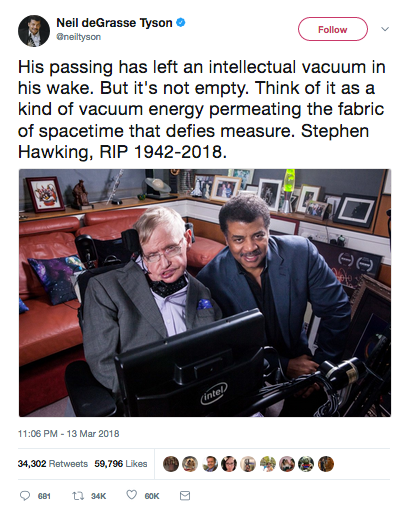
Screen Shot 2018-03-13 at 11.22.26 PM.png

The
physicist’s 
Wikipedia page
has been updated to reflect his passing.

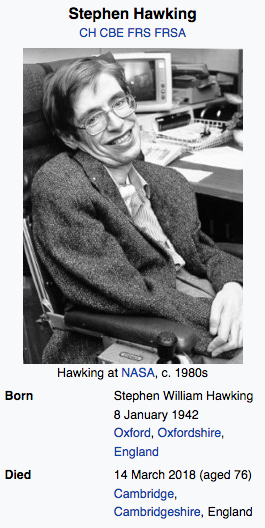
Screen Shot 2018-03-13 at 11.24.50 PM.png

Stephen
Hawking came into the world exactly 300 years after the death of
Galileo and made his exit on March 14th, also known as 
Pi
Day
.


Zie ook:

Stephen Hawking Stood up for Palestinians, Supported Boycott of Israel