De fratsenmaker Juncker, voorzitter van de Europese Commissie was gisteren in Washington om met Trump te spreken over de handelsoorlog die Trump tegen de EU voert. En ja hoor, na een relatief kort gesprek was men eruit: de EU zal de handelsbelemmeringen voor VS bedrijven opheffen, zodat wij straks ook genetisch gemanipuleerd ‘Frankensteinvoedsel’ tot ons kunnen nemen, zonder dat we het weten, daar de VS bedrijven die dit voedsel produceren tegen labeling zijn met het etiket ‘genetisch gemanipuleerd….’ (met zo’n labeling laat een groot deel van de klanten dergelijke levensmiddelen uiteraard staan)
Als vlag op de strontschuit zal de EU grote hoeveelheden genetisch gemanipuleerde soja uit de VS importeren…. Trump zat daar mee in de maag, daar een deel van zijn achterban onder de sojaboeren is te vinden en na de importheffingen op Chinese producten door de VS, stelde de Chinese regering een grote importheffing in op soja uit de VS………
Overigens is de import van sojabonen uit de VS, een grove schoffering van de Chinese regering, daar deze regering zoals gezegd in reactie op de voortdurende handelsoorlog van de VS tegen haar land, besloot een fikse heffing op soja uit de VS te leggen…… Anders gezegd: de EU helpt de VS met haar handelsoorlog tegen China, benieuwd wat men daar in China van denkt…….
Dan nog de EU import van vloeibaar gas (LNG) uit de VS, deze import was al lang het doel van de Trump administratie, daar de VS over grote voorraden (gesubsidieerd) schaliegas beschikt…… Bovendien komt hiermee het Nordstream 2 (NS2) project in gevaar, gas import uit Rusland via pijpleidingen, overigens veel goedkoper dan het gas uit de VS……. Het NS2 project was trouwens al een doorn in het oog van de VS
De Nederlandse media spraken vanmorgen vol lof over Juncker en stelden dat dit een ongekende prestatie is……. ‘Een geweldige prestatie’ dat Juncker zich en daarmee de hele EU, in het pak heeft genaaid……..
Als tegenprestatie zal Trump binnenkort nog eens kijken naar de VS heffingen op staal en aluminium uit de EU……. ha! ha! ha! ha! ha!
Mocht alles doorgang vinden, zoals dit vanmorgen werd gebracht, is een TTIP verdrag met de VS niet meer nodig en kan de peperdure TTIP lobby-missie van de EU in Washington naar huis…… Reken maar dat Juncker al afspraken heeft gemaakt over het toestaan van o.a. gentech voedsel uit de VS……. Zo heeft de EU en hebben de afzonderlijke EU lidstaten straks niets meer te vertellen over wat er wel in niet verkocht mag worden binnen de EU……
Kortom zonder enig contact met de EU bevolking of het EU parlement heeft Juncker als een autocraat knopen doorgehakt in Washington….. Ach zo werkt de EU nu eenmaal…….
Zoals vandaag al eerder gesteld: NEXIT, voor het te laat is!
In Nederland maken longartsen zich druk over het roken, waar ze met geen woord reppen over de slechte luchtkwaliteit in Nederland…… Deze slechte luchtkwaliteit wordt veroorzaakt door autoverkeer, luchtvaart, scheepvaart, industrie, kolengestookte energiecentrales* en als klap op de spreekwoordelijk vuurpijl het vuurwerk (bij afsteken van dat laatste wordt meer en zwaardere luchtvervuiling geproduceerd dan in 1 jaar tijd door de hoogovens in IJmuiden…)…..
Jaarlijks overlijden rond de 18.000 mensen vroegtijdig (na een akelig ziekbed) aan de gevolgen van langdurige blootstelling aan de uitstoot van alleen al autoverkeer…… Ter vergelijking: jaarlijks overlijden 20.000 mensen aan de gevolgen van roken…… Hier moet nog aan toegevoegd worden, dat jaarlijks een groot aantal kinderen long- en of luchtwegklachten oplopen door deze auto-uitstoot…….
Dat het ook anders kan wordt in de volgend video getoond, een video waarin je longartsen ziet demonstreren tegen dieselauto’s en waarin wordt uitgelegd wat de gevolgen zijn voor de volksgezondheid van diesel-uitstoot:
* In de nieuwe kolencentrales worden kolen samen met houtpellets verbrand (bio bijstook), voor dat laatste worden hele bossen uit de VS verwerkt (tot houtpellets)…….. Voor die ‘bio bijstook’ kregen deze centrales nog eens meer dan 4 miljard subsidie van VVD opperhufter Kamp, dit in de laatste maanden van Rutte 2……. Zelfs alleen het stoken van deze pellets is veel meer vervuilend, dan het verstoken van gas, waar de gascentrales in ons land al jaren allemaal zijn uitgeschakeld……. Pas in 2030 moeten deze vieze kolengestookte centrales stoppen met het veroorzaken van kanker enz…. En maar lullen aan ‘klimaattafels…’
PS: ook de namen van de Kanter en Dekker toegevoegd aan de labels direct onder dit bericht, daar deze longartsen nooit spreken over de enorme slechte luchtkwaliteit in ons land (deze behoort tot de slechtste van de EU), terwijl ze wel bezig zijn met een kruistocht tegen het roken…….
Een
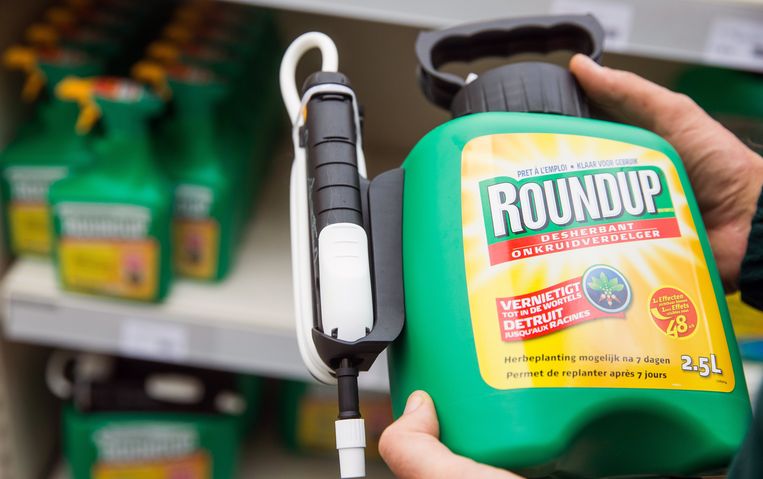
aantal mensen in de VS, allen lijdend aan kanker dan wel hun nabestaanden, gaan Monsanto
vervolgen voor het niet waarschuwen van het publiek voor de
kankerverwekkende eigenschappen van Roundup….
Lullig
te moeten zeggen, maar ik geef deze mensen niet veel kans, niet
alleen omdat Monsanto de wetenschappers demoniseert die stellen dat Roundup de
veroorzaker van kanker kan zijn, maar omdat de ‘rechters’ in de VS
meestal kiezen voor het bedrijfsleven…… Overigens niet zo vreemd in zo’n
corrupte maatschappij waar presidenten nadat ze de verkiezingen wonnen met een
enorme bak geld van grote bedrijven, zelfs hun eigen familie mogen aanstellen op hoge posities…….
Niet
getreurd, de eerste aanzet tot het totale verbod op het gebruik van glyfosaat is daar en gegarandeerd dat de
slachtoffers, hun nabestaanden en groepen die hen vertegenwoordigen, net als bij het
aanklagen van de tabaksfabrikanten, geduld genoeg hebben om door te
gaan tot de rechter met goed fatsoen de klacht ontvankelijk zal
verklaren (lullig genoeg geldt dit niet voor de slachtoffers, die
uiteraard nog maar weinig tijd hebben, al zullen er nog veel mensen bijkomen die kanker hebben ontwikkeld door glyfosaat…….)
De
EU, omgekocht door de lobbyisten van Monsanto, heeft besloten dat Glyfosaat nog 5 jaar gebruikt mag worden,
ondanks dat men weet dat dit middel levensgevaarlijk is…….. Ach
ja, ook de EU is er in eerste instantie voor: -het grote bedrijfsleven, -de financiële maffia, -het militair-industrieel complex (immers wat is
de mens zonder oorlog?), -degenen die meer dan een €
70.000 per jaar verdienen (en natuurlijk voor de superrijken, dus van miljonairs tot miljardairs…..) en uiteraard voor zichzelf >> na de politieke loopbaan volgt t.z.t. de beloning voor de geleverde ‘prestaties’, prestaties als de bevolking nog langer blootstellen aan een levensgevaarlijk gif…….. Kortom weer gaan de centen voor op de volksgezondheid……. (en maar klagen over het stijgen van de zorgkosten…..)
Target: Stephen
Censky, Deputy Secretary of Agriculture
Goal: Punish
Monsanto Company for allegedly hiding cancer research from public.
Monsanto
is accused of causing cancer in thousands of customers. A man dying
of cancer who has used Monsanto products for his job is suing
Monsanto for not having necessary warning labels on its products
reportedly containing a potentially carcinogenic chemical.
DeWayne
Johnson was diagnosed with non-Hodgkin lymphoma in 2016, developed
cancerous lesions over most of his body, and is now seeking justice
for his terrible condition that he believes is linked to the product.
Mr. Johnson is the first of some 4,000 people who are suing Monsanto
over allegations that their glyphosate-based Roundup led to their
cancers to have his case brought to trial.
The
alleged secretive motive of Monsanto covering up its products’
probable effects has been brought to light through company letters.
The letters allegedly shed light on Monsanto’s back-handed dealings
of denying cancer risk and protecting the use of chemical
“glyphosate,” which has been listed as “probably a human
carcinogen” by the World Health Organization’s (WHO) International
Agency for Research on Cancer. Monsanto has reportedly been profiting
greatly from the use of glyphosate in its products, and whenever
evidence of the chemical’s carcinogenic potential is brought forth
by research scientists, the company and its close partners vehemently
deny such research and work to discredit the outspoken scientists.
Monsanto
has been getting away with withholding information from the public
and possibly placing the public in danger. Sign this petition to
demand justice for Mr. Johnson and for the public’s health and
awareness.
DeWayne
Johnson was not aware of the allegedly carcinogenic properties of the
Roundup weed killer, one of Monsanto’s products, which he used for
many years in his career as a groundskeeper. He was unknowingly
exposing himself to the probable cancer-causing chemical
“glyphosate.” Monsanto, as alleged in letters by Monsanto
employees, has been actively working to deny and to hide cancer
research scientists’ claims of glyphosate’s potentially
carcinogenic properties.
I
write to urge you to punish Monsanto for not informing the public of
the alleged cancer-causing dangers of its Roundup weed killer. People
who use Monsanto products must be informed of potential risks, and
individuals like Mr. Johnson, who has already been affected, deserve
justice.
PS: in de labels direct onder dit bericht vind je ook het label Bayer, dit eerder oorlogsmisdaden en misdaden tegen de menselijkheid plegend bedrijf onder de nazi’s (o.a. gruwelijke medicijnproeven op concentratiekamp gevangenen), heeft Monsanto overgenomen…….
Ongelofelijk maar waar: zonder dat het overgrote deel van de EU bevolking (inclusief mijzelf) het doorhad, heeft de EU onderhandeld met Japan over een vrijhandelsverdrag, dat gisteren werd getekend……. De politiek heeft deze onderhandelingen verborgen gehouden, onderhandelingen over een verdrag dat als TTIP en CETA zijn nu eenmaal niet het belang van het EU volk, maar van de grote bedrijven…….. Zelfs databescherming wordt met dit verdrag het kind van de rekening……
Blijkbaar was men bang voor nieuwe protesten. Gistermiddag hoorde ik op WDR voor het eerst over JAFTA, waarmee zelfs Japanse bedrijven hier waterbedrijven kunnen overnemen….. Dat laatste wordt door de EU ontkend, terwijl dezelfde EU stelt dat ook geprivatiseerde waterbedrijven zich aan de wet moeten houden……. ha! ha! ha! ha! ha! ha! ha! Kortom Japanse bedrijven kunnen straks wel degelijk waterbedrijven overnemen!
Wat betreft het zich aan de wet houden: geprivatiseerde bedrijven als waterbedrijven geven alleen het hoogstnodige uit aan onderhoud van bijvoorbeeld de zuiveringsinstallaties en het leidingsstelsel, zoals we in diverse buitenlanden kunnen zien…… Bovendien kunnen deze bedrijven de waterprijs fiks opdrijven, zoals deze schoften zelfs in arme landen durven te doen, waar mensen die het geld niet hebben hun water weer uit gevaarlijke bron halen, dit met alle gevolgen voor de volksgezondheid en een stijging van kindersterfte in het bijzonder……
Met JAFTA krijgen bedrijven als met TTIP en CETA, macht over soevereine staten, waar ze wetten die het hun onmogelijk maken zaken te doen in EU lidstaten, door een geheime rechtbank (Investeerder-staatsarbitrage >> ISDS) teniet kunnen laten doen…… Let wel: het gaat hier o.a. om het beschermen van voedsel en water tegen bijvoorbeeld gifstoffen….. EU boeren mogen nog maar mondjesmaat gif gebruiken op hun gewassen, echter die regels gelden niet voor groente en fruit van buiten de EU…… Je zou de mensen de kost moeten geven, die niet op de hoogte zijn van de regels aangaande het voornoemde gebruik van gif…..* Je had al begrepen dat straks de slappe regelgeving in Japan ook hier haar intrede zal doen, regelgeving die o.a. onze voedselveiligheid zou moeten waarborgen…..
Kortom: ons is alweer een reuzen oor aangenaaid door het ondemocratische EU-instituut…..
Nexit, zo snel mogelijk! Terug naar de eerdere EEG, even effectief en veel meer in het belang van de burgers. Niets staat een douane unie in zo’n EEG 2.0 in de weg! De invoering van de euro is dan ook vooral gedaan om een uiteenvallen van de EU te voorkomen >> nog zo’n aangenaaid ‘reuzen oor….’
* Buiten de EU zijn veel boeren/tuinders uit de EU te vinden, daar gebruiken zij het gebrek aan regelgeving, neem rozen en bonen uit Afrikaanse landen als Kenia en Egypte….. Nog een voordeel: je mag arbeiders daar ‘gewoon’ uitbuiten en mensen van hun land gooien, na de autoriteiten te hebben omgekocht…..
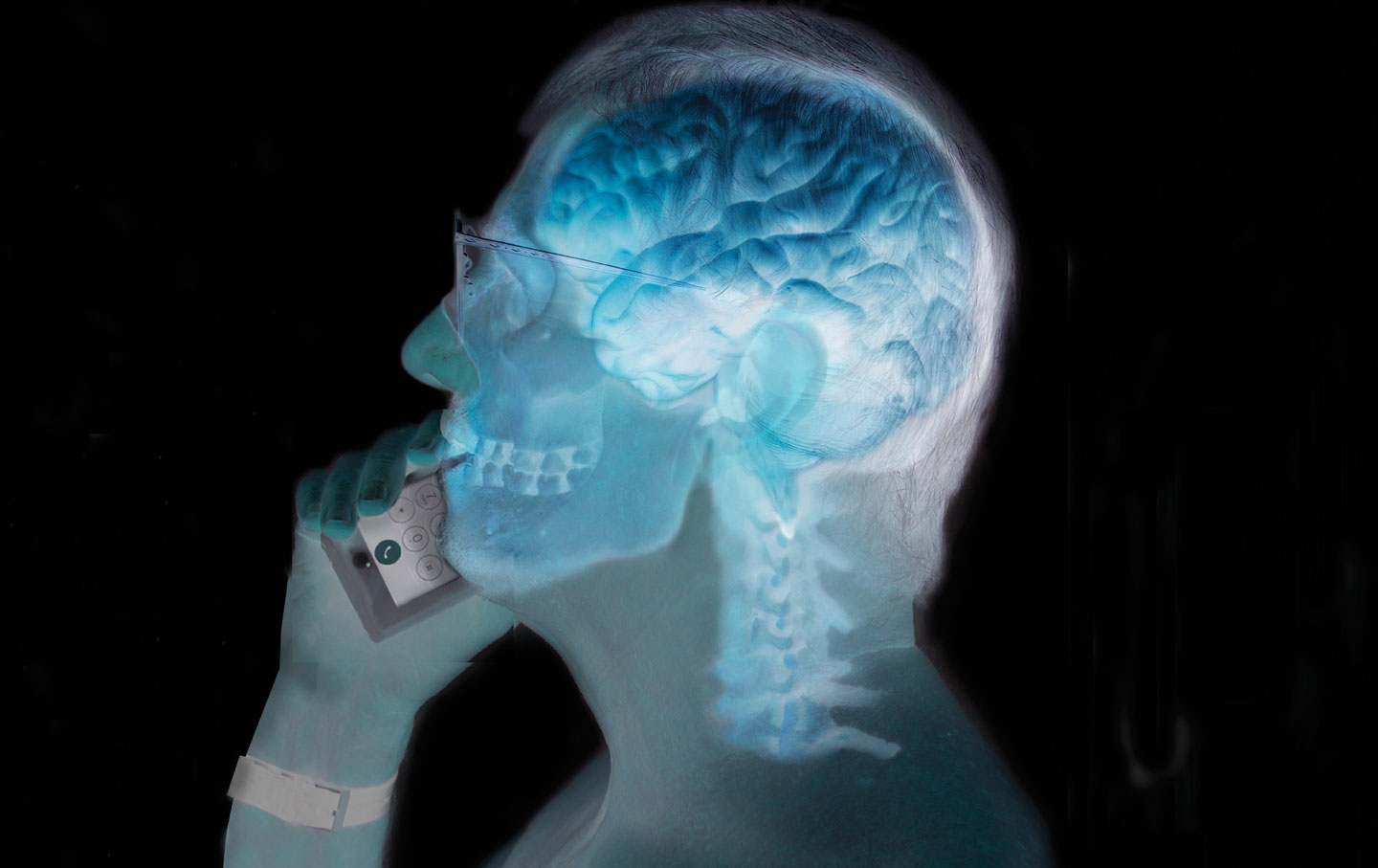
Met het uitrollen van 5G netwerk komt er steeds
meer twijfel aan de veiligheid van de straling voor de hersenen en
raken meer en meer wetenschappers ervan overtuigd dat de straling die
wordt aangewend voor de mobiele telefoon, kankerverwekkend
is, ofwel o.a. hersentumor bevorderend……. Met het 5G netwerk wordt die straling nog gevaarlijker……..
In het hieronder opgenomen artikel
geschreven door Mark Hertsgaard en Mark Dowie en eerder geplaatst op
The Nation (hier de link naar het origineel), wordt aangetoond dat
de fabrikanten van mobiele telefoons en de netwerkbeheerders willens en wetens
wetenschappers betaalden voor hen gunstige uitkomsten uit onderzoek
naar straling van mobile telefoons……. Echter zoals het onderzoek naar het gebruik van tabak en fossiele brandstoffen verging, vonden
een aantal van deze wetenschappers wel degelijk bewijzen voor negatieve beïnvloeding van de hersenen door de straling, overigens kan door diezelfde straling ook het
DNA beschadigd worden……
De Wereldgezondheidsorganisatie (WHO) waarschuwt en stelt dat straling van mobiele telefoons ‘mogelijk’ kankerverwekkend kan zijn……. Zo zie je nog maar eens de werking van lobbyisme in de WHO, de lobby van netwerkbeheerders en fabrikanten van mobiele telefoons…….
In feite zijn een paar miljard mensen alleen door de mobiele telefoon te gebruiken, onderdeel geweest van een gezondheidsonderzoek, daar nooit van te voren een onderzoek werd ingesteld naar negatieve gezondheidseffecten door het gebruik van deze telefoons……..
Lees het volgende ontluisterende
artikel ajb en neem het zekere voor het onzekere: gebruik je telefoon
met ‘oortjes’ en microfoon, dus niet tegen je hoofd en zegt het
voort! (en doe je telefoon niet in je broekzak…)
Let wel deze ‘geschreven video’ is een andere dan de gesproken tekst in de ‘video’ op het origineel
Things
didn’t end well between George Carlo and Tom Wheeler; the last time
the two met face-to-face, Wheeler had security guards escort Carlo
off the premises. As president of the Cellular Telecommunications and
Internet Association (CTIA), Wheeler was the wireless industry’s
point man in Washington. Carlo was the scientist handpicked by
Wheeler to defuse a public-relations crisis that threatened to
strangle his infant industry in its crib. This was back in 1993, when
there were only six cell-phone subscriptions for every 100 adults in
the United States. But industry executives were looking forward to a
booming future.
Remarkably,
cell phones had been allowed onto the US consumer market a decade
earlier without any government safety testing. Now, some customers
and industry workers were being diagnosed with cancer. In January
1993, David
Reynard sued the NEC America Company,
claiming that his wife’s NEC phone caused her lethal brain tumor.
After Reynard appeared on national TV, the story went viral. A
congressional subcommittee announced an investigation; investors
began dumping their cell-phone stocks; and Wheeler and the CTIA swung
into action.
A
week later, Wheeler announced that his industry would pay for a
comprehensive research program. Cell phones were already safe,
Wheeler told reporters; the new research would simply “re-validate
the findings of the existing studies.”
George
Carlo seemed like a good bet to fulfill Wheeler’s mission. He was
an epidemiologist who also had a law degree, and he’d conducted
studies for other controversial industries. After a study funded by
Dow Corning, Carlo had declared that breast implants posed only
minimal health risks. With chemical-industry funding, he had
concluded that low levels of dioxin, the chemical behind the Agent
Orange scandal, were not dangerous. In 1995, Carlo began directing
the industry-financed Wireless Technology Research project (WTR),
whose eventual budget of $28.5 million made it the best-funded
investigation of cell-phone safety to date.
Outside
critics soon came to suspect that Carlo would be the front man for an
industry whitewash. They cited his dispute
with Henry Lai,
a professor of biochemistry at the University of Washington, over a
study that Lai had conducted examining whether cell-phone radiation
could damage DNA. In 1999, Carlo and the WTR’s general counsel sent
a letter to the university’s president urging that Lai be fired for
his alleged violation of research protocols. Lai accused the WTR of
tampering with his experiment’s results. Both Carlo and Lai deny
the other’s accusations.
Critics
also attacked what they regarded as the slow pace of WTR research.
The WTR was merely “a confidence game” designed to placate the
public but stall real research, according to
Louis Slesin, editor of the trade publication Microwave
News.
“By dangling a huge amount of money in front of the cash-starved
[scientific] community,” Slesin argued, “Carlo guaranteed silent
obedience. Anyone who dared complain risked being cut off from his
millions.” Carlo denies the allegation.
Whatever
Carlo’s motives might have been, the documented fact is that he and
Wheeler would eventually clash bitterly over the WTR’s findings,
which Carlo presented to wireless-industry leaders on February 9,
1999. By that date, the WTR had commissioned more than 50 original
studies and reviewed many more. Those studies raised “serious
questions” about cell-phone safety, Carlo told a closed-door
meeting of the CTIA’s board of directors, whose members included
the CEOs or top officials of the industry’s 32 leading companies,
including Apple, AT&T, and Motorola.
Carlo
sent letters to each of the industry’s chieftains on October 7,
1999, reiterating that the WTR’s research had found the following:
“The risk of rare neuro-epithelial tumors on the outside of the
brain was more than doubled…in cell phone users”; there was an
apparent “correlation between brain tumors occurring on the right
side of the head and the use of the phone on the right side of the
head”; and “the ability of radiation from a phone’s antenna to
cause functional genetic damage [was] definitely positive….”
Carlo
urged the CEOs to do the right thing: give consumers “the
information they need to make an informed judgment about how much of
this unknown risk they wish to assume,” especially since some in
the industry had “repeatedly and falsely claimed that wireless
phones are safe for all consumers including children.”
The
World Health Organization classifies cell-phone radiation as a
“possible” carcinogen.
The
very next day, a livid Tom Wheeler began publicly trashing Carlo to
the media. In a letter he shared with the CEOs, Wheeler told Carlo
that the CTIA was “certain that you have never provided CTIA with
the studies you mention”—an apparent effort to shield the
industry from liability in the lawsuits that had led to Carlo’s
hiring in the first place. Wheeler charged further that the studies
had not been published in peer-reviewed journals, casting doubt on
their validity.
Wheeler’s
tactics succeeded in dousing the controversy. Although Carlo had in
fact repeatedly briefed Wheeler and other senior industry officials
on the studies, which had indeed undergone peer review and would soon
be published, reporters on the technology beat accepted Wheeler’s
discrediting of Carlo and the WTR’s findings. (Wheeler would go on
to chair the Federal Communications Commission, which regulates the
wireless industry. He agreed to an interview for this article but
then put all of his remarks off the record, with one exception: his
statement that he has always taken scientific
guidance from the US Food and Drug Administration (FDA), ‘which, he said, “has concluded, ‘the weight of scientific
evidence had not linked cell phones with any health problems.’”)
Why,
after such acrimony, Carlo was allowed to make one last appearance
before the CTIA board is a mystery. Whatever the reason, Carlo flew
to New Orleans in February 2000 for the wireless industry’s annual
conference, where he submitted the WTR’s
final report to
the CTIA board. According to Carlo, Wheeler made sure that none of
the hundreds of journalists covering the event could get anywhere
near him.
When
Carlo arrived, he was met by two seriously muscled men in plain
clothes; the larger of the two let drop that he had recently left the
Secret Service. The security men steered Carlo into a holding room,
where they insisted he remain until his presentation. When summoned,
Carlo found roughly 70 of the industry’s top executives waiting for
him in silence. Carlo had spoken a mere 10 minutes when Wheeler
abruptly stood, extended a hand, and said, “Thank you, George.”
The two muscle men then ushered the scientist to a curbside taxi and
waited until it pulled away.
In
the years to come, the WTR’s cautionary findings would be
replicated by numerous other scientists in the United States and
around the world, leading the World Health Organization in 2011 to
classify cell-phone radiation as a “possible” human carcinogen
and the governments of Great Britain, France, and Israel to issue
strong warnings on cell-phone use by children. But as the taxi
carried Carlo to Louis Armstrong International Airport, the scientist
wondered whether his relationship with the industry might have turned
out differently if cell phones had been safety-tested before being
allowed onto the consumer market, before profit took precedence over
science. But it was too late: Wheeler and his fellow executives had
made it clear, Carlo told The
Nation,
that “they would do what they had to do to protect their industry,
but they were not of a mind to protect consumers or public health.”
This
article does not argue that cell phones and other wireless
technologies are necessarily dangerous; that is a matter for
scientists to decide. Rather, the focus here is on the global
industry behind cell phones—and the industry’s long campaign to
make people believe that cell phones are safe.
As
happened earlier with Big Tobacco and Big Oil, the wireless
industry’s own scientists privately warned about the risks.
That
campaign has plainly been a success: 95 out of every 100 adult
Americans now own a cell phone; globally, three out of four adults
have cell-phone access, with sales increasing every year. The
wireless industry is now one of the fastest-growing on Earth and one
of the biggest, boasting annual sales of $440 billion in 2016.
Carlo’s
story underscores the need for caution, however, particularly since
it evokes eerie parallels with two of the most notorious cases of
corporate deception on record: the campaigns by the tobacco and
fossil-fuel industries to obscure the dangers of smoking and climate
change, respectively. Just as tobacco executives were privately told
by their own scientists (in the 1960s) that smoking was deadly, and
fossil-fuel executives were privately told by their own scientists
(in the 1980s) that burning oil, gas, and coal would cause a
“catastrophic” temperature rise, so Carlo’s testimony reveals
that wireless executives were privately told by their own scientists
(in the 1990s) that cell phones could cause cancer and genetic
damage.
Carlo’s
October 7, 1999, letters to wireless-industry CEOs are the
smoking-gun equivalent of the
November 12, 1982, memo that
M.B. Glaser, Exxon’s manager of environmental-affairs programs,
sent to company executives explaining that burning oil, gas, and coal
could raise global temperatures by a destabilizing 3 degrees Celsius
by 2100. For the tobacco industry, Carlo’s letters are akin to the
1969 proposal that
a Brown & Williamson executive wrote for countering anti-tobacco
advocates. “Doubt is our product,” the memo declared. “It is
also the means of establishing a controversy…at the public level.”
Like
their tobacco and fossil-fuel brethren, wireless executives have
chosen not to publicize what their own scientists have said about the
risks of their products. On the contrary, the industry—in America,
Europe, and Asia—has spent untold millions of dollars in the past
25 years proclaiming that science is on its side, that the critics
are quacks, and that consumers have nothing to fear. This, even as
the industry has worked behind the scenes—again like its Big
Tobacco counterpart—to deliberately addict its customers. Just as
cigarette companies added nicotine to hook smokers, so have wireless
companies designed cell phones to deliver a jolt of dopamine with
each swipe of the screen.
This Nation investigation
reveals that the wireless industry not only made the same moral
choices that the tobacco and fossil-fuel industries did; it also
borrowed from the same public-relations playbook those industries
pioneered. The playbook’s key insight is that an industry doesn’t
have to win the scientific argument about safety; it only has to keep
the argument going. That amounts to a win for the industry, because
the apparent lack of certainty helps to reassure customers, even as
it fends off government regulations and lawsuits that might pinch
profits.
Central
to keeping the scientific argument going is making it appear that not
all scientists agree. Again like the tobacco and fossil-fuel
industries, the wireless industry has “war gamed” science, as a
Motorola internal memo in 1994 phrased
it. War-gaming science involves playing offense as well as defense:
funding studies friendly to the industry while attacking studies that
raise questions; placing industry-friendly experts on advisory bodies
like the World Health Organization; and seeking to discredit
scientists whose views depart from the industry’s.
Funding
friendly research has perhaps been the most important component of
this strategy, because it conveys the impression that the scientific
community truly is divided. Thus, when studies have linked wireless
radiation to cancer or genetic damage—as Carlo’s WTR did in 1999;
as the WHO’s
Interphone study did in 2010;
and as the
US National Toxicology Program did in 2016—industry
spokespeople can point out, accurately, that other studies disagree.
“[T]he overall balance of the evidence” gives no cause for alarm,
asserted Jack Rowley, research and sustainability director for the
Groupe Special Mobile Association (GSMA), Europe’s wireless trade
association, speaking
to reporters about the WHO’s findings.
A
closer look reveals the industry’s sleight of hand. When Henry Lai,
the professor whom Carlo tried to get fired, analyzed 326
safety-related studies completed between 1990 and 2005, he learned
that 56 percent found a biological effect from cell-phone radiation
and 44 percent did not; the scientific community apparently was
split. But when Lai recategorized the studies according to their
funding sources, a different picture emerged: 67 percent of the
independently funded studies found a biological effect, while a mere
28 percent of the industry-funded studies did. Lai’s findings were
replicated by a
2007 analysis in Environmental
Health Perspectives that
concluded industry-funded studies were two and a half times less
likely than independent studies to find a health effect.
One
key player has not been swayed by all this wireless-friendly
research: the insurance industry. The
Nation has
not been able to find a single insurance company willing to sell a
product-liability policy that covered cell-phone radiation. “Why
would we want to do that?” one executive chuckled before pointing
to more than two dozen lawsuits outstanding against wireless
companies, demanding a total of $1.9 billion in damages. Some judges
have affirmed such lawsuits, including a judge
in Italy who refused to allow industry-funded research as evidence.
Even
so, the industry’s neutralizing of the safety issue has opened the
door to the biggest, most hazardous prize of all: the proposed
revolutionary transformation of society dubbed the “Internet of
Things.” Lauded as a gigantic engine of economic growth, the
Internet of Things will not only connect people through their
smartphones and computers but will connect those devices to a
customer’s vehicles and home appliances, even their baby’s
diapers—all at speeds faster than can currently be achieved.
Billions
of cell-phone users have been subjected to a public-health experiment
without informed consent.
There
is a catch, though: The Internet of Things will require augmenting
today’s 4G technology with 5G, thus “massively increasing” the
general population’s exposure to radiation, according to a
petition signed by 236 scientists worldwide who
have published more than 2,000 peer-reviewed studies and represent “a
significant portion of the credentialed scientists in the radiation
research field,” according to Joel Moskowitz, the director of the
Center for Family and Community Health at the University of
California, Berkeley, who helped circulate the petition.
Nevertheless, like cell phones, 5G technology is on the verge of
being introduced without pre-market safety testing.
Lack
of definitive proof that a technology is harmful does not mean the
technology is safe, yet the wireless industry has succeeded in
selling this logical fallacy to the world. In truth, the safety of
wireless technology has been an unsettled question since the
industry’s earliest days. The upshot is that, over the past 30
years, billions of people around the world have been subjected to a
massive public-health experiment: Use a cell phone today, find out
later if it causes cancer or genetic damage. Meanwhile, the wireless
industry has obstructed a full and fair understanding of the current
science, aided by government agencies that have prioritized
commercial interests over human health and news organizations that
have failed to inform the public about what the scientific community
really thinks. In other words, this public-health experiment has been
conducted without the informed consent of its subjects, even as the
industry keeps its thumb on the scale.
“The
absence of absolute proof does not mean the absence of risk,” Annie
Sasco, the former director of epidemiology for cancer prevention at
France’s National Institute of Health and Medical Research, told
the attendees of the 2012 Childhood Cancer conference. “The younger
one starts using cell phones, the higher the risk,” Sasco
continued, urging a public-education effort to inform parents,
politicians, and the press about children’s exceptional
susceptibility.
For
adults and children alike, the process by which wireless radiation
may cause cancer remains uncertain, but it is thought to be indirect.
Wireless radiation has been shown
to damage the blood-brain barrier,
a vital defense mechanism that shields the brain from carcinogenic
chemicals elsewhere in the body (resulting, for example, from
secondhand cigarette smoke). Wireless radiation has also been shown
to interfere
with DNA replication,
a proven progenitor of cancer. In each of these cases, the risks are
higher for children: Their skulls, being smaller, absorb more
radiation than adults’ skulls do, while children’s longer life
span increases their cumulative exposure.
The
wireless industry has sought to downplay concerns about cell phones’
safety, and the Federal Communications Commission has followed its
example. In 1996, the FCC established cell-phone safety levels based
on “specific absorption rate,” or SAR. Phones were required to
have a SAR of 1.6 watts or less per kilogram of body weight. In
2013, the
American Academy of Pediatrics advised the FCC that
its guidelines “do not account for the unique vulnerability and use
patterns specific to pregnant women and children.” Nevertheless,
the FCC has declined to update its standards.
The
FCC has granted the industry’s wishes so often that it qualifies as
a “captured agency,” argued journalist Norm Alster in a
report that
Harvard University’s Edmond J. Safra Center for Ethics published in
2015. The FCC allows cell-phone manufacturers to self-report SAR
levels, and does not independently test industry claims or require
manufacturers to display the SAR level on a phone’s packaging.
“Industry controls the FCC through a soup-to-nuts stranglehold that
extends from its well-placed campaign spending in Congress through
its control of the FCC’s congressional oversight committees to its
persistent agency lobbying,” Alster wrote. He also quoted the CTIA
website praising the FCC for “its light regulatory touch.”
The
revolving-door syndrome that characterizes so many industries and
federal agencies reinforces the close relationship between the
wireless industry and the FCC. Just as Tom Wheeler went from running
the CTIA (1992– 2004) to chairing the FCC (2013–2017), Meredith
Atwell Baker went from FCC commissioner (2009–2011) to the
presidency of the CTIA (2014 through today). To ensure its access on
Capitol Hill, the wireless industry made $26 million in campaign
contributions in 2016, according
to the Center for Responsive Politics,
and spent $87 million on lobbying in 2017.
Neutralizing
the safety issue has been an ongoing imperative because the research
keeps coming, much of it from outside the United States. But the
industry’s European and Asian branches have, like their US
counterpart, zealously war-gamed the science, spun the news coverage,
and thereby warped the public perception of their products’ safety.
The
WHO began to study the health effects of electric- and magnetic-field
radiation (EMF) in 1996 under the direction of Michael Repacholi, an
Australian biophysicist. Although
Repacholi
claimed on disclosure forms that he was “independent” of
corporate influence, in fact Motorola had funded his research: While
Repacholi was director of the WHO’s EMF program, Motorola paid
$50,000 a year to his former employer, the Royal Adelaide Hospital,
which then transferred the money to the WHO program. When journalists
exposed the payments, Repacholi denied that
there was anything untoward about them because Motorola had not paid
him personally. Eventually, Motorola’s payments were bundled with
other industry contributions and funneled through the Mobile and
Wireless Forum, a trade association that gave the WHO’s program
$150,000 annually. In 1999, Repacholi helped engineer a WHO statement
that “EMF exposures below the limits recommended in international
guidelines do not appear to have any known consequence on health.”
Two
wireless trade associations contributed $4.7 million to the
Interphone study launched
by the WHO’s International Agency for Cancer Research in 2000. That
$4.7 million represented 20 percent of the $24 million budget for the
Interphone study, which convened 21 scientists from 13 countries to
explore possible links between cell phones and two common types of
brain tumor: glioma and meningioma. The money was channeled through a
“firewall” mechanism intended to prevent corporate influence on
the IACR’s findings, but whether such firewalls work is debatable.
“Industry sponsors know [which scientists] receive funding;
sponsored scientists know who provides funding,” Dariusz
Leszczynski, an adjunct professor of biochemistry at the University
of Helsinki, has explained.
The
FCC grants the wireless industry’s wishes so often that it
qualifies as a “captured agency.”
To
be sure, the industry could not have been pleased with some of
the Interphone
study’s conclusions.
The study found that the heaviest cell-phone users were 80
percent more likely to develop glioma.
(The initial finding of 40 percent was increased to 80 to correct for
selection bias.) The Interphone study also concluded that individuals
who had owned a cell phone for 10 years or longer saw their risk of
glioma increase by nearly 120 percent.
However,
the study did not find any increased risk for individuals who used
their cell phones less frequently; nor was there evidence of any
connection with meningioma.
When
the Interphone conclusions were released in 2010, industry
spokespeople blunted their impact by deploying what experts on lying
call “creative truth-telling.” “Interphone’s conclusion of no
overall increased risk of brain cancer is consistent with conclusions
reached in an already large body of scientific research on this
subject,” John Walls, the vice president for public affairs at the
CTIA, told
reporters.
The wiggle word here is “overall”: Since some of the Interphone
studies did not find increased brain-cancer rates, stipulating
“overall” allowed Walls to ignore those that did. The misleading
spin confused enough news organizations that their coverage of the
Interphone study was essentially reassuring to the industry’s
customers. The
Wall Street Journal announced
“Cell Phone Study Sends Fuzzy Signal on Cancer Risk,” while the
BBC’s headline declared: “No Proof of Mobile Cancer Risk.”
The
industry’s $4.7 million contribution to the WHO appears to have had
its most telling effect in May 2011, when the WHO convened scientists
in Lyon, France, to discuss how to classify the cancer risk posed by
cell phones. The industry not only secured “observer” status at
Lyon for three of its trade associations; it placed two
industry-funded experts on the working group that would debate the
classification, as well as additional experts among the “invited
specialists” who advised the group.
Niels
Kuster, a Swiss engineer, initially filed a conflict-of-interest
statement affirming only that his research group had taken money from
“various governments, scientific institutions and corporations.”
But after Kuster co-authored a summary of the WHO’s findings in The
Lancet Oncology,
the medical journal issued
a correction expanding
on Kuster’s conflict-of-interest statement, noting payments from
the Mobile Manufacturers Forum, Motorola, Ericsson, Nokia, Samsung,
Sony, GSMA, and Deutsche Telekom. Nevertheless, Kuster participated
in the entire 10 days of deliberations.
The
industry also mounted a campaign to discredit Lennart Hardell, a
Swedish professor of oncology serving on the working group. Hardell’s
studies,
which found an increase in gliomas and acoustic neuromas in long-term
cell-phone users, were some of the strongest evidence that the group
was considering.
Hardell
had already attracted the industry’s displeasure back in 2002, when
he began arguing that children shouldn’t use cell phones. Two
scientists with industry ties quickly published
a report with
the Swedish Radiation Authority dismissing Hardell’s research. His
detractors were John D. Boice and Joseph K. McLaughlin of the
International Epidemiology Institute, a company that provided
“Litigation Support” and “Corporate Counseling” to various
industries, according
to its website.
Indeed, at the very time Boice and McLaughlin were denigrating
Hardell’s work, the institute was providing expert-witness services
to Motorola in a brain-tumor lawsuit against the company.
The
wireless industry didn’t get the outcome that it wanted at Lyon,
but it did limit the damage. A number of the working group’s
scientists had favored increasing the classification of cell phones
to Category 2A, a “probable” carcinogen; but in
the end, the group could only agree on
an increase to 2B, a “possible” carcinogen.
That
result enabled the industry to continue proclaiming that there was no
scientifically established proof that cell phones are dangerous. Jack
Rowley of the GSMA trade association said that “interpretation
should be based on the overall balance of the evidence.” Once
again, the slippery word “overall” downplayed the significance of
scientific research that the industry didn’t like.
Industry-funded
scientists had been pressuring their colleagues for a decade by then,
according to Leszczynski, another member of the Lyon working group.
Leszczynski was an assistant professor at Harvard Medical School when
he first experienced such pressure, in 1999. He had wanted to
investigate the effects of radiation levels higher than the SAR
levels permitted by government, hypothesizing that this might better
conform to real-world practices. But when he proposed the idea at
scientific meetings, Leszczynski
said,
it was shouted down by Mays Swicord, Joe Elder, and C.K.
Chou—scientists who worked for Motorola. As Leszczynski recalled,
“It was a normal occurrence at scientific meetings—and I attended
really a lot of them—that whenever [a] scientist reported
biological effects at SAR over [government-approved levels], the
above-mentioned industry scientists, singularly or as a group, jumped
up to the microphone to condemn and to discredit the results.”
Years
later, a
study that
Leszczynski described as a “game changer” discovered that even
phones meeting government standards, which in Europe were a SAR of
2.0 watts per kilogram, could deliver exponentially higher peak
radiation levels to certain skin and blood cells. (SAR levels reached
a staggering 40 watts per kilogram—20 times higher than officially
permitted.) In other words, the official safety levels masked
dramatically higher exposures in hot spots, but industry-funded
scientists obstructed research on the health impacts.
“Everyone
knows that if your research results show that radiation has effects,
the funding flow dries up.” —Dariusz Leszczynski, adjunct
professor of biochemistry at the University of Helsinki
“Everyone
knows that if your research results show that radiation has effects,
the funding flow dries up,” Leszczynski said in an interview in
2011. Sure enough, the Radiation and Nuclear Safety Authority of
Finland, where Leszczynski had a long career, discontinued research
on the biological effects of cell phones and discharged him a year
later.
According
to scientists involved in the process, the WHO may decide later this
year to reconsider its categorization of the cancer risk posed by
cell phones; the WHO itself told The
Nation that
before making any such decision, it will review the final report of
the National Toxicology Program, a US government initiative.
The results
reported by the NTP in
2016 seem to strengthen the case for increasing the assessment of
cell-phone radiation to a “probable” or even a “known”
carcinogen. Whereas the WHO’s Interphone study compared the
cell-phone usage of people who had contracted cancer with that of
people who hadn’t, the NTP study exposed rats and mice to
cell-phone radiation and observed whether the animals got sick.
“There
is a carcinogenic effect,” announced Ron Melnick, the designer of
the study. Male rats exposed to cell-phone radiation developed cancer
at a substantially higher rate, though the same effect was not seen
in female rats. Rats exposed to radiation also had lower birth rates,
higher infant mortality, and more heart problems than those in the
control group. The cancer effect occurred in only a small percentage
of the rats, but that small percentage could translate into a massive
amount of human cancers. “Given the extremely large number of
people who use wireless communications devices, even a very small
increase in the incidence of disease…could have broad implications
for public health,” the NTP’s draft report explained.
The
NTP study was to be peer-reviewed at a meeting on March 26–28, amid
signs that the program’s leadership is pivoting to downplay its
findings. The NTP had issued a public-health warning when the study’s
early results were released in 2016. But when the NTP released
essentially the same data in February 2018, John Bucher, the senior
scientist who directed the study, announced in a telephone press
conference that “I don’t think this is a high-risk situation at
all,” partly because the study had exposed the rats and mice to
higher levels of radiation than a typical cell-phone user
experienced.
Microwave
News’s
Slesin speculated
on potential explanations for
the NTP’s apparent backtracking: new leadership within the program,
where a former drug-company executive, Brian Berridge, now runs the
day-to-day operations; pressure from business-friendly Republicans on
Capitol Hill and from the US military, whose weapons systems rely on
wireless radiation; and the anti-science ideology of the Trump White
House. The question now: Will the scientists doing the peer review
endorse the NTP’s newly ambivalent perspective, or challenge it?
The
scientific evidence that cell phones and wireless technologies in
general can cause cancer and genetic damage is not definitive, but it
is abundant and has been increasing over time. Contrary to the
impression that most news coverage has given the public, 90 percent
of the 200 existing studies included in the National Institutes of
Health’s PubMed database on the oxidative effects of wireless
radiation—its tendency to cause cells to shed electrons, which can
lead to cancer and other diseases—have found a significant impact,
according to a survey of the scientific literature conducted by Henry
Lai. Seventy-two percent of neurological studies and 64 percent of
DNA studies have also found effects.
The
wireless industry’s determination to bring about the Internet of
Things, despite the massive increase in radiation exposure this would
unleash, raises the stakes exponentially. Because 5G radiation can
only travel short distances, antennas roughly the size of a pizza box
will have to be installed approximately every 250 feet to ensure
connectivity. “Industry is going to need hundreds of thousands,
maybe millions, of new antenna sites in the United States alone,”
said Moskowitz, the UC Berkeley researcher. “So people will be
bathed in a smog of radiation 24/7.”
There
is an alternative approach, rooted in what some scientists and
ethicists call the “precautionary principle,” which holds that
society doesn’t need absolute proof of hazard to place limits on a
given technology. If the evidence is sufficiently solid and the risks
sufficiently great, the precautionary principle calls for delaying
the deployment of that technology until further research clarifies
its impacts. The scientists’
petition discussed
earlier urges government regulators to apply the precautionary
principle to 5G technology. Current safety guidelines “protect
industry—not health,” contends the petition, which “recommend[s]
a moratorium on the roll-out of [5G]…until potential hazards for
human health and the environment have been fully investigated by
scientists independent from industry.”
No scientist can say with
certainty how many wireless-technology users are likely to contract
cancer, but that is precisely the point: We simply don’t know.
Nevertheless, we are proceeding as if we do know the risk, and that
the risk is vanishingly small. Meanwhile, more and more people around
the world, including countless children and adolescents, are getting
addicted to cell phones every day, and the shift to radiation-heavy
5G technology is regarded as a fait accompli. Which is just how Big
Wireless likes it.
Mark
HertsgaardTWITTERMark
Hertsgaard, The
Nation’s
environment correspondent and investigative editor, is the author of
seven books, including HOT:
Living Through the Next Fifty Years on Earth .
To
submit a correction for our consideration, click here.
===============================
Ach, de normale gang van zaken: geld verdienen gaat in de inhumane neoliberale maatschappij ver voor op de volksgezondheid………… (al moet gezegd worden dat deze gang van zaken zo oud is als de weg naar Rome….)
Hoorde afgelopen vrijdag Joost Vullings, politiek verslaggever en duider (ha! ha! ha!) voor o.a. de NOS en KRO – NCRV op Radio1. Het ging in de uitzending na 9.30 u. over al dan niet liegende politici, weet niet meer wat de stelling was en vind het bovendien te suf om op te zoeken, immers iedereen zal wel weten dat politici vooral heel vaak de boel belazeren en dus liegen bij het leven…..
Vullings durfde te zeggen dat Rutte onterecht wordt beschuldigd van liegen……. ha! ha! ha! ha! ha! ha! ha! ha! Vullings de politiek deskundige en duider heeft nooit een leugen kunnen ontdekken van Rutte, zo vulde hij zijn woorden aan…… Moet je nagaan: dezelfde Vullings heeft zich nogal eens negatief uitgelaten over nepnieuws op de sociale media…. ha! ha! ha! ha! ha! ha! ha!
Mensen het viel me nog alleszins mee van politiek duider Vullings dat hij erkende dat andere politici ‘wel eens liegen’, maar zo stelde hij, de meeste politici bedoelen het beste…… ha! ha! ha! ha! ha! ha! ha! Ja voor de eigen positie, die van de financiële wereld plus de belangen van het grote bedrijfsleven en het militair-industrieel complex……..
Lullig genoeg is Vullings onderdeel van de publieke media, die al net als de commerciële media, vooral het woord van de zittende neoliberale regeringen en de hiervoor aangehaalde bedrijven prediken….. Tja dan moet je natuurlijk wel flink omhoog likken en geen kritiek leveren…….
Ongelofelijk dat Vullings zelfs mag werken voor de zogenaamd onafhankelijke NOS, in feite wordt hij betaald van ons belastinggeld……
BBC World Service radio meldde afgelopen woensdag (rond 0.47 u.) dat de Indiase hoofdstad New Delhi stikt van de luchtvervuiling. Deskundigen stellen dat de vervuiling zo erg is dat je beter 30 sigaretten kan roken, dan te wonen of verblijven in New Delhi…… (de vervuiling wordt geschat op een vergelijkbaar niveau van het roken van 35 tot 40 sigaretten per dag, al moet ik daar direct aan toevoegen dat de uitstoot uit een auto veel gevaarlijker is dan sigarettenrook…..)
Ondanks dit feit wil de stad maar liefst 16.500 bomen kappen t.b.v. het bouwen van woningen voor ambtenaren…….
Felle protesten van de bevolking (waarvoor de Nederlandse media geen belangstelling hadden en hebben) leidden er een paar dagen geleden toe dat de kap van bomen is stilgelegd…… De stad zou beloofd hebben nieuwe bomen te planten, echter wat een 100 jaar oude boom aan stof en andere troep afvangt en aan zuurstof produceert, kan nog niet door 1.000 jonge bomen worden vervangen*, in dit geval zou het dan om meer dan 16,5 miljoen bomen gaan, daar is uiteraard geen plek voor in New Delhi…….
Je snapt werkelijk niet dat een stadsbestuur (of wat voor bestuur dan ook) zo ongelofelijk schunnig omgaat met de volksgezondheid van haar inwoners…….. Een ‘mooi voorbeeld’ in Nederland was de stad Rotterdam. Het vorige autocratische (en fascistoïde) bestuur van deze stad besloot de milieuzones in de stad op te heffen……..
Meer dan schunnig als je ziet hoe vervuild de stad wordt door de: -vele snelwegen rond de stad, -de olieraffinaderijen die niet zelden de lucht in de stad, vooral ‘s nachts, totaal verzieken, -de vele cruiseschepen die nabij het stadscentrum mogen afmeren en daar de lucht verpesten (de scheepsmotoren moeten blijven draaien, daarmee heb je een fabriek inclusief uitstoot in de stad) en dan nog het enorme aantal auto’s dat de stad kan doorkruisen………
Dit deed het vorige college van B&W in Rotterdam alleen voor de vele stemmers op partijen die schijt hebben aan de luchtvervuiling (eerder was men tegen het terugbrengen van de maximumsnelheid op de rondwegen van 100 naar 80 km/u…….) en de klimaatverandering (die zou niet bestaan, althans niet door de mens veroorzaakt, terwijl Shell en Exxon uit eigen onderzoek al decennia geleden wisten dat dit wel zo is……). Deze partijen, zoals ‘Leefbaar Rotterdam’ (ha! ha! ha!), houden de burgers voor dat e.e.a de grootst mogelijke onzin is….. Terwijl er jaarlijks in Nederland rond de 18.000 mensen vroegtijdig overlijden, alleen al vanwege de auto-uitstoot, uiteraard na een akelig ziekbed….. Gelukkig heeft Rotterdam nu een college die de milieuzones, inclusief een verbod voor oude diesel en benzine auto’s, definitief zal doorvoeren.
* Daarmee wordt nog eens aangegeven dat het vliegen met een compensatie voor de vervuiling middels het planten van bomen, een oplichterstruc van formaat is! Ofwel: we moeten veel minder gaan vliegen…… Toevallig bracht vanmorgen op DeBeurs.nl het bericht dat het aantal passagiersvliegtuigen de komende 20 jaar zal verdubbelen, ten opzichtige van het huidig aantal vliegtuigen……. Intussen praten de politici volop over een klimaatakkoord en de dringende noodzaak actie te ondernemen, echter het blijft zoals gewoonlijk bij praten alleen, maar ja wat wil je met een regering die in de zak zit van de oliemaffia en andere multinationals………
Wat eigenlijk al veel langer bekend is, werd gisteren door UMC Utrecht, Radbout UMC en de Nederlandse Hartstichting (opgevoerd als: Netherlands Heart Institute (ha! ha! lekker interessant dat Engels) ten overvloede nog eens bevestigd: dierproeven zijn voor het overgrote deel zinloos…..
Niet alleen worden onderzoeken nauwelijks gepubliceerd, zodat dezelfde dierproeven tot in het oneindige worden herhaald, inclusief het enorme leed onder de misbruikte dieren…… Daarnaast worden proeven vaak slecht gedaan, waardoor ook nog eens onnodig vaak dieren sterven (na een vreselijke tijd te hebben geleden als proefdier…)…..
Voorts geldt voor 85% van de testen met nieuwe medicijnen geen effect hebben op de gezondheid van mensen……. Hier vonden veel van de reguliere media gisteren het nodig aan toe te voegen, dat dit wel voor dieren geldt, dus deze proeven hebben wel zin voor de medicatie t.b.v. dieren…… Of anders gezegd, deze dierproeven hebben toch wel zin……. ‘Zin’ voor welke dieren: die in de intensieve martelveehouderij?? Of heeft het uitvoeren van dierproeven op huisdieren (zoals in het buitenland en zelfs in ons land) zin voor de levens van andere huisdieren zoals men deze houdt in Nederland…..??? Wie vindt het dan oké dat er dierproeven op andere huisdieren worden gedaan, alleen ten bate van het eigen huisdier….??
Lullig genoeg zijn er voldoende medische wetenschappers die stellen dat dierproeven al helemaal niet meer nodig zijn, daar proeven bijvoorbeeld kunnen worden gedaan op verkregen en vermeerderde menselijke cellen, of middels computer simulaties…. (vergeet niet dat van heel veel stoffen al lang bekend is wat deze doen met dieren en mensen)
Daarnaast zou er een wereld te winnen zijn, als alle in het verleden uitgevoerde dierproeven goed gedocumenteerd worden opgeslagen met een goede toegang voor medische wetenschappers……..
Dan zijn er nog de bijwerkingen van medicijnen, die worden gedocumenteerd door Lareb, ook uit die documentatie kan men veel te weten komen over de werking van allerlei onderdelen van medicijnen of ‘medicijnen in het geheel’. (moet je nagaan: het gaat dan om medicijnen waarvoor veelal dierproeven zijn uitgevoerd…..)
Veel van wat hierboven te lezen is, was al aan het begin van deze eeuw bekend en toch blijft men op grote schaal dierproeven uitvoeren, alsof de dierenbeulen die zich hier schuldig aan maken, het wel een ‘kick’ vinden dieren te zien lijden……..
De hoogste tijd dat dierproeven in het geheel worden verboden! (en tijd dat de dierenpolitie zich eens richt op deze vorm van dierenmishandeling….)
Om
misselijk van te worden: kreeg gisteren een oproep van Varkens in
Nood voor donaties. In deze mail aandacht voor een artikel op RTL
(Nieuws) waarin wordt bericht over de ongelofelijke dierenmishandeling in
Nederlandse en Belgische slachthuizen…….
Vorig
jaar kwam e.e.a. al in het nieuws door berichtgeving van o.a. Varkens
in Nood over Belgische slachthuizen, de dierenmishandeling die daar plaatsvond (en vindt) schreef Varkens in Nood ook toe aan Nederlandse slachthuizen. Staatssecretaris en PvdA oplichter van Dam bagatelliseerde
zaak (we zitten ‘tenslotte’ in Nederland, niet in België) vooral en stelde dat er cameratoezicht zou komen in de
slachthuizen, m.a.w. deze zaken zouden na installatie van die
camera’s niet meer kunnen gebeuren, dit ook n.a.v. een
personeelstekort bij het volledig disfunctionerende orgaan
NVWA…..*
Wat van
Dam er niet bij vertelde is dat dit cameratoezicht alleen in een
aantal grote slachterijen zou worden doorgevoerd……..
RTL
onderzocht de door de NVWA beboete slachthuizen en wat blijkt, dieren worden
zelfs levend gekookt en gevild in Nederlandse martelcentra die men slachthuizen noemt…… Bij de rituele slacht blijkt het
ook vaak fout te gaan, zo zijn de halsslagaders van dieren vaak niet
goed doorgesneden, waardoor de dood veel later intreedt dan de bewuste dierenbeulen ons willen laten geloven…….. (trouwens toch vreemd, dat ritueel
slachten, immers vleeseten zou door god zijn voorgeschreven, die de mens echter niet maakte voor een vlees dieet, neem alle aandoeningen die je kan
krijgen door het eten van vlees: o.a. kanker, hartklachten, nier-, lever- en huidproblemen…..)
Het
aantal gevallen waarin het goed fout ging in de slachthuizen die door de NVWA werden onderzocht, is maar het
spreekwoordelijke topje van de ijsberg en het is welhaast zeker dat
dergelijke afschuwelijke martelingen bijna dagelijks voorkomen in
Nederlandse slachterijen uh dierenmartelcentra…. (dat dit kan gebeuren is nogmaals vanwege het
personeelstekort bij de NVWA)
RTL
spreekt over ‘horrorslachthuizen’, behoorlijk vreemd daar een
slachthuis wel de ultieme vorm van horror is voor de arme dieren, waarover de mens zich het recht heeft toegeëigend ze te mogen uitputten, martelen**en ze vervolgens op barbaarse manier te vermoorden in slachthuizen***.
Mensen,
stop ajb met het eten van vlees. Het stoppen met vleeseten is een krachtig middel om de
opwarming van de aarde nog enigszins te beperken, daar vee methaan produceert**** Vandaar dat het Nederlandse mestprobleem zo groot is geworden, in het ‘groeiseizoen’ zijn bijna dagelijks boeren bezig de mestwetgeving te overtreden, dat alles veroorzaakt nog eens een extra grote hoeveelheid methaanuitstoot…….. Verder wordt de aarde opgewarmd door de plek waar men groenten teelt, zoals gentech soja
in het Amazonewoud, waar hele stukken oerwoud ofwel worden
gekapt dan wel verbrand…… Dan zijn er nog alle vervoersbewegingen over
de wereld, o.a. met groenten voor diervoer (NL is de nr 2
importeur van soja, na nr 1 China en dat alleen voor diervoer, waar 80% van de totale wereldsojaproductie naar vee gaat…) en
vervoer van dieren dan wel hun kadavers, of de ‘eindproducten’
daarvan…..
Stoppen
met vleeseten heeft niet alleen een uiterst gunstig effect op de
vermindering van methaan en andere uitstoot, maar is zoals gezegd ook
goed voor je lichaam. Zo hebben veganisten zelden of nooit een te
hoog cholesterol gehalte… Verder kan vleeseten (zoals gezegd) de volgende zaken veroorzaken: fikse aantasting van de huid (+ niet alleen met pukkels), hartklachten, maag/darmkanker (waar obstipatie ook vaak een gevolg is van vleeseten) en nierfalen…… Dat vleeseten slecht is voor de lever en daarmee
voor de hersens bleek wel na de BSE (gekkekoeienziekte) uitbraak begin 90er jaren van de
vorige eeuw……
Geen vleeseten heeft ook een gunstig effect op het
wereldvoedselprobleem, immers voor elke kilo vlees is gemiddeld 5
kilo groente nodig, plus een gigantische plas zoetwater, ofwel: vleeseten is uiterst inefficiënt…….
Echter
het belangrijkste zijn uiteraard de dieren die zoals Robert Long al
lang geleden vaststelde moeten leven in concentratiekampen waar ze
groot gemarteld worden…. Als je stopt met vleeseten, ben je eindelijk ook van dat knagende
gevoel in je achterhoofd af, het gevoel dat het niet fris is kadaver te eten en het ergst nog: dat daar dieren voor moeten sterven (na een kort klote leven)…….
De NVWA weigert overigens vooralsnog de namen van deze martelcentra weer te geven (zie de link met foto onder het hierna opgenomen artikel)……. Ja veronderstel dat het publiek zou besluiten maar helemaal te stoppen met het gebruik van vlees en zuivel……..
Dieren
levend gekookt en gevild in Nederlandse slachthuizen
Beelden
uit België die ook in Nederland voor een schok zorgden. In Nederland
blijkt het niet veel beter.
Varkens
die gillend en hevig trappelend in een gloeiend heet waterbad
verdrinken. En kalveren en schapen die levend worden gevild. Dit
soort dierenleed komen inspecteurs tegen in de Nederlandse
slachthuizen. Dat blijkt uit rapporten die de onderzoeksredactie van
RTL Nieuws heeft opgevraagd bij de Nederlandse Voedsel- en
Warenautoriteit (NVWA).
In
ruim 2 jaar tijd zijn er bij 19 slachthuizen door de NVWA 48 boetes
opgelegd voor misstanden bij het aanvoeren en doden van dieren. In
totaal zijn er 180 slachthuizen waar varkens, runderen en schapen
worden geslacht. Eén
slachthuis kreeg maar liefst 11 boetes opgelegd. Bedrijfsnamen
zijn niet vrijgegeven.
Aanleiding
voor het opvragen van de Nederlandse gegevens waren de schokkende
undercoverbeelden die vorig
jaar naar buiten kwamen van een Belgisch slachthuis in Tielt.
De Nederlandse overheid en vleessector zeiden destijds dat dat soort
ernstige misstanden in onze slachthuizen niet voorkomen.
Er
zijn wel tekortkomingen, bekende toenmalig staatssecretaris Van Dam
op Radio 1, “maar”, voegde hij eraan toe: “we hebben
geen aanwijzingen dat zoiets wat in België is gebeurd ook in
Nederland zou gebeuren.”
Uit
de inspectierapporten van de NVWA blijkt nu dat dat niet klopt. Het
gaat geregeld mis bij het doden van de dieren. Nadat ze zijn
verdoofd, moeten de halsslagaders worden doorgesneden. De inspecteurs
hebben in zestien gevallen geconstateerd dat dat fout gaat. De dieren
leven dan nog terwijl het slachtproces doorgaat.
Spetterend
in heet bad
Gevolg
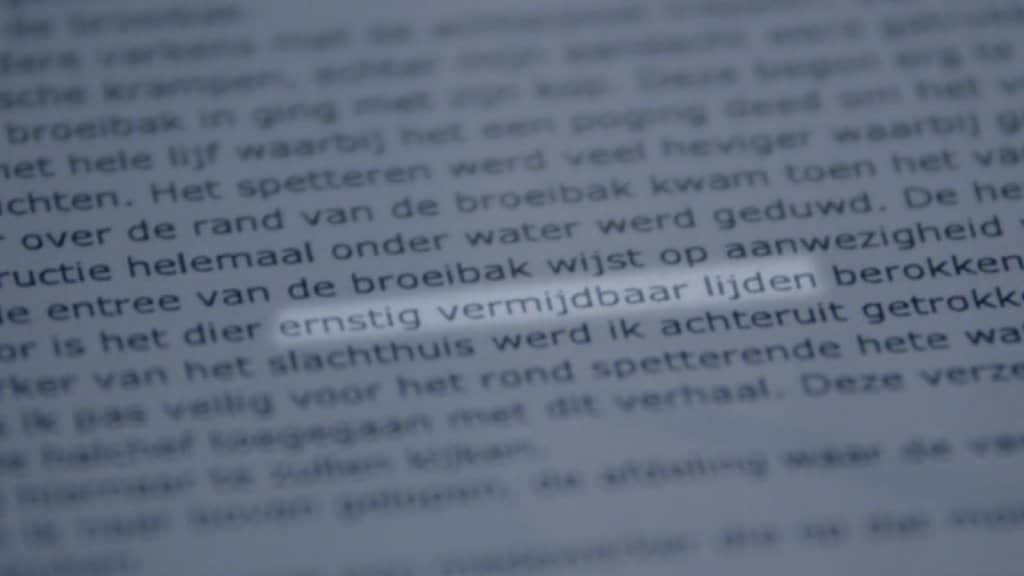
is dat verschillende varkens levend in een hete bak water van 60
graden terechtkwamen. Een inspecteur schrijft: “Een varken begon
erg te spartelen en te bewegen met het hele lijf. Het spetteren werd
veel heviger waarbij grote hoeveelheden water over de rand kwamen.”
Vervolgens werd het varken door een ijzeren constructie onder water
gedrukt, waarbij het dier verdronk.
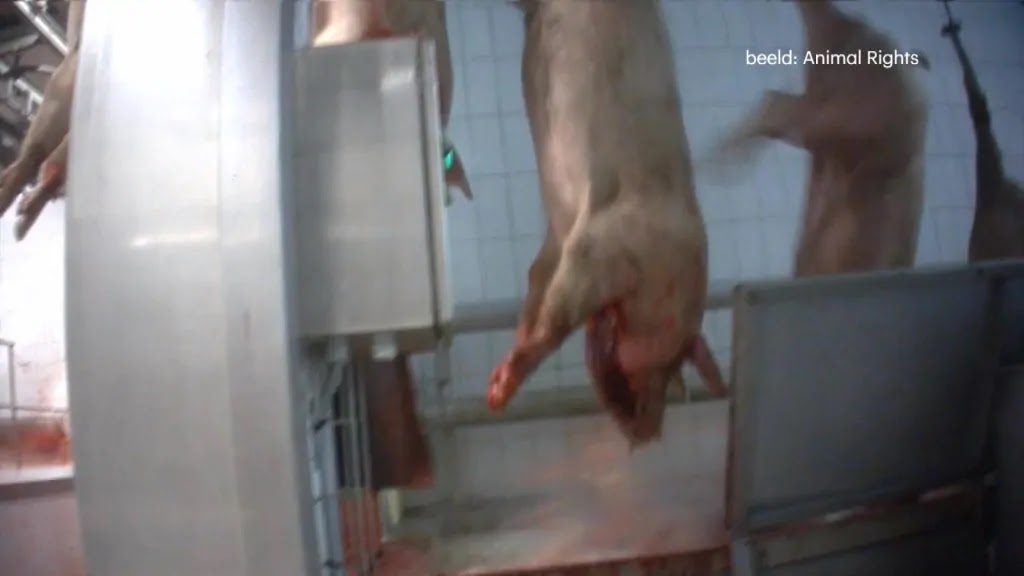
Dit
levende varken spartelt in een heet bad in een Belgisch slachthuis.
Soortgelijke taferelen vinden plaats in Nederland. (beeld: Animal
Rights)
De
inspecteur schrijft dat het varken bij bewustzijn was toen het dier
het hete bad in ging en dat het varken hierdoor ernstig heeft
geleden.
Zoiets
gebeurde nog eens bij een ander slachthuis vlak voor de ogen van een
NVWA-inspecteur. Hij ziet vier varkens na elkaar levend de hete
waterbak van 60 graden in gaan. Ze proberen boven water te blijven en
trappen met hun poten.
Animal
Rights bracht vorig jaar de beelden van het Belgische slachthuis
in Tielt naar buiten. De dierenrechtenorganisatie schrikt van
wat ze lezen in de NVWA-rapporten. “Die varkens worden eigenlijk
levend gekookt”, zegt directeur Robert Molenaar. “Toen de
Belgische beelden naar buiten kwamen is mij vaak gevraagd: gebeurt
dit ook in Nederland? Ik vermoedde toen van wel, maar hier staat het
nu zwart op wit.”
RTL
Nieuws heeft de rapporten van de NVWA in zijn bezit.
Een
horrorsetting
In
de stukken staan nog tientallen overtredingen zoals kreupele dieren
die pijn hebben bij het lopen en dieren die levend worden gevild. Er
wordt gesneden in een kalf dat nog beweegt. De inspecteur schrijft:
“Ondanks de bewegingen van het kalf heeft hij (de slachter) het
kalf van zijn kophuid ontdaan, en wilde verdergaan met het afknippen
van de voorklauwen”, maar dat weet de inspecteur te voorkomen.
Van
dit soort mishandelingen hebben ze bij Animal Rights nog nooit
gehoord: “Dit is een horrorsetting, de inspecteur staat er bij”,
zegt Robert Molenaar. In een ander slachthuis zien inspecteurs dat
twee schapen levend worden gevild.
In
een reactie laat de NVWA weten dat de overtredingen waarvoor ze de
slachthuizen de afgelopen jaren hebben beboet niet voldoende waren om
een slachthuis te sluiten. “We grijpen in met een middel dat in
verhouding staat tot de ernst en de frequentie van de overtreding.”
Meestal
wordt eerst een waarschuwing gegeven en dan volgen boetes, die kunnen
ook verhoogd worden. Als dit niet helpt – en dan moet je het volgens
een woordvoerder van de NVWA dus ‘wel heel bont maken’- dan pas kan
een bedrijf worden gesloten.
De
overtredingen
Boetes
zijn opgelegd voor:
–
Doden van dieren gaat fout: 24 gevallen.
Halsslagaders
niet doorgesneden.
Dieren
levend gevild.
Dieren
niet verdoofd.
Dieren
breken los uit fixatiekooi.
–
Het lossen, huisvesten en verzorging van dieren gaat fout: 24
gevallen.
Kreupele/gewonde
dieren.
Geen
drinkwater voor de dieren.
Overvolle
stallen.
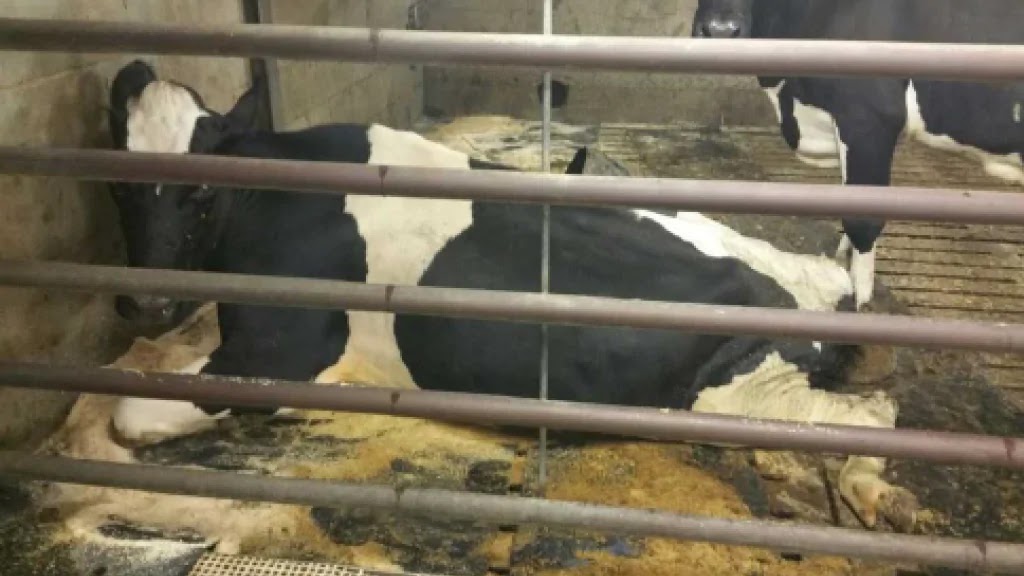
Deze
koe is uitgegleden en kan niet meer opstaan. Op zijn kop zitten
schaafwonden. (foto uit rapport NVWA)
Boetes
liggen tussen de 1500 euro en 5000 euro:
–
20 keer 1500 euro
Doden
dieren gaat fout: kalf levend gevild.
Doden
dieren gaat fout: halsslagaders bij twee varkens niet doorgesneden.
Stal
overvol: 78 dieren in hok met capaciteit voor 48.
–
14 keer 2500 euro
Kreupel
dier kan niet staan vanwege val, maar wordt niet direct uit lijden
verlost.
Doden
dieren gaat fout: halsslagaders niet doorgesneden.
– 6
keer 3000 euro
Schapen
vallen op hun rug vanwege gladde vloer veroorzaakt door uitwerpselen
en urine. Ook is er geen drinkwater.
Geit
ontsnapt uit slachtruimte.
Doden
dieren gaat fout: halsslagaders niet doorgesneden/personeel
controleert niet of dieren dood zijn.
– 4
keer 4000 euro
Doden
dieren gaat fout: halsslagaders varken niet doorgesneden. Vier
varkens leven nog in hete waterbak van 60 graden.
Kreupel
rund, had niet aangevoerd mogen worden.
– 1
keer 4500 euro
Doden
dieren gaat fout: levend varken gaat heet waterbad van 60 graden in
spartelt hevig en verdrinkt/halsslagaders niet doorgesneden.
– 3
keer 5000 euro
Kreupel/gewond/ziek
dier: dier met puntig voorwerp gestoken. Dier levend naar
slachtplaats gesleept.
Doden
dieren gaat fout: schapen levend gevild/schapen hadden bloedingen
doordat ze bij hun vacht werden opgetild.
* Het CDA is de hoofdverantwoordelijke voor het uitkleden van inspecties en het opzetten van de disfunctionerende NVWA. Dit daar van meet af aan werd ingezet op het zoveel mogelijk afschaffen van inspecties, die zijn maar lastig voor ondernemers en dierenbeulen (‘boeren’)….. Terwijl er destijds onder de kabinetten Balkenende al jaarlijks schandalen bovenkwamen die veelal met vlees of de intensieve veehouderij te maken hadden…… Voor het CDA, VVD, D66, CU en SGP gaat de economie ver voor op de volksgezondheid en al helemaal ver voor op het dierenwelzijn……. (dat geldt overigens ook voor de PVV, met de hypocriete [pl]ork Dion Gaus, die een enorme grote bek opzet over dierenmishandeling, maar daarbij vergeet dat in Nederland jaarlijks een half miljard [!!!] dieren worden groot en doodgemarteld……)
** Martelen door: -het geven van krachtvoer, waardoor koeien hun veel te korte leven continu aan de diarree zijn (ga maar ‘s na wat dat betekent…), -‘opslag’ in veel te kleine ruimten, -inhumaan vervoer van de dieren, -martelen tijdens vervoer (veel te lange transporten, veelal zonder water en vaak urenlang in de zon, er gaan zelfs transporten naar Turkije…..) en de ultieme marteling >> het vermoorden van de dieren……
*** Daarbij begrijpen veel dieren dondersgoed dat hen de dood staat te
wachten, als ze moeten wachten op hun beurt in het slachthuis (of op
het terrein van het slachthuis, niet zelden in de brandende zon),
vandaar ook de blinde paniek bij die dieren en waardoor m.n. koeien het nogal eens op een lopen zetten (althans als ze dat nog kunnen, nadat ze de veewagen in werden geschopt)……. Om nog maar te zwijgen over de tienduizenden dieren die jaarlijks bij brand omkomen in een intensieve martelveehouderij, waar de dierenbeulen (‘boeren’) te belazerd zijn om hun elektra jaarlijks te laten controleren en brandpreventieve maatregelen te nemen…….
****Methaangas is één van de sterkste broeikasgassen ter wereld, dit gas wordt geproduceerd door de enorme Nederlandse veestapel van 500 miljoen dieren………….
Donderde gistermiddag van m’n benen toen ik het BNR nieuws van 17.00 u. hoorde. in dat nieuws het bericht dat de 2 oudste kolencentrales in Nederland, de Hemweg centrale in Amsterdam en de Amercentrale bij de Biesbosch, uiterlijk over 6 jaar, dus in 2024 dicht moeten…….
Nou nee, volgens VVD oplichter Wiebes gaat het kabinet niet over centrales sluiten maar over steenkool…… ha! ha! ha! ha! ha! ha! ha! Nee, het kabinet gaat alleen over die centrales als men ze volkomen overbodig wil bouwen, zoals de laatste nieuwe kolencentrales!* Daarover gesproken: met de nieuwe centrales zouden de oude centrales worden gesloten, een besluit van jaren geleden en toch mogen ze nu openblijven tot 2024….. Of hoe belazer je het volk……
Daarnaast is het wel degelijk een taak van de landelijke overheid om de volksgezondheid te beschermen, maar ja, dan zou je een echte volksvertegenwoordiging nodig hebben en niet een kabinet dat doet aan bedrijvenvertegenwoordiging….. Een kabinet waar de economische belangen nu eenmaal ver voorgaan op de gezondheid van het volk…….
Wiebes probeerde uit te leggen dat de twee hiervoor genoemde centrales in 2024 en zo mogelijk eerder moeten stoppen met steenkoolverbranding…….. ‘Leuk’ voor de Amsterdammers die onder de stinkende en letterlijk kankerverwekkende uitstoot van de Hemweg centrale leven….. Volgens Wiebes mogen deze centrales ook na 2024 openblijven als ze overschakelen op biomassa, waarna ze vervolgens mogen doorgaan met de luchtkwaliteit te verkankeren…. Immers ook met de stook van biomassa komt kankerverwekkende uitstoot vrij, evenals CO2……..
Hetzelfde geldt voor de andere centrales die in 2030 dicht moeten, als zij besluiten geheel op het verstoken van bossen over te stappen (gesubsidieerd door de overheid van ons belastinggeld, vorig jaar nog 4 miljard door demissionair VVD minister en Obersturmbannführer Kamp toegekend….)….. Bossen die in de VS worden gesloopt, waarbij nog eens een hele berg luchtvervuiling komt kijken tot van de bomen houtpellets zijn gemaakt en deze verscheept (het meest vervuilende vervoer op aarde) zijn naar Nederland………
Uiteraard staan de VVD en het CDA pal achter deze beslissing, D66 veilingmeester Pechtold doet net of hij e.e.a. niet gehoord heeft, tja, als je jouw partij als groen afschildert kan je beter even stil zitten als je wordt geschoren, hetzelfde geldt voor de enorme hypocriete ‘Christen’Unie……
Pechtold moet zich doodschamen dat hij tot dit onzalige kabinet is toegetreden, hoewel het precies aangeeft wat D66 is, een inhumane neoliberale partij, die iets lichter te verteren is als de VVD, hoewel je van beiden ‘het zuur’ krijgt….. D66 stemmers hoe vaak laat u zich nog belazeren door veilingmeester, of beter gezegd tweede hands autodealer Pechtold en zijn club van volksverlakkers??!!!
Weer is ons een reuzenoor aangenaaid!!
Remco de Boer, ‘de energie en duurzaamheidsdeskundige’ stelde vorig jaar nog dat Nederland vanaf 2022 door een groot aantal windparken zal voldoen aan het meer dan lamme energieakkoord, waarvoor de milieuorganisaties zich de oren van de kop schamen (dat ze deze tekenden). Afgelopen week stelde deze mislukte zakkenwasser dat er te weinig windmolens worden gebouwd, er is zelfs een giga bedrag aan subsidie voor duurzame energie over van 2017……. Volgens de Boer is de vergoeding per kilowattuur veel te laag, waardoor investeerders het laten afweten…… Het gevolg hiervan is dat Nederland de gestelde doelen voor 2020 niet zal halen, zoals de doelstellingen voor 2022 waar hij eerder over liep op te scheppen niet zullen worden gehaald……..
* Deze nieuwe kolencentrales werden gebouwd voor de export van elektriciteit, dit daar de VS en Australië massaal steenkool dumpen op de wereldmarkt >> daarom zijn de Nederlandse gascentrales uitgeschakeld…..