ING doet het goed volgens Ralph Hamers (opperhoofd ING)

Vanmorgen op BNR een gesprek met Ralph Hamers, de topgraaier van ING, over de nieuwste cijfers, die enigszins tegen schijnen te vallen, dit o.a. door de inspanningen om witwassen tegen te gaan, een zaak die ING jarenlang door de vingers zag en daarvoor een mega schikking trof met het OM…….. Volgens Hamers heeft men om het ING witwasschandaal te tackelen 4.000 mensen aan het werk gezet, alsof de top voorheen niet wist dat deze praktijken plaatsvonden, lullig genoeg hield men er geen rekening mee dat het ooit zou uitkomen…..

Ach dit is zeker niet het eerste misdadig handelen van banken en al even zeker niet het laatste, zie de aanleiding voor de bankencrisis, waar het volk middels de belastingen deze banken op poten moest houden met een paar honderd miljard euro…….

Hamers liet o.a. weten dat ING het goed doet en je wilt natuurlijk meteen weten wat ING dan zo goed doet….. Wel, om een lang verhaal kort te maken en niet oneindig lang te rekken door op allerlei andere zaken te wijzen, zoals het mooie weer, hier het antwoord (houd je vast en doe je veiligheidsgordels om): ING betaalt haar klanten 0,1% rente op spaartegoeden…….. ha! ha! ha! ha! ha! ha! ha! ha! ha! ha! ha! ha! ha! ha! Tja er zijn banken die in het geheel geen rente meer betalen of zelfs negatieve rente in rekening brengen en je weet het: in het land van de blinden is een bankier met zelfs maar 1% zicht koning…… Uiteraard rekent ING een veel hogere rente als het bijvoorbeeld gaat om rood staan, of om een lening dan wel een hypotheek…….

Voor de vorm maakten en maken de banken wat ophef als Lagarde (en eerder haar voorganger Draghi) van de ECB (Europese Centrale Bank) de rente nog verder verlaagde/verlaagt, dit daar men de klanten met een spaarrekening wil laten geloven dat de banken geen belang hebben bij een lage rente…… Uiteraard hebben de banken daar wel belang bij, immers men hoeft bijna geen rente te betalen en kan vervolgens, zoals gezegd vergeleken met bijvoorbeeld die 0,1% van ING, een fikse rente vragen (en vergeleken bij 0,1% is 4 of 5% een stevige rente……)

Voorts verkopen veel banken ook nog eens aandelen, waar je tegelijk niet moet vergeten dat de rente bewust laag wordt gehouden voor de grootaandeelhouders, je weet wel van die spuugrijke figuren die gelukkig worden van massaontslagen en het bedrijf dat dit doet daarvoor belonen met een fikse koersstijging door de aankoop van veel aandelen (in dat bedrijf)………

Vergeten voor plaatsing te melden: het ‘too big to fail’ (te groot om failliet te laten gaan) worden van banken zou niet weer gebeuren, immers de Nederlandse banken waren voor een groot deel te groot vergeleken met ons BBP…. Eén en ander werd ons uit en te na beloofd nadat de bankencrisis zich ten volle had geopenbaard en ons belastinggeld werd gebruikt om de banken te redden, daar het anders nog veel meer geld zou kosten (o.a. een leugen van de minister van Financiën, destijds, PvdA oplichter Bos)…. Intussen zijn zeker ING en ABN Amro gigantisch gegroeid in het buitenland en bijna weer op het niveau van voor 2008….. De zogenaamde kapitaalbuffer die de banken moeten aanhouden van de ECB is 3% en die buffer zou moeten voorkomen dat we banken moeten redden bij een volgende bankencrisis…… Echte deskundigen zeggen dat dit onmogelijk is met zo’n kleine kapitaalbuffer, 30% zou nog te laag zijn…… Zo worden we telkens weer opgelicht door de politiek en de banken!!!

Tot slot nog dit: nog steeds een grote schande dat je je bankrekening niet mag meenemen als je naar een andere bank gaat, dit heeft de peperdure lobby van de banken voor elkaar gekregen bij de politiek…… Des te belachelijker daar we het meer dan achterlijk lange IBAN rekeningnummer kregen, zogenaamd als het BSN nummer (voormalig sofinummer), een nummer dat je je leven lang zou houden, behalve dan als je een bank voor misdadig gedrag wil straffen en overstapt naar een andere bank…….. Deze zaak is een internationaal strafrechtelijk onderzoek meer dan waard, waarbij de politici die zich hebben laten omkopen, alsook de bankiers zwaar gestraft zouden moeten worden!!!!

Voor meer berichten met Hamers, Lagarde, rente, de ECB, ING, schikkingen en/of IBAN, klik op het betreffende label, direct onder dit bericht.

Lagarde (top ECB): “Je kan beter een baan hebben dan spaargeld”

Lagarde heeft afgelopen vrijdag de baan van topgraaier Draghi als president van de Europese Centrale Bank (ECB) overgenomen, ook al heeft zij bepaald geen financieel economische opleiding gevolgd. Alle hoop van een aantal centrale banken in de EU op een ander beleid dan dat van Draghi werd vrijwel onmiddellijk de grond ingeboord. Vreemd overigens die verwachting, immers Lagarde is ook verantwoordelijk voor de gore spelletjes die het IMF sinds 2011 heeft gespeeld, in dat jaar werd ze directeur van deze inhumane neoliberale organisatie…..

Overigens, Lagarde is in feite een veroordeelde misdadiger, die haar straf van een jaar gevangenisstraf ontliep daar er anders een crisis in het IMF zou zijn ontstaan, dit nadat haar voorganger en verkrachter Strrauss-Kahn het veld moest ruimen….. Ongelofelijk daarom ook dat de ondemocratische EU Lagarde koos als topgraaier van de ECB…….

Lagarde nam haar functie bij de ECB op o.a. door Nederland en Duitsland te manen hun overschot te investeren, voorts begon Lagarde te zeuren over onderlinge ‘solidariteit’, ofwel steek ook je kont diep in de schulden. Wat betreft het ‘beleid’ van Draghi: Lagarde gaat gewoon door op de doodlopende weg die Draghi eerder heeft bewandeld: obligaties van landen opkopen en het verlagen van de rente tot nog verder onder de – 0,5%, die nu al ingevoerd wordt (zo ongeveer de laatste actie van Draghi), ofwel een rente die nog verder onder het ‘nulpunt’ zal dalen, anders gezegd: negatieve rente (waarmee geld lenen zelfs geld zou moeten opleveren, al zal dat ‘natuurlijk niet’ voor het gewone volk opgaan…)….
Dat daardoor een flink aantal mensen in de problemen komt interesseert autocraat Lagarde net zo min als haar voorganger Draghi, schijt aan de pensioenen die mensen hun werkende leven lang hebben opgebouwd, dokken en niet zeuren……. Ook de kleine spaarders kunnen wat Lagarde betreft doodvallen, ze durfde keihard te zeggen dat je beter een baan kan hebben dan geld op de bank….. Moet je nagaan: de misdadige dweil Lagarde gaat een inkomen verdienen van rond de 4 ton op jaarbasis is en dat is exclusief een gigantische onkostenvergoeding……
Taaie stof mensen, het hieronder opgenomen artikel van Tyler Durden, maar zeer de moeite van het lezen waard (het artikel werd eerder gepubliceerd op Zero Hedge). Daaronder een verduidelijking over QE ofwel Quantitative Easing, een artikel van Investopedia, QE of het waanzinnige beleid van Draghi om zoveel mogelijk obligaties van EU landen op te kopen (ook werden schulden van banken in Zuid-Europa opgekocht, waardoor de Grieken de regie in eigen land zijn kwijtgeraakt en nog steeds diep in de ellende zitten…)….

De ECB heeft overigens al aangekondigd, na de stop van één jaar, opnieuw bonussen ter waarde van 20 miljard euro op te willen kopen, ook al is het allesbehalve duidelijk of dit ook maar iets heeft opgeleverd voor de EU, behalve dan dat de drukpersen voor papiergeld overuren maakten en ons geld in feite steeds minder waard werd ook al merken we daar nu nog weinig van….. (dat gebeurt als de volgende crisis zich aandient en zoals je weet die komt eraan, de vraag is wanneer precies)

Lagarde: “We Should Be Happier To Have A Job Than To Have Savings”

Mon, 11/04/2019 – 06:12
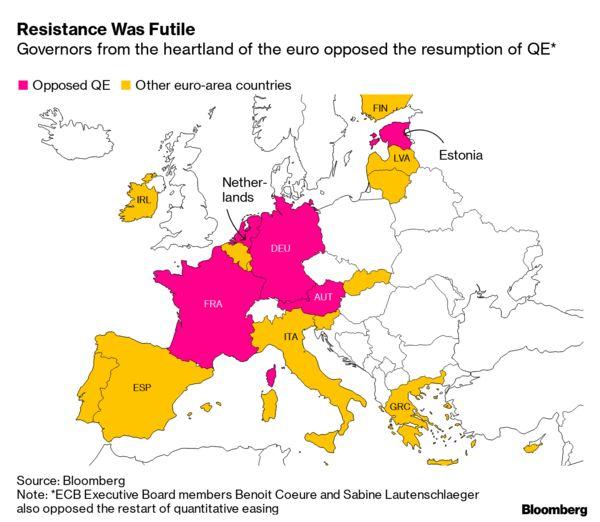
Any hopes that the replacement of Mario Draghi, who on Halloween left the ECB more polarized than ever, as the core European nations revolted against the Italian’s profligately loose monetary policy in an unprecedented public demonstration of discord within the European Central Bank…
… with the ECB’s new head, former IMF Director and convicted criminal, Christine Lagarde would result in some easing of tensions, were promptly crushed when Lagarde picked up where Draghi left off, calling on Germany and the Netherlands to use their budget surpluses to fund investments that would help stimulate the economy, in a sharp rebuke that will not win the former French finance minister any friends in fiscally conservative Germany.
In an appeal to Germany’s sense of solidarity, and in hopes that Germany’s memory of hyperinflation has faded enough, Lagarde said that there “isn’t enough solidarity” in the single currency area, adding: “We share a currency, but we don’t share much budgetary policy for now.”
“Those that have the room for manoeuvre, those that have a budget surplus, that’s to say Germany, the Netherlands, why not use that budget surplus and invest in infrastructure? Why not invest in education? Why not invest in innovation, to allow for a better rebalancing?” asked Lagarde, blaming Germany and the Netherlands for living within their means, and demanding they should no longer do so, just because most other Europeans decided to pull a page out of the American playbook, and live exorbitantly outside of their means.
Lagarde’s direct attempt at shaming Europe’s fiscal conservatives was nothing short of shocking: normally ECB officials avoid naming individual countries in public statements, because their mandate is to act in the interests of the eurozone as a whole. But when Lagarde made her speech she had not yet officially taken over at the Frankfurt-based institution — she succeeds Mario Draghi on Friday.
We somehow doubt this “explanation” will fly with the German population, which sees itself as funding peripheral Europe’s profligate ways for the past decade, even as it benefited from the weak euro to supercharge the German export machine.
And just to guarantee she is as resented by Germany as was Mario Draghi, she said that the German and Dutch governments, which last year had budget surpluses of 2% and 1.5% respectively, “have not really made the necessary efforts,” she added, referring to establishment’s increasing desperation to force anyone with an even remotely normal balance sheet to sink to the same level as their insolvent peers.
As for the punchline, Lagarde defended the negative interest rates introduced by her predecessor Draghi, arguing that people should be happier to have a job than a higher savings rate. This, as a reminder, comes at a time when virtually everyone who is not named “Draghi” or “Lagarde” thinks that negative rates are catastrophic, and assure doom for the Eurozone.

When asked about the impact of negative rates on savers, Ms Lagarde said on Thursday that they should think about how much worse the situation would be if the ECB had not cut rates as much as it had.

Would we not be in a situation today with much higher unemployment and a far lower growth rate, and isn’t it true that ultimately we have done the right thing to act in favor of jobs and of growth rather than the protection of savers?” she asked.

The unemployment rate in the 19-country eurozone has fallen from 12 per cent in 2013 to 8.2 per cent last year. GDP growth in the single currency zone was 1.8 per cent last year and the ECB expects it to slow to 1.1 per cent this year.

Finally, for those curious if the authorities will stop at anything to destroy the currency and send rates to even more negative levels if it means kicking the can on a global, populist uprising, by just a few months, weeks or days, here is the answer: “We should be happier to have a job than to have our savings protected,” said Lagarde.

“I think that it is in this spirit that monetary policy has been decided by my predecessors and I think they made quite a beneficial choice.”

Let’s check back on that statement in a year, shall we?
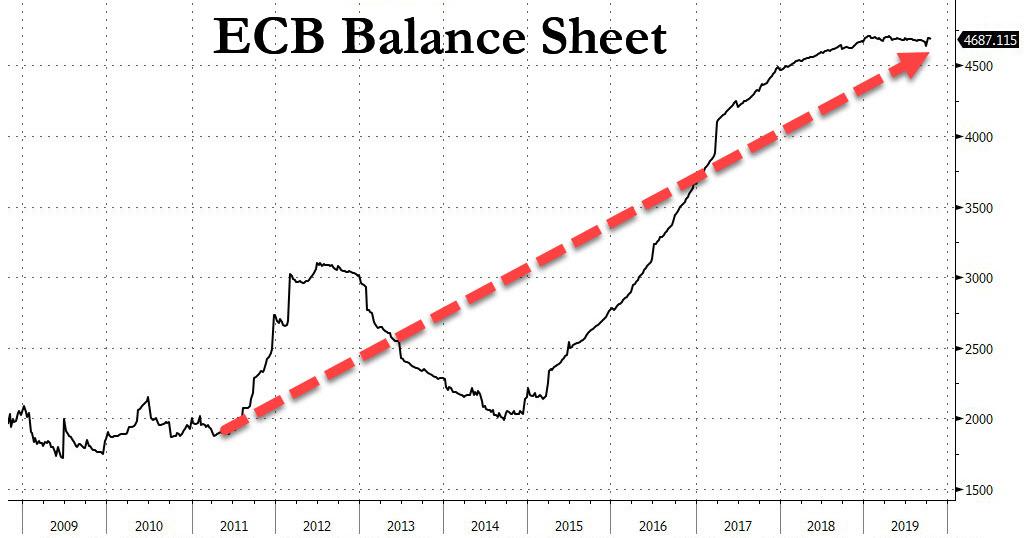
Of course, there is no magic solution here: all the ECB has done is kick the can, and ensure that the next crisis will be even worse than if some semblance of a price-clearing reality had been allowed under Draghi’s 8 years. Instead, the ECB’s balance sheet exploded to €4.7 trillion euros, as the world’s largest central bank-cum-hedge fund bought every bond in sight in hopes of keeping asset prices artificially elevated.

In October, the ECB, less than a year after it ended QE* in a failed attempt to “renormalize” monetary policy, announced it would cut rates to a record -0.5% and unveiled open-ended plans to start buying €20bn of bonds starting in November.

Needless to say, the comments by the former French finance minister confirm market expectations that she is likely to pursue similar monetary policy strategy to Draghi who flooded the financial system with cheap money to fight slowing growth and inflation while calling on governments to do more through fiscal policy to take the burden off the central bank.

In the end, the consequences of Draghi’s monetary policy, as we explained before, will be catastrophic, but the former Goldman partner was wise enough to get off the European Titanic before it hit the iceberg. It will now be Lagarde’s task to save as many people as possible once the ship starts sinking, and judging by her remarks, she is perfectly fine of not only going down with the ship, but also being blamed for the collision.

Tags: Business Finance
===============================

* Hieronder de uitleg over QE of: Quantitative Easing, geschreven door Jim Chappelow en gepubliceerd op Investopedia (zie ook het eerste staatje in het artikel van Durden):

Quantitative Easing (QE)
REVIEWED BY JIM CHAPPELOW Updated Sep 6, 2019

What Is Quantitative Easing? (QE)

Quantitative easing is an unconventional monetary policy in which a central bank purchases government securities or other securities from the market in order to increase the money supply and encourage lending and investment. When short-term interest rates are at or approaching zero, normal open market operations, which target interest rates, are no longer effective, so instead a central bank can target specified amounts of assets to purchase. Quantitative easing increases the money supply by purchasing assets with newly created bank reserves in order to provide banks with more liquidity.

KEY TAKEAWAYS

  • Quantitative easing (QE) is the name for a strategy that a central bank can use to increase the domestic money supply.
  • QE is usually used when interest rates are already near 0 percent and can be focused on the purchase of government bonds from banks.
  • QE programs were widely used following the 2008 financial crisis, although some central banks, like the Bank of Japan, had been using QE for several years prior to the financial crisis.

Understanding Quantitative Easing

To execute quantitative easing, central banks increase the supply of money by buying government bonds and other securities. Increasing the supply of money is similar to increasing supply of any other asset—it lowers the cost of money. A lower cost of money means interest rates are lower and banks can lend with easier terms. This strategy is used when interest rates approach zero, at which point central banks have fewer tools to influence economic growth.
If quantitative easing itself loses effectiveness, fiscal policy (government spending) may be used to further expand the money supply. In effect, quantitative easing can even blur the line between monetary and fiscal policy, if the assets purchased consist of long term government bonds that are being issued to finance counter-cyclical deficit spending.

The Drawbacks of Quantitative Easing

If central banks increase the money supply, it can cause inflation. In a worst-case scenario, the central bank may cause inflation through QE without economic growth, causing a period of so-called stagflation. Although most central banks are created by their countries’ government and are involved in some regulatory oversight, central banks can’t force the banks to increase lending or force borrowers to seek loans and invest. If the increased money supply does not work its way through the banks and into the economy, QE may not be effective except as a tool to facilitate deficit spending (i.e. fiscal policy).
Another potentially negative consequence is that quantitative easing can devalue the domestic currency. For manufacturers, this may help stimulate growth because exported goods would be cheaper in the global market. However, a falling currency value makes imports more expensive, which can increase the cost of production and consumer price levels.

Is Quantitative Easing Effective?

During the QE programs conducted by the U.S. Federal Reserve starting in 2008, the Fed increased the money supply by $4 trillion. This means that the asset side of the Fed’s balance sheet grew significantly as it purchased bonds, mortgages, and other assets. The Fed’s liabilities, primarily reserves at U.S. banks, grew by the same amount. The goal was that the banks would lend and invest those reserves to stimulate growth.
However, as you can see in the following chart, banks held onto much of that money as excess reserves. At its peak, U.S. banks held $2.7 trillion in excess reserves, which was an unexpected outcome for the Fed’s QE program.
(voor de staat die hier hoort te staan, zie het origineel)

Most economists believe that the Fed’s QE program helped rescue the U.S. (and world) economy following the 2008 financial crisis. However, the magnitude of its role in the subsequent recovery is more debated and impossible to quantify. Other central banks have attempted to deploy QE to fight recession and deflation with similarly cloudy results.

Following the Asian Financial Crisis of 1997, Japan fell into an economic recession. Beginning in 2000, the Bank of Japan (BoJ) began an aggressive QE program to curb deflation and to stimulate the economy. The Bank of Japan moved from buying Japanese government bonds to buying private debt and stocks. The QE campaign failed to meet its goals. Ironically, the BoJ governors had concluded that “QE was not effective” just months before launching their program in 2000. Between 1995 and 2007, Japanese GDP fell from $5.45 trillion to $4.52 trillion in nominal terms, despite the BoJ’s efforts.

The Swiss National Bank (SNB) also employed a QE strategy following the 2008 financial crisis. Eventually, the SNB owned assets nearly equal to annual economic output for the entire country, which made the SNB’s version of QE the largest in the world as a ratio to GDP. Although economic growth has been positive during the subsequent recovery, how much the SNB’s QE program contributed to that recovery is uncertain. For example, although it was the largest QE program in the world as a ratio to GDP and interest rates were pushed below 0%, the SNB was still unable to achieve its inflation targets.

In August 2016, the Bank of England (BoE) announced that it would launch an additional QE program to help alleviate concerns over “Brexit.” The plan was for the BoE to buy 60 billion pounds of government bonds and 10 billion pounds in corporate debt. If successful, the plan should have kept interest rates from rising in the U.K. and stimulated business investment and employment.

From August 2016 through June 2018, the Office for National Statistics in the U.K. reported that gross fixed capital formation (a measure of business investment) was growing at an average quarterly rate of 0.4 percent, which was lower than the average from 2009 through 2018. The challenge for economists is to detect whether growth would have been worse without quantitative easing.

Argentinië voor decennia in het IMF pak genaaid……..

De Argentijnse neoliberale (‘conservatieve’) regering Macri (een goede vriend van de wolf in schaapskleren paus Franciscus) heeft na een fikse lobby bij het IMF, haar handtekening gezet onder een lening van 50 miljard dollar van deze neoliberale organisatie, daarmee is het land waarschijnlijk voor decennia in het IMF pak genaaid……

Ofwel: de Argentijnen zullen afhankelijk blijven van het IMF en na een verkiezingsoverwinning van links in de nabije toekomst, zal zo’n regering in feite zo goed als niets kunnen doen voor de grote arme onderlaag in Argentinië. Nog simpeler gezegd: het IMF zal in feite het land leiden, zoals de Griekse regering (van de ‘socialistische’ verrader Tsipras*) is verworden tot een marionet van het IMF en de EU, waar de laatste twee in feite een dictatuur vormen in Griekenland…….

Daarnaast heeft Argentinië ook bij de Wereldbank en Zuid-Amerikaanse banken een lening van bijna 6 miljard dollar afgesloten…….

De VS liet vorige maand weten dat het dolblij was met de lening van het IMF voor Argentinië….. Niet zo vreemd als je ziet dat een links regeringsbeleid in de toekomst onmogelijk werd gemaakt met die lening……. Voorlopig hoeft de CIA geen ‘regime change’ (lees: staatsgreep) na te streven in Argentinië…..

Ongelofelijk, of eigenlijk schandalig dat de consequenties van die IMF lening voor het grootste deel van de Argentijnse bevolking, niet in de reguliere media is beschreven……..

Intussen is de staatsschuld van Argentinië zover opgelopen dat deze niet in afzienbare tijd zal kunnen worden afgelost, waar bovenop de regering Macri in 2016 heeft toegezegd een in feite al afgeschreven schuld uit 2001, alsnog te zullen voldoen, alsof dit in het belang is van het Argentijnse volk……..

* Al moet ik zeggen dat Tsipras waarschijnlijk is gewaarschuwd dat wanneer zijn regering niet akkoord ging, er een militaire staatsgreep zou plaatsvinden door NAVO leider VS en haar hielenlikkende NAVO lidstaten in de EU….. Als dat inderdaad zo is, had Tsipras moeten aftreden en de zaak in de media moeten gooien…… Zeker nadat hij al wist dat de armoede in Griekenland enorm groot was en velen niet eens de beschikking hadden over kanker medicatie, of pijnstillers bij chronische pijnklachten……. Aan de hiervoor beschreven situatie in Griekenland is intussen niets veranderd….. Bovendien zijn de Griekse staatseigendommen voor 99 jaar (!!!) overgedragen aan het Europees Stabiliteitsmechanisme (ESM), dat naar goeddunken deze eigendommen voor een appel en ei kan verkopen aan buitenlandse investeerders…….

Argentijnse regering naait het volk in IMF pak

Het IMF leent de totaal onverantwoordelijke regering van Argentinië het voor dit land fenomenaal grote bedrag van 50 miljard dollar.
Alsof het geld gratis is zo laat de Argentijnse regering weten blij te zijn met deze meer dan waanzinnige deal…….
Eerder gaf de Argentijnse regering een obligatielening uit waar deze voor 100 jaar een vaste winst garandeert………
De grote onderlaag zal weer keihard worden gepakt met deze lening, zoals dit eerder deze eeuw (zie het tweede hieronder opgenomen artikel uit 2004 met de titel ‘IMF admits mistakes in Argentina crisis‘) en in de 90 er jaren al eens het geval was. Argentinië zal zich met deze deal moeten onderwerpen aan het IMF en haar keiharde neoliberale eisen tot hervormingen…….
Begin deze eeuw versterkte een grote lening van het IMF de crisis in Argentinië en ook nu is de verwachting dat dit zal gebeuren…….
Argentinië verwordt met deze IMF lening tot het Zuid-Amerikaanse Griekenland, waar de welgestelden, zoals die in Griekenland al lang hun kapitaal hebben veiliggesteld in het buitenland (2 vliegen in 1 klap >> ten eerste het geld is veilig voor eventuele faillissementen van banken (of grote belastingverhogingen op vermogen), ten tweede: de ontduiking van belastingen op enorme schaal…… (waar familie Zorreguieta, je weet wel de familie van pampakoningin Maxima, ook tot de welgestelden behoort……)
De arme bevolking van Griekenland, intussen het grootste deel van de bevolking weet wat dit betekent, zoals de ouderen die daar praktisch geen pensioen meer ontvangen (waar ze zelf voor spaarden), of wat dacht je van kankerpatiënten die de benodigde medicamenten zoals pijnstillers niet meer kunnen betalen……..
De Griekse schuld is zo hoog dat de (lage) rentebetalingen al niet zijn te voldoen, laat staan dat het land tot aflossen van de enorme schuld zal komen, hetzelfde lot wacht Argentinië…….
Lees nogmaals hoe ijskoud, inhumaan neoliberaal beleid tot grote ellende zal leiden onder de grote maatschappelijke onderlaag van Argentinië en de crisis daar alleen zal verdiepen…… Bovendien regeert president en regeringsleider Mauricio Macri van de Propuesta Republicana, kortweg PRO, over zijn eigen graf en dat van nakomende regeringen, immers Argentinië heeft met deze lening een groot deel van de zeggenschap in eigen land vrijwillig overgedragen aan het IMF……..

Daarmee is het zeker dat Argentinië zich met hart en ziel heeft verbonden aan het ijskoude, inhumane neoliberalisme, waar zelfs een socialistische regering niets tegen kan ondernemen…… Zie de Griekse situatie waar Tsipras een zogenaamde socialist zijn land uit handen heeft gegeven aan de Europese Commissie, het IMF en de ECB, de Europese Centrale Bank……. Staatseigendommen zijn voor 99 jaar uit handen gegeven aan een EU orgaan, het Europees Stabiliteitsmechanisme (ESM) dat naar goeddunken staatseigendommen kan verkopen voor een appel en een ei…….

Argentina Just Made IMF History With Biggest Bailout Loan Ever

June 7, 2018 at 9:51 pm
Written by Tyler Durden
(ZHE) — Just a few weeks after Argentina became ground zero for the coming Emerging Market crisis, when its currency suddenly collapsed at the end of April amid soaring inflation, exploding capital outflows and a central bank that was far behind the curve (as in “13% of rate hikes in a week” behind)…
the IMF has officially bailed out the country – again – this time with a $50 billion, 36-month stand-by loan, and coming in about $10 billion more than rumored earlier in the week, it was the largest ever bailout loan in IMF history, meant to help restore investor confidence in a nation that, between its soaring external debt and current account deficit, prompted JPMorgan to suggest that along with Turkey, Argentina is in effect, doomed.
As the JPM chart below shows, the country’s total budget deficit, which includes interest payments on debt, was 6.5% of GDP last year, much of reflecting a debt binge of about $100 billion over the last two and a half years. The primary fiscal deficit in 2017 was 3.9%.

The loan will have a minimum interest rate of 1.96% rising as high as 4.96%.
We are convinced that we’re on the right path, that we’ve avoided a crisis,” Finance Minister Nicolás Dujovne said at a press conference in Buenos Aires. “This is aimed at building a normal economy.”
Dujovne said that about $15 billion from the credit line would be immediately available to Argentina after the package is approved by the IMF’s board, which is expected on June 20. The rest would be dispersed as needed as Argentina meets its targets.
Shortly after the news the loan was finalized, Dujovne made some additional, more bizarre comments, saying that “the amount we received is 11 times Argentina’s quota, which reflects the international community´s support of Argentina,” almost as if he was proud at just how insolvent his country “suddenly” become. He was certainly delighted that, in his view, Argentina is now “too big to fail”, and received not only this loan as a result…

It’s very good news that the integration with the world allows us to receive this support.”

but also hinted that the international community would also foot the bill for all other upcoming Argentinian bailouts. And if the country’s history is any indication, there will be plenty more, as well as the occasional military coup for good measure.
According to Bloomberg, Argentina will see 30% of the funds a day or two after the Fund’s June 20 board meeting, and in typical IMF-bailout fashion, a form of austerity will be imposed on what was once Latin America’s richest nation: as part of the agreement, the country will now target a fiscal deficit of 1.3% of GDP in 2019 and 2.7% this year, with a fiscal balance targeted for 2020 (good luck). And since the previous targets of 2.2% and 3.2%, were almost as laughable, this latest IMFian austerity package not only has zero chance of ever being achieved, but if Greece is any indication, it will make the Argentina crisis far worse. The government has also set a new inflation target of 17% in 2019 – It’s considered low – declining to 13% in 2020 and 9% in 2021.
And the biggest joke, as part of the program, Argentina will agree to accelerate the pace at which it reduces the government deficit. The nation spends more than it collects in revenue and imports more than it exports, creating fiscal and current-account shortfalls that leave Argentina vulnerable to fluctuations in its currency. But, thanks to the even more idiotic policies of central banks, Argentina managed to sell a 100 year bond last year, demonstrating just how stupid some managers of “other people’s money” really are.
This is a plan owned and designed by the Argentine government, one aimed at strengthening the economy for the benefit of all Argentines,” IMF Managing Director Christine Lagarde says in the statement which can be found on the IMF’s website.
To take effect, the deal reached between the IMF’s staff and Argentine authorities still requires the approval of the IMF’s executive board.
Oh, and thank you American taxpayers: the IMF’s largest shareholder, the U.S., said in a statement Thursday from Treasury Secretary Steven Mnuchin that it supported the program, according to the WSJ.
The size of the package should provide relief, but implementing the program entails significant challenges and will require skillful political leadership,” said Martin Castellano, the head of Latin America research at the Institute of International Finance (IFF).
Argentina was bailed out by the IMF for the second time in 2 decades after three rate hikes pushed borrowing costs above 40% but failed to halt a plunge in the currency. The peso fell 25% against the dollar this year to trade at 24.9850 on Thursday, while capital outflows soared.
Central Bank President, Federico Sturzenegger, said the bank will continue to intervene in currency markets in times of “disruptive movement” although the central bank will not target inflation this year, he said. Meanwhile, the government has agreed to send a bill that gives the central bank more autonomy, and as a result it wil no longer transfer funds to the Treasury.
We’re convinced that we’re on the right track, that we managed to avoid a crisis, gather support for the program we already had and that has been in place since Dec. 2015, which looks to build a normal economy, reduce poverty and protect the vulnerable,” Dujovne said, echoing what Greece said after its first bailout 8 years… and its second… and its third.
Gerry Rice, an IMF spokesman, speaking Thursday before the details of the bailout were announced, told reporters that the IMF is “not seeing negative spillovers to other countries at this point.”
Well, he may want to take a look at Brazil.
* * *
As for what happened the last time the IMF bailed out Argentina in the early 2000, the following 2004 article from the Telegraph tells you all you need to know why when a nation is desperately in need of deleveraging, giving it another $50 billion in debt is generally a bad idea.

IMF admits mistakes in Argentina crisis

By Edmund Conway12:01AM BST 30 Jul 2004

The International Monetary Fund yesterday admitted that its mistakes helped plunge Argentina deeper into the red during the currency crisis that crippled the country’s economy three years ago.

In a report published yesterday by its independent evaluation office, the IMF said it ought to have prevented the Argentine government from following poor economic policies.

IMF surveillance failed to highlight the growing vulnerabilities in the authorities’ choice of policies and the IMF erred by supporting inadequate policies too long,” it said.

The financial meltdown that reached a climax in 2001, causing the country to default on $132 billion of foreign debt, was worsened by the government’s vain attempts to maintain the Argentine peso’s peg against the dollar. The IMF ploughed money into the country to help it sustain the peg, pledging an extra $22 billion as late as the end of 2000.

In retrospect, the resources used in an attempt to preserve the peg could have been better used to mitigate some of the inevitable costs of exit,” the report said.

Although it became clear to some IMF staff that the country’s currency plan was flawed in the 1990s, they did not report their doubts to their board for fear of triggering a speculative attack on the peso. The executive board, for its part, ignored staff complaints that Argentina was not reforming its economy satisfactorily.

Both the IMF and the US touted the country as Latin America’s economic success story but the fund maintained its support despite the fact that Argentina missed its fiscal targets every year since 1994. Analysts have also claimed that the IMF’s demands that Argentina raise taxes in 2002 worsened the crisis. The conclusions will come as a blow to the institution, whose role has come under increased scrutiny in recent years.

Yesterday the Argentine finance minister, Roberto Lavagna, argued that the country should not be pressed too hard for repayments of its current three-year $13 billion loan. He said the IMF was now insisting it reformed its economy “in a way absent throughout the 90s” and “under a schedule that is oblivious to the political realities of the country”.

Good luck, and some advice to Argentina: this time try to prevent Elliott Management from buying up your debt at distressed prices.
By Tyler Durden / Republished with permission / Zero Hedge / Report a typo

Lagarde en haar IMF roepen centrale banken op, de rente niet te verhogen………..

Het IMF laat weer eens zien waar het eigenlijk voor staat: de de georganiseerde bankenmaffia en de aandeelhouders……. Aan de vooravond van de G20, in het tot een religieus-fascistisch staat veranderende Turkije, riep het IMF centrale banken op, de rente niet te verhogen en daarmee te wachten tot de wereldeconomie aan kracht heeft gewonnen……. ha! ha! ha! ha! ha! ha! ha! Dat duurt nog wel ‘een paar jaar!!’

Het IMF vervolgde met te stellen, dat de wereldeconomie de laatste maanden juist aan kracht heeft ingeboet….. ha! ha! ha! ha! Dus je ziet dat iets niet werkt, de rente staat immers bijna op nul en dan schrijf je de centrale banken voor dat ze de rente niet mogen verhogen. De enigen die voordeel hebben bij een lage rente, zijn zoals gezegd de georganiseerde bankenmaffia en de aandeelhouders, al doen de aandelen het nu ook behoorlijk waardeloos en zakt de beursbubbel deels in…..

Bovendien een uiterst dom advies, met een hogere rente kunnen pensioenfondsen niet alleen meer binnenhalen op de uitstaande gelden….. Maar de pensioenfondsen kunnen daarmee ook meer uitgeven voor bijvoorbeeld nieuwbouw van sociale huurwoningen (tegen een normale prijs, dus bouwfirma’s en materiaal uit het buitenland!). En schijt aan de EU regels over wat pensioenfondsen wel of niet mogen, desnoods kunnen de pensioenfondsen zelf huizen bouwen, als dit morgen Duitsland, of Frankrijk goed uit zou komen, geven ze daar nog dezelfde dag toestemming voor……

Lagarde moest nog kwijt, dat centrale banken staatsobligaties op moeten kopen…… ha! ha! ha! ha! ha! ha! Ja zodat de belastingbetalers in de EU straks voor de verliezen mogen opdraaien, als de boel toch in de soep loopt!!!

Tot slot zou ‘t godverdomme tijd worden, dat de kleine spaarders eindelijk wat meer rente krijgen, op hun vaak zuurverdiende centen!!

Voor meer berichten met/over IMF, Lagarde, banken, rente, aandeelhouders, bankencrisis (laten we die niet vergeten, we zitten er nog midden in!) en/of pensioenfonds, klik op het desbetreffende label, onder dit bericht.

IMF bemoeit zich met Nederlandse politiek en die houdt zich doodstil over deze totaal onaanvaardbare inmenging………

Het IMF laat Nederland de ‘triple-A-status’ behouden, maar dit instituut van vervloekte neoliberale onmensen, o.l.v. hare groot-kwaadaardigheid Lagarde, voegde daar wel aan toe, dat men zich zorgen maakt over de komende verkiezingen. Dat kan maar één ding betekenen, het IMF wil het huidige kabinet behouden…… Waarom? Omdat het zo goed omging met de crisis, zodat we nu met een record aantal werklozen zitten, dat de 1 miljoen ruim overtreft? De echte cijfers wel te verstaan, niet de cijfers die de overheid totaal gekleurd laat maken, na eerst te hebben gegoocheld met het begrip werkloosheid…… Of vanwege het feit, dat Nederland een gigantisch aantal huisuitzettingen kent op jaarbasis?? Een aantal dat met elk jaar van Rutte 2 flink is gestegen……… Of vanwege het record aantal faillissementen, die dit kabinet wist te bewerkstelligen….?? Of vanwege de enorme armoede..?? Meer dan 4 miljoen mensen die tegen, op of onder de armoedegrens leven…..

In het bericht werd niet gesproken over de gigantisch hoge hypotheekschuld in Nederland van bijna 700 miljard euro (!!!), iets dat eerder een grote doorn in het oog van het IMF was. Trouwens ook al een zaak waar het kabinet geen barst aan heeft gedaan…….

Ongelofelijk dat hier niet één politicus op heeft gereageerd, op deze onaanvaardbare inmenging in onze politiek….. Als makke schapen, laten ‘we’ ons koeioneren, door het IMF geteisem dat de Grieken ook verder uitzuigt, dan menselijk gesproken aanvaardbaar is, uiteraard met de ECB en de Europese commissie op de bok.

Lagarde legt uit

Gisteren de bruin gebronsde IMF, grootgraai-huppelkut Lagarde in Nieuwsuur. Ze zei hier o.a. dat ze blij is dat Nederland nog niet hoeft te voldoen aan de 3% begrotingstekort regel van de EU. Als we maar wel inzetten op hervormingen, dus de grote onderlaag nog eens op een gore manier pakken, door de door henzelf bevochten arbeidsrechten tot een minimum terug te brengen. Voorts deed ze nog een goed woordje voor de bouwmaffia, u weet wel die misdadigers die de overheid en de bevolking ongeveer een triljard euro afhandig hebben gemaakt. Nog wat gelul over banken die geen hypotheken verstrekken en dat wel moeten doen, alsof ze geen heel scheve balans met juist veel te hoge hypotheken hebben, nog wat over de huizenprijs, maar niet dat deze echt veel te hoog is, of de huizenbubbel, of de gigantisch grote hypotheekschuld in ons land.

De boodschap is duidelijk, jullie mogen nog even doorspelen, maar wel volgens de EU (door het IMF goedgekeurde) spelregels!!!!

Gelukkig werd ze vandaag door Griekse studenten en sympathisanten lekker voor lul gezet!